Capoeira — The Dancing Fight of the Enslaved
Capoeira is Brazil's Afro-Brazilian martial art — game, fight and dance in one, persecuted by police, now UNESCO Cultural Heritage and a symbol of cultural resistance.
Lineage
Origins
Contents
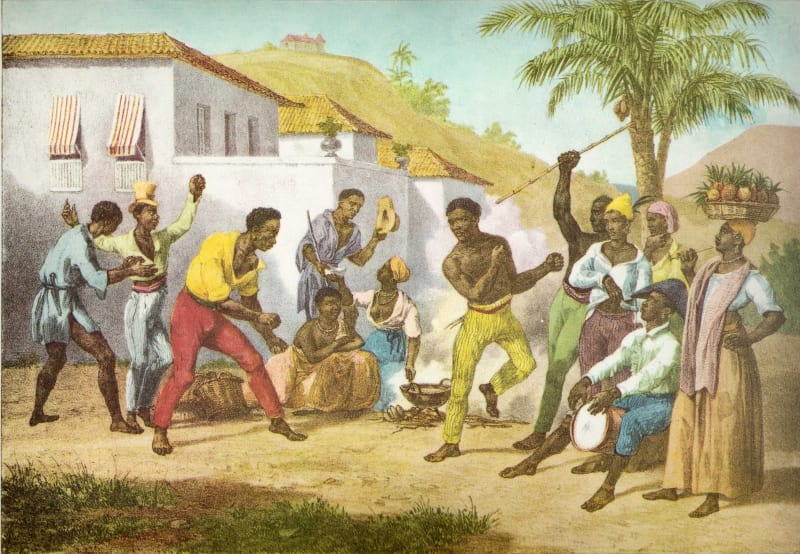
Capoeira is Brazil’s unique Afro-Brazilian martial art — a synthesis of combat, dance, acrobatics, and music, born under the most extreme conditions: slavery. African enslaved people, trafficked to Brazil from the 16th century onward, developed a combat system in which game, fight and dance run into one another. That this fusion was a disguise from the overseers is the most widespread reading — but a reading; the article on engolo sets out why the Angolan material points rather to a shared grammar of game, fight and dance. Capoeira is therefore inseparable from music: the Berimbau (a one-stringed bow with resonating gourd) sets the rhythm that determines both the tempo and nature of the play. Without music, Capoeira is incomplete. Banned in Brazil in 1892, Capoeira experienced rehabilitation in the 1930s through two masters with opposing visions: Mestre Bimba reformed and modernized it, Mestre Pastinha preserved the traditional Angola forms. In 2014, Capoeira received UNESCO status as Intangible Cultural Heritage of Humanity.
History
Origins in Slavery (16th–19th century)
From the 16th century, Portuguese colonists deported millions of African enslaved people to Brazil — primarily from Angola, the Congo, and West African regions. Brazil became the world’s largest slave society; until abolition in 1888, an estimated 4–5 million Africans were trafficked.
In this context of oppression, cultural survival strategies emerged. Which African combat games went into it is open. The one usually named is engolo, the game of the Nkhumbi herders on the Kunene — in the far south-west of Angola, not in the Kongo Kingdom that is often cited for it. Also attested are slap boxing and stick fighting, both widespread in south-west Angola and documented in Brazilian ports. The ginga, the rhythmic leg techniques and the musicality belong to that context — as combat training and as play at once.
Prohibition and Underground (1892–1937)
After abolition (1888) and the proclamation of the Republic (1889), Capoeira was explicitly criminalized in the Brazilian penal code in 1892. Practitioners were arrested and deported. The art survived in the poorest urban districts (Favelas) of Salvador da Bahia and Rio de Janeiro — illegal, but alive.
Mestre Bimba and Legalization (1932–1937)
Mestre Bimba (Manuel dos Reis Machado, 1899–1974) was the decisive reformer. He recognized that Capoeira needed to modernize to survive and earn respect. He developed Capoeira Regional — a systematized form with clear curriculum, grading system, and integrated acrobatics. In 1932 he opened the first official Capoeira school.
After a demonstration to the Governor of Bahia and later President Getúlio Vargas, Capoeira was legalized in 1937 and declared a Brazilian national sport.
Mestre Pastinha (Vicente Ferreira Pastinha, 1889–1981) responded by preserving traditional Capoeira Angola — less acrobatic, more earthbound, more ritual, closer to African roots. He opened his Angola center in Salvador in 1941.
The rivalry between Regional (Bimba) and Angola (Pastinha) shapes Capoeira to this day.
The Jogo — The Game
Capoeira is not “fought” — it is “played” (Jogo = game). The Jogo is a dialogue between two players, conducted in a circle (Roda), accompanied by music and song.
The Roda is sacred: it is simultaneously combat arena, theater, and community space. Audience and musicians sing together; the Berimbau leads the tempo.
Core Techniques
Ginga (swaying movement) — the fundamental standing movement: left-right weight shifting that keeps the body constantly moving and makes strikes hard to predict.
Leg techniques:
- Giro — spinning kicks
- Meia Lua de Frente — crescent-shaped front kick
- Meia Lua de Compasso — crescent-shaped spinning kick
- Chapa — side push kick
- Rabo de Arraia — “stingray tail,” spinning kick
Groundwork and acrobatics:
- Au — cartwheel (handstand-based)
- Rolê — ground roll
- Negativa — defensive ground position
Cabeçada — headbutt; Rasteira — foot sweep; Cotovelada — elbow strike
Music and Instruments
The music is not accompaniment — it is Capoeira:
| Instrument | Role |
|---|---|
| Berimbau | Lead instrument, sets game speed |
| Atabaque | Drum, keeps rhythm |
| Pandeiro | Tambourine |
| Agogô | Bell |
| Reco-reco | Scraper |
Song: Ladainha (litany, sung by the master) · Corrido (refrains, repeated by the circle)
Philosophy
Capoeira is deeply political: it is the art of surviving under oppression, of cultural resistance, and of preserving identity and dignity. The play principle — combat as dialogue — reflects a deep life philosophy: engagement without destruction, strength through cunning rather than force.
“No one can define it. Capoeira is full of malícia, it is art and skill, it has the potential for everything that is thought to be good in life.” — Mestre Pastinha
Connections to Other Martial Arts
- BJJ — both are Brazilian martial arts; Capoeira has almost no ground fighting, BJJ almost no standing combat
- Kung Fu — parallel development: both use animal movement inspiration and integrate philosophy deeply into technique
- Savate — both emphasize kicking techniques as the primary combat method
Today
Capoeira is practiced in over 150 countries. Since 2014 it is UNESCO World Heritage. Two main styles coexist: Capoeira Angola (traditional, ritual) and Capoeira Regional (structured, acrobatic). A third approach — Capoeira Contemporânea — attempts to unite both.
Related Articles
- Brazilian Jiu-Jitsu
- Kung Fu & Wushu
- Budo
- Breakfalls Compared — the ground as a third level rather than an incident
- The Roundhouse Kick in Six Systems — the same kick out of the ginga
- Grading Systems Compared — why the cordas arrived only in 1972 and still differ from group to group
- Mestre Bimba — the man who created Capoeira Regional and brought it from illegality into the studio
- Engolo — the Angolan combat game taken for the mother — and probably a cousin
- Thang-Ta — a ban one year before the Brazilian one — and no disguise story came of it
- Footwork Compared — the ginga among eight paths — and the only one that also goes up and down