Krav Maga — The Israeli Self-Defense System
Krav Maga is Israel's military combat system — born in the streets of Bratislava by Imi Lichtenfeld, perfected by the IDF, today the world's most widely taught self-defense system.
Lineage
Contents
Krav Maga (קרב מגע, “close combat” or “contact combat”) is the Israeli self-defense and combat system — the most pragmatic, most military-oriented, and most widely practiced close-combat system in the modern world. No competition, no art, no philosophical superstructure: Krav Maga has a single function — to enable the practitioner to survive and neutralize real attacks as quickly as possible. The system was developed by Imi Lichtenfeld (1910–1998) in the 1930s in Bratislava, Czechoslovakia — as a direct response to antisemitic street violence. Lichtenfeld was a European wrestling champion and boxing champion; he recognized that competition rules could kill in a survival situation. He synthesized the most effective elements from boxing, wrestling, and street fighting into a rule-free system aimed at rapid neutralization. With the founding of the State of Israel in 1948, Krav Maga became the official combat art of the IDF (Israel Defense Forces) and was personally developed by Lichtenfeld as Chief Instructor for over 15 years.
History and Founders
Imi Lichtenfeld (full name: Imre Lichtenfeld) was born on May 26, 1910 in Budapest and grew up in Bratislava. His father Samuel Lichtenfeld was a Detective Inspector and circus athlete — he taught his son boxing, wrestling, and acrobatics.
In the Bratislava of the 1930s, antisemitic violence escalated. Lichtenfeld organized groups of young Jewish men to protect their community. He recognized a fundamental difference: competition techniques were inadequate for street self-defense. An opponent attacking with a knife does not follow boxing rules. A drunk attacker in a mob is not a fair opponent.
From this insight emerged the core of Krav Maga: only what works in genuine danger has a place in the system.
1948: Lichtenfeld immigrated to Israel and joined the Haganah (Jewish underground army). With Israel’s statehood he became Chief Instructor for Physical Fitness and Krav Maga at the IDF Combat Fitness School — a position he held for 15 years.
1964: He left the army and adapted Krav Maga for civilian self-defense — with modifications for ordinary people of all ages and fitness levels. This version is today practiced in millions of schools worldwide.
Lichtenfeld received Israel’s civil rights award in 1997, a year before his death — for his lifetime service to national security.
Principles
Krav Maga has no fixed techniques or forms — only principles:
| Principle | Meaning |
|---|---|
| Simultaneous attack and defense | No separate blocking and striking phases |
| Attack vital points | Eyes, throat, genitals, knees — no sport rules |
| Maximum efficiency | Fastest possible neutralization |
| Adaptability | Use any available weapon — bottle, chair, keys |
| Scenario training | Training under stress, surprise, exhaustion |
Core Techniques
Simultaneous block-strike combinations: Krav Maga combines defense and counter-attack into a single movement — typically: inner arm deflection + fist to throat simultaneously.
360° defense: System for defending against attacks from all directions — with minimal, automated responses.
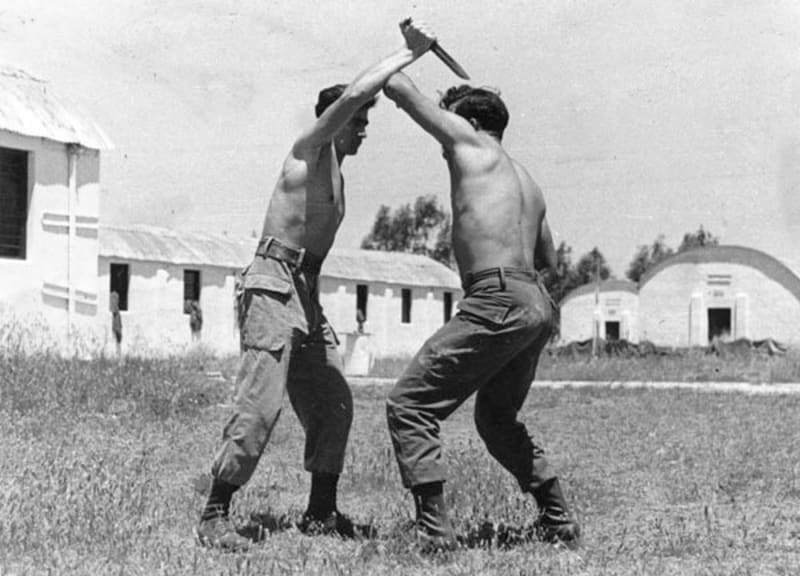
Knife and weapon defense: Krav Maga is known for its curriculum of weapons defense techniques (knife, gun, club).
Ground attacks: Krav Maga trains getting up from the ground under attack — no extended ground fighting like BJJ.
Training Philosophy
Krav Maga teaches under real stress: exercises are conducted with surprise elements, multiple opponents, darkness, and exhausted body. The goal: techniques should become automated before the mind has fully processed the situation.
“So that one may walk in peace.” — Imi Lichtenfeld; his recorded motto, carried through the Krav Maga literature as the founding sentence
Connections to Other Martial Arts
- Boxing — foundation of hand techniques and footwork
- Wrestling / Judo / Sambo — takedown and clinch techniques
- BJJ — ground fundamentals (but without extensive groundwork)
- MMA — Krav Maga and MMA overlap strongly technically; Krav Maga adds multiple opponents and weapons
Today
Krav Maga is practiced in police, military, and civil protection in over 50 countries — officially deployed. Numerous international organizations (IKMF, Krav Maga Worldwide, KMG) have however led to fragmentation of the system.
Criticism: Many “Krav Maga” schools have little in common with the original IDF system. Without clear quality standards, training quality varies enormously.