Pencak Silat — The Martial Art of Southeast Asia
Pencak Silat is the martial art of the Malay archipelago — deeply spiritual, rich in regional styles, recognized as UNESCO Cultural Heritage in 2019.
Contents
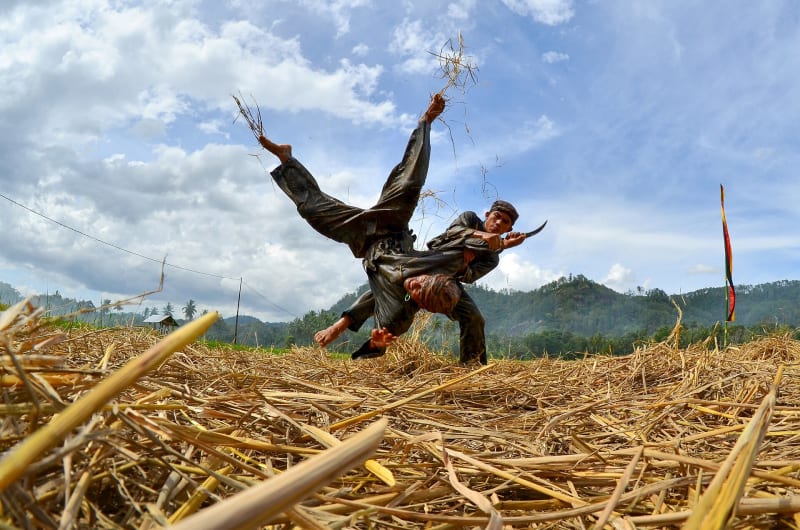
Pencak Silat (also simply: Silat) is the umbrella term for the traditional martial arts of the Malay archipelago — a rich, multilayered system practiced in Indonesia, Malaysia, Brunei, Singapore, southern Thailand, the southern Philippines, and southern Vietnam. The name combines the Javanese “Pencak” (performance, presentation) with “Silat” (combat, self-defense). Pencak Silat is not a unified style but a family of hundreds of regional styles (Aliran) and schools (Perguruan), differing in techniques, philosophy, and aesthetics — some emphasizing striking, others joint manipulation, weapons, or spiritual practice. What unites them: the balance between physical strength, mental clarity, and spiritual dimension. In 2019, Pencak Silat and Silat were jointly recognized by UNESCO as Intangible Cultural Heritage of Humanity.
History
Pencak Silat developed over centuries throughout the Malay archipelago as a survival skill and war art of the local kingdoms. The earliest clear historical evidence comes from pre-colonial times — the kingdoms of Srivijaya, Majapahit, and Malacca had trained Silat warriors in their armies.
The spread of Islam from the 14th century onward in the region significantly shaped Silat: many styles integrated Islamic spiritual practices, breathing exercises, and ethical principles. In Malaysia and Brunei, Silat today is firmly connected to Islamic cultural identity.
During the colonial era (Portuguese, Dutch, British), Silat was sometimes banned or suppressed — and survived disguised as cultural and religious practice in ceremonies, dances, and celebrations.
After independence, Indonesia and Malaysia experienced institutional revival: PERSILAT (Persekutuan Silat Antarabangsa / International Silat Federation) was founded in 1980 and coordinates worldwide competitions and transmission of the art.
Technical Foundations
Pencak Silat combines striking, grappling, joint locks, throws, and weapons techniques:
| Area | Content |
|---|---|
| Serangan (Attack) | Strikes, kicks, elbows, knees |
| Tangkisan (Defense) | Blocking, redirecting, evasion |
| Kuncian (Joint locks) | Grip and lever techniques |
| Jatuhan (Throws) | Ground-throwing techniques |
| Senjata (Weapons) | Kris, Golok, Toya (staff), Kerambit |
Langkah (footwork) is fundamental: circular, flowing movements constantly changing position and angle — similar to the Ginga in Capoeira.
Philosophy
The philosophical foundation of Pencak Silat consists of three elements:
- Raga — physical strength: the body as instrument
- Cipta — mental clarity: the mind as guide
- Rasa — spiritual awareness: the connection to higher dimension
This triad makes Pencak Silat more than a martial art — it is a way of life that aims to develop body, mind, and spirit.
Particularly in Indonesian styles, Tenaga Dalam (inner energy) is a central concept — comparable to Ki/Chi, cultivated through specific breathing exercises and meditation practice.
“Silat does not teach killing. Silat teaches not being killed — and beyond that: how to live.” — Traditional Silat maxim
Styles and Schools
| Style | Origin | Distinctive Feature |
|---|---|---|
| Silat Melayu | Malaysia/Brunei | Traditional, Islamic-influenced |
| Silat Harimau (Tiger) | West Sumatra | Ground and low-stance techniques |
| Silat Cimande | West Java | Broad emphasis across all areas |
| Silat Merpati Putih | Java | Spiritual, Tenaga Dalam |
| Kali/Arnis | Philippines | Weapon-based, overlaps with Escrima |
Connections to Other Martial Arts
- Escrima/Arnis — both from the Southeast Asian region; Silat weapon system and Escrima overlap in blade and staff
- Capoeira — structurally distantly similar: both disguise martial arts in dance/ceremony, both have spiritual dimension
- Kung Fu — trade between China and the Malay archipelago brought Chinese influences into early Silat styles
Today
Pencak Silat is practiced in over 50 countries today — through Indonesian and Malay diaspora communities and international martial arts interest. At the SEA Games (Southeast Asian Games), Pencak Silat is an established discipline.
Related Articles
- Escrima / Arnis / Kali
- Kung Fu & Wushu
- Budo
- Sisemba — the Toraja kick fighting of Sulawesi: Indonesian, but outside the silat lineage