Greco-Roman Wrestling — Olympics' Oldest Combat Sport
The only wrestling style at the 1896 Athens Olympics and continuously on the programme since 1908 — exclusively upper-body grips and spectacular throws.
Lineage
Origins
Contents
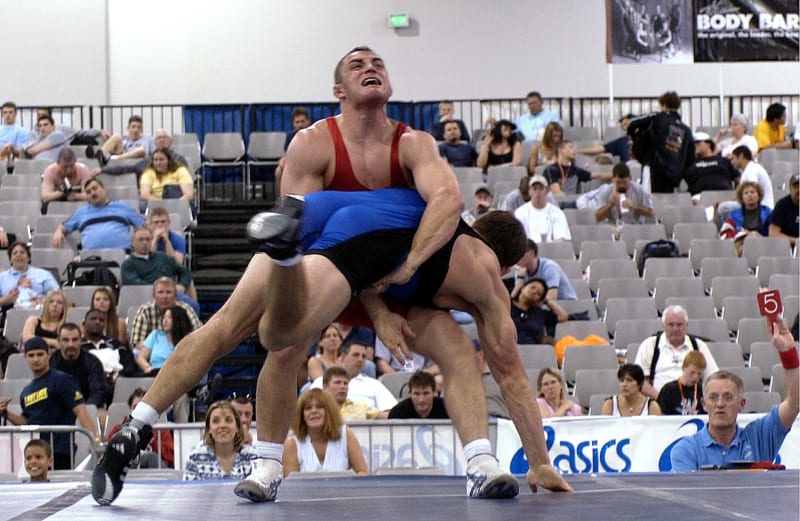
Greco-Roman Wrestling was the only wrestling style represented at the first modern Olympic Games in Athens in 1896. It was then absent twice — in 1900 wrestling was not on the programme at all, and in 1904 only freestyle was contested — and has been continuously Olympic since 1908. The defining rule: grips below the hip are forbidden. No leg grabs, no leg trips, no hip lifts with leg contact. Greco-Roman wrestlers counter this restriction with spectacular upper-body throws and suplexes — throws where the opponent is arced over the thrower’s head. Greco-Roman developed in early 19th-century France — initially under the name “French Wrestling” (La Lutte Française). A Napoleonic soldier named Jean Exbrayat reportedly established the core rule that no grips below the waist were to be allowed. The name “Greco-Roman” was introduced later as a marketing strategy — to link the art to the great ancient civilizations and enhance its prestige.
History
French Origins (1848)
Greco-Roman Wrestling developed in France as a regulated wrestling system — a response to the desire for a more orderly, less brutal folk sport than unrestricted Catch Wrestling. Jean Exbrayat, a Napoleonic soldier, reportedly formulated the fundamental ruleset: no grips below the waist, no leg attacks, no painful holds.
The system spread through traveling fairground wrestlers and became popular — particularly in southern Europe and Turkey.
Basilio Bartoletti, an Italian wrestler, coined the term “Greco-Roman Wrestling” — as a reference to ancient tradition and to enhance prestige.
Olympic History (1896–present)
1896, Athens: Greco-Roman Wrestling is the only wrestling system at the first modern Olympic Games — a single heavyweight bout.
Since 1908, London it has been represented at every Olympiad — as an exclusively male discipline (freestyle wrestling has had a women’s category since 2004).
The Soviet Union, Russia, and Eastern European countries (Ukraine, Romania, Sweden) have traditionally dominated Greco-Roman.
Technical Foundations
The defining feature: No grips below the hip.
| Permitted | Forbidden |
|---|---|
| Upper-body grips and throws | Grips below the hip |
| Clinch and body control | Leg trips |
| Suplex throws | Hip lifts with leg contact |
| Transition techniques | Thigh grabs |
Competition structure: Two periods of 3 minutes each. Victory by pin (both shoulder blades touching the mat) or points.
Clinch period: If no takedown occurs, a clinch phase is forced — both wrestlers start from a ground position. This distinguishes Greco-Roman from freestyle wrestling.
Core Techniques
Suplex (overhead throw) — the hallmark of Greco-Roman wrestling: opponent is gripped at the upper body and arced over the head in a throw. Depending on angle: German Suplex, Belly-to-Back, Overhead Suplex.
Gut Wrench — drilling movement from ground fighting: opponent is gripped around the waist and rolled in a full circle — points for each completed roll.
Arm Throw — arm lever throw from clinch.
Double Nelson — shoulder pressure from behind for shoulder blade fixation.
Philosophy
Greco-Roman has no explicit philosophy — it is pure performance sport. But the restriction to upper-body techniques gives it a special elegance: the spectacular throws require extraordinary strength, technique, and courage. The suplex — a person in the air, arcing elegantly over one’s own head — is aesthetically unique among combat sports.
“In Greco-Roman there is no hiding behind legs. You must dominate your opponent with pure upper-body strength and technique.” — Greco-Roman wrestling saying
Connections to Other Martial Arts
- Freestyle wrestling — sister discipline; same fundamental principles, but freestyle permits leg techniques
- Catch Wrestling — historical precursor; Catch is the freer, more aggressive system
- Sambo — Russian system with Greco-Roman influences (via Oshchepkov’s wrestling studies)
- Judo — similar throwing principles; Judo permits leg sweeps, but similarly emphasizes upright combat
Today
Greco-Roman is an Olympic core sport — at every modern Olympics since 1908. United World Wrestling (UWW) is the international governing body. Dominated by Russian, Georgian, Armenian, and Swedish fighters.
In MMA, Greco-Roman is rarely used as a base — leg techniques are absent. But Greco-Roman clinch and suplex throws appear regularly in MMA fights.
Related Articles
- Catch Wrestling
- Sambo
- Judo
- Pankration
- Throwing — One Principle, Seven Rule Sets — what the ban on the legs does to the lever
- Freestyle Wrestling — the same sport without the ban on leg attacks, and an entirely different technique
- Jean Exbrayat — the man behind the one rule — and what about it is documented and what is not