Luta Livre — Brazil's Forgotten Grappling Art
Luta Livre is Brazil's no-gi grappling art — the working-class alternative to the elite's BJJ, heir to Catch Wrestling, locked in a legendary rivalry with the Gracie family.
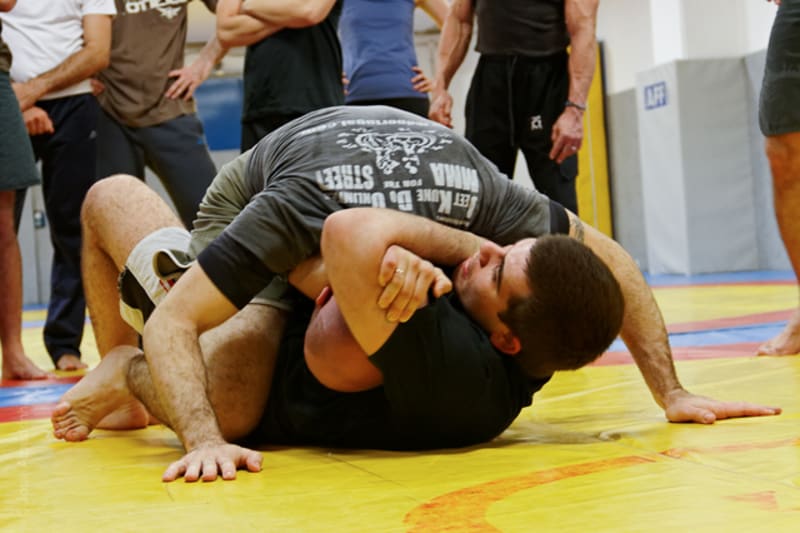
Lineage
Luta Livre (Portuguese: “free wrestling”) is Brazil’s independent grappling martial art — the less well-known but battle-tested alternative to Brazilian Jiu-Jitsu. Without Gi (kimono), with a full submission arsenal, and a fighting history that traces directly to catch wrestling. Euclydes Hatem (nicknamed “Tatu,” 1914–1984) joined the ACM in Rio de Janeiro in 1928, aged fourteen, where he learned catch wrestling; he formalised his own system only in the 1950s. What followed was one of the most dramatic rivalries in combat sports history: Luta Livre vs. BJJ — working class vs. aristocracy, no-gi vs. gi, Hatem vs. Gracie. This rivalry shaped two generations of Brazilian combat athletes and ended only with the rise of MMA, which integrated both systems. Luta Livre is less known than BJJ today — but its submissions, ground game, and philosophy have substantially shaped MMA.
History
Euclydes Hatem — the founder (1914–1984)
Euclydes Hatem (nickname: “Tatu,” the armadillo) was a Carioca (Rio de Janeiro resident) of humble origins. In 1928, aged fourteen, he joined the ACM (Rio’s YMCA) and took up catch wrestling there. His teachers are known by name: Manoel Rufino dos Santos, a physical education teacher who had spent six years in the United States, and Orlando Américo da Silva (“Dudú”) — both catch wrestlers. No Kosen-trained teacher is named anywhere.
The standard account calls his system a mixture of catch wrestling and Kosen judo groundwork. That attribution is unsourced — not refuted, but not covered by any named teacher either; the Kosen judo article holds it open for the same reason. What is documented is the catch wrestling. His students carried the art forward.
The Class Warfare Dimension
BJJ arose for and through the wealthy Gracie family — with expensive kimonos and exclusive schools. Luta Livre was the working class’s grappling: cheap (no Gi needed), pragmatic, effective. This social divide made the rivalry bitter.
The Legendary 1991 Desafio
Desafio 1991: A historic confrontation — three BJJ fighters (Gracie side) against three Luta Livre fighters. BJJ won all three fights. This was a turning point: BJJ cemented its reputation as the superior grappling system — but Luta Livre supporters argued the fights were unfair (kimonos were worn, which favored BJJ).
1997: After several violent incidents between BJJ and Luta Livre training groups in Rio, the main representatives of both camps declared a truce.
Technical Foundations
Luta Livre fights exclusively without Gi — which defines the technical character:
| Aspect | Luta Livre | BJJ (comparison) |
|---|---|---|
| Gi | No — no-gi always | Yes (and no-gi) |
| Submissions | Aggressive, broad | Structured |
| Influence | Catch Wrestling + Judo | Judo + Jujutsu |
| Leg locks | Early permitted | Grade-dependent |
Characteristic submissions: Heel Hook · Wrist Lock · Kimura (more aggressive than BJJ) · Leg Locks from unusual positions
Leg lock philosophy: Luta Livre integrated leg and foot locks earlier and more comprehensively than classical BJJ — a Catch Wrestling legacy.
Connections to Other Martial Arts
- BJJ — main rivalry; both from Brazil, both submission grappling; Luta Livre = no-gi, BJJ = originally gi-based
- Catch Wrestling — direct technical root through Hatem
- Sambo — Russian counterpart: both without gi, both with broad submission arsenal; Sambo more throw-focused
Today
Luta Livre was partially absorbed into BJJ no-gi through the MMA rise — the boundary is fluid. Significant Luta Livre fighters like Marco Ruas (UFC veteran) demonstrated combat effectiveness. In Brazil, Luta Livre continues to be taught in working-class neighborhoods; internationally it is less visible than BJJ.
Related Articles
- Brazilian Jiu-Jitsu
- Catch Wrestling
- Sambo
- Kosen Judo — what in the Kosen attribution is supported and what is not
- Euclydes Hatem — the founder, and the question of the second root