Ninjutsu — The Hidden Art of the Shinobi
Ninjutsu is the Japanese combat and espionage art of the Shinobi — a system of concealment, deception, guerrilla warfare, and over 18 classical combat disciplines.
Lineage
Contents
Ninjutsu (忍術, “art of endurance / concealment”) is the traditional Japanese system of combat techniques, espionage, and survival methods of the Shinobi (忍び) — better known in the West as Ninja. Ninjutsu is not a single martial art but a comprehensive system: it encompasses combat (Taijutsu, Kenjutsu, Shurikenjutsu), survival (medicine, climbing, swimming), intelligence techniques (disguise, infiltration, signaling), explosives knowledge, and psychology. Originating in the mountainous regions of Iga and Koka (modern Mie and Shiga Prefectures), Shinobi were employed during the Sengoku era (1467–1615) as mercenaries for intelligence gathering, sabotage, and covert operations. What circulates today as Ninja myth — black clothing, throwing stars, magical powers — is a mixture of historical reality, Edo-period popular culture, and Western fantasy. The genuine art is pragmatic, versatile, and far deeper than any pop culture version.
History and Origins
The origins of Ninjutsu lie in the 12th century. Togakure-ryū — the oldest documented Ninjutsu school — was allegedly founded by Daisuke Nishina (later Daisuke Togakure), a samurai who lost his lands and title after a military defeat and fled in 1162 to the mountain regions of the Kii Peninsula. There he met the Chinese warrior-monk Doshi and jointly developed a guerrilla combat art beyond the Bushido code.
The Sengoku era (1467–1615) was the Shinobi’s golden age. Constant warfare among the Daimyo created high demand for covert operations — espionage, sabotage, assassination, disinformation. The mountain villages of Iga and Koka developed professional Shinobi clans that sold their services to changing warlords.
Notable historical Ninja actions:
- 1558: Shinobi forces of Daimyo Rokkaku Yoshikata infiltrated enemy castles and spread chaos through coordinated arson
- 1582: Tokugawa Ieyasu used Iga Shinobi to flee through enemy territory after Oda Nobunaga’s death
With the Edo period (1603–1868), practical demand for Shinobi ended — the Tokugawa peace made open warfare rare. Ninjutsu survived in secret family traditions. Simultaneously, popular cultural ninja figures emerged in Kabuki theater and pulp literature — the myth began to overshadow reality.
The 18 Combat Disciplines (Ninja Juhakkei)
Ninjutsu traditionally encompasses 18 combat disciplines:
| # | Discipline | Content |
|---|---|---|
| 1 | Seishin-teki Kyōyō | Spiritual cultivation |
| 2 | Taijutsu | Unarmed body combat |
| 3 | Ninja Ken | Sword techniques |
| 4 | Bōjutsu | Staff fighting |
| 5 | Shurikenjutsu | Throwing blades |
| 6 | Sōjutsu | Spear fighting |
| 7 | Naginatajutsu | Halberd combat |
| 8 | Kusarigamajutsu | Chain-sickle |
| 9 | Kayakujutsu | Pyrotechnics / explosives |
| 10 | Hensōjutsu | Disguise art |
| 11 | Shinobi-iri | Infiltration, concealment |
| 12 | Bajutsu | Mounted combat |
| 13 | Sui-ren | Water techniques / swimming |
| 14 | Bōryaku | Strategy and ruse of war |
| 15 | Chōhōjutsu | Espionage and intelligence |
| 16 | Intonjutsu | Escape and evasion techniques |
| 17 | Tenmon | Astronomy / weather observation |
| 18 | Chi-mon | Geography and terrain knowledge |
Core Techniques
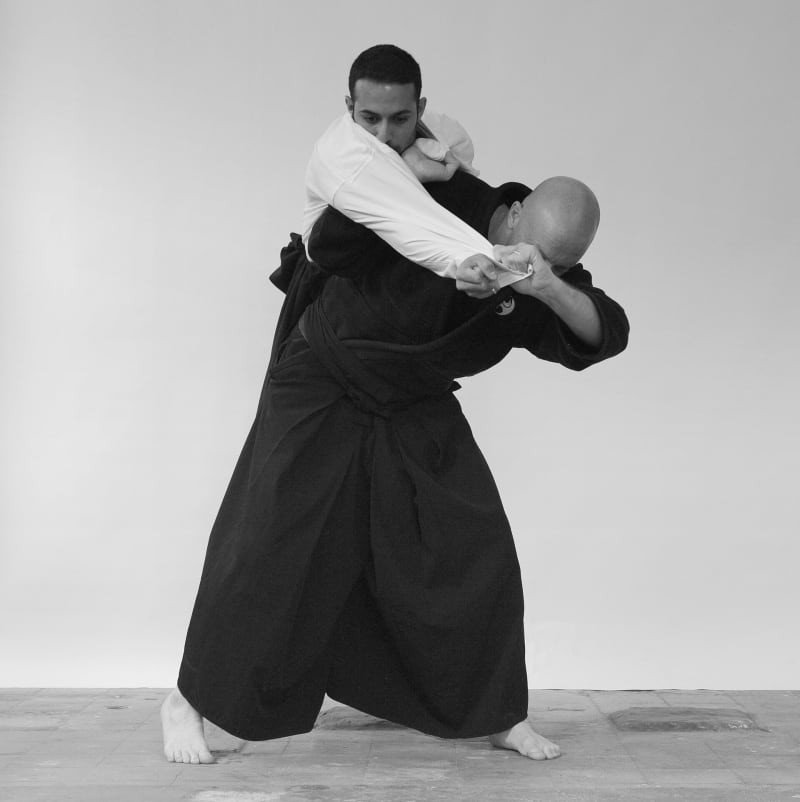
Taijutsu (体術) is the foundation of Ninjutsu combat: unarmed techniques from the Jujutsu tradition — throws, joint locks, strikes, kicks, combined with rapid entry and exit movements.
Shurikenjutsu — throwing techniques with Shurikens (手裏剣): the classic “throwing stars” (Hira-Shuriken) were distraction tools, not lethal weapons. More effective were the needle-shaped Bo-Shuriken (rod Shuriken).
Hensōjutsu (変装術) — disguise art: Shinobi learned to appear as monks, merchants, farmers, entertainers, or physicians. The seven classical disguises (Shichi-ho-de) covered various professional roles.
Kayakujutsu — fire and explosives: the 17th-century handbook Bansenshūkai describes smoke bombs, incendiaries, flash grenades, and primitive rockets.
Philosophy
Ninjutsu is based on the concept of Nin (忍) — the character combines “heart” beneath a “blade”: endurance despite pain, concealment despite the urge to be visible. The Shinobi remained hidden — not from cowardice but from strategic intelligence.
Banpen Fugyō (万変不驚) — “Ten thousand changes, no surprise”: adaptability as the highest virtue. The Shinobi always prepared for change is undefeatable.
“The Ninja does not fight when they can win without fighting. Does not fight when they can flee. Fights only when there is no other option.” — Togakure-ryu tradition
Schools
| School | Founded | Distinctive Feature |
|---|---|---|
| Togakure-ryū | ~1162 | Oldest school, Bujinkan core |
| Gyokko-ryū | ~1100s | Combat foundation, bone-breaking techniques |
| Koto-ryū | ~1543 | Striking techniques to bones and vital points |
| Iga-ryū | Sengoku | Iga region, most famous historical school |
| Koka-ryū | Sengoku | Koka region, rivaled with Iga |
Bujinkan — The Modern School
Masaaki Hatsumi (*1931) is the 34th Sōke (school head) of Togakure-ryū and heads the Bujinkan (武神館, “Hall of the Divine Warrior”), the umbrella over nine classical schools. A founding year cannot be given cleanly, and the commonly cited 1978 does not mark the founding: what is documented is that Takamatsu named him successor to all nine schools in 1968, died on 2 April 1972, and that Hatsumi named his dōjō in his honour; by 1978 the name and the shidōshi title are in use. The literature also gives 1970 and 1974 — different milestones, not a contradiction — three Ninjutsu Ryuha and six Samurai Bujutsu traditions. He withdrew from active teaching in 2020. The Bujinkan today has schools in over 50 countries and is the most influential modern Ninjutsu organization.
Connections to Other Martial Arts
- Jujutsu — Ninjutsu Taijutsu and Koryu Jujutsu share common roots; Ninjutsu adopted and adapted Jujutsu techniques
- Kenjutsu — Ninja learned sword techniques but often used shorter blades (Ninjato, Kodachi)
- Naginatajutsu and Sojutsu — both part of the classical 18 disciplines
Today
Ninjutsu lives primarily in the Bujinkan. Additionally, Genbukan (Shoto Tanemura) and Jinenkan (Fumio Manaka) — two organizations from Hatsumi’s former students — continue the tradition.
Criticism: Ninjutsu is one of the most controversial martial arts. The transmission chain is sometimes historically difficult to verify; many “Ninja schools” are Western inventions. Within the Bujinkan there are debates about the combat effectiveness of modern Ninjutsu practice.
The Ninja myth in popular culture (Naruto, TMNT, countless Hollywood action films) has both publicized and distorted the genuine historical art.
Related Articles
- Jujutsu
- Kenjutsu
- Naginatajutsu
- Budo
- Shurikenjutsu — the throwing-blade art attributed to ninjutsu, and older than the attribution