Sumo — Japan's Oldest Martial Art
Sumo is Japan's oldest martial art — over 2000 years old, deeply rooted in Shinto religion, and still one of the most fascinating cultural phenomena in the world.
Lineage
Contents
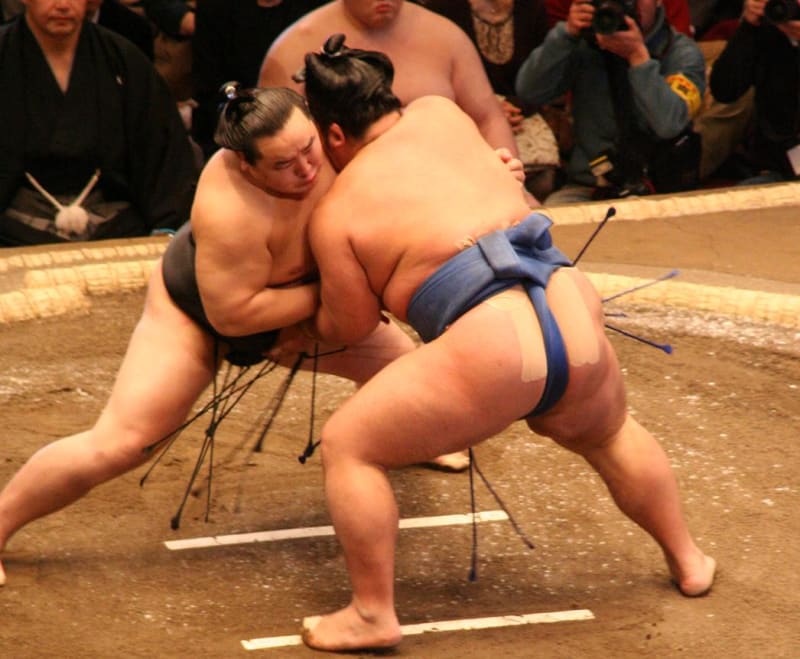
Sumo (相撲) is Japan’s oldest martial art — and far more than a sport. It is a living Shinto ritual, a cultural heritage of over two thousand years, and one of the world’s most singular and fascinating combat forms. Two massive athletes (Rikishi) face each other in the Dohyo (sand ring), accompanied by elaborate ceremonial ritual: salt purification, leg stomping (Shiko), sacred water. The objective is as simple as it is absolute: force the opponent out of the circular Dohyo (4.55 m diameter) or cause any body part other than the soles of the feet to touch the ground. For this, 82 classified winning techniques (Kimarite) are available. What sounds simple carries a complex system of rules, ranks, rituals, and history — accumulated over more than two millennia of Japanese culture.
History and Origins
Sumo’s origins dissolve into mythology. The Nihon Shoki (720 AD) describes the first Sumo match: Emperor Suinin (r. 29 BCE–70 CE) commanded the Rikishi Nomi no Sukune to fight against Taima no Kehaya. Sukune won and killed his opponent. This mythological founding anchors Sumo in Japan’s imperial and divine context.
Historically confirmed contests date from the Yayoi period (~300 BCE–300 CE), originally as an oracular Shinto ritual to prophesy the harvest.
In the Nara period (710–794), Sumo was institutionalized under imperial patronage — the Sumo festival (Sumai no Sechie) was mandatory at the imperial court. Many of today’s rituals developed from this courtly context.
In the Sengoku era (1467–1615), warlords (Daimyo) promoted Sumo as a method to identify and train strong fighters. Oda Nobunaga was particularly renowned as a Sumo enthusiast and in 1578 organized a tournament with over 1,500 participants.
The Edo period (1603–1868) brought professionalization: regular competitions were organized from 1684 at Tomioka Hachimangu Shrine in Tokyo. The former samurai Ikazuchi Gondayu established the rules and ring still adhered to today.
Technical Foundations
| Element | Term | Meaning |
|---|---|---|
| Ring | Dohyo (土俵) | Circular ring, 4.55 m diameter, rice-straw bales as boundary |
| Starting lines | Shikiri-sen | Two lines in the center of the ring |
| Belt | Mawashi | Heavy silk fabric, 9 m long, 80 cm wide |
| Winning technique | Kimarite | 82 classified winning methods |
| Ceremonial entry | Dohyo-iri | Ceremonial ring entry, top ranks only |
The two fundamental styles:
- Yotsu-zumo — belt wrestling: grip the Mawashi, then force out
- Oshi-zumo — pushing: push and shove without a firm grip
Rituals and Shinto Connection
Sumo is inseparable from Shinto. Every element carries religious meaning:
Shiko (四股) — the powerful stomping before combat: evil spirits are crushed into the ground and annihilated.
Salt throwing — salt (Shio) purifies the ring from impurity. Some Rikishi throw liters of salt before each match.
Sacred water (Chikara-Mizu) — strength-water, spit from the mouth as purification.
The roof over the Dohyo (Yakata) is modeled on a Shinto shrine — the fighting ring is sacred space. The four tassels at the corners represent the four seasons and four cardinal directions.
The Gyoji (referee) wears priestly robes of the Heian period and renders decisions with a wooden fan.
Ranking System
The Banzuke system (番付) is one of sport’s most stringent hierarchies:
| Rank | Term | Note |
|---|---|---|
| Yokozuna | 横綱 | Highest rank, never surrendered — retirement rather than demotion |
| Ozeki | 大関 | Second highest, “Great Lock” |
| Sekiwake | 関脇 | Third, “Side Guard” |
| Komusubi | 小結 | Fourth, “Small Knot” |
| Maegashira | 前頭 | Lowest top-division rank, numbers 1–17 |
In the entire history of modern Sumo there have been only 73 Yokozuna. The rank is conferred by ceremonial appointment — not by points, but by dignity, strength, and character (Hinkaku).
Philosophy
Sumo is not mere competition — it is Budo in its most elemental form: physical confrontation as spiritual practice. The Rikishi must embody dignity (Hinkaku), strength, and inner stillness.
Training in the Heya (stable / training house) is not a sports membership but a way of life: Rikishi sleep, eat, and train together under one roof, following strict hierarchical rules.
“Sumo is not strength against strength. It is spirit against spirit, in a moment of maximum physical commitment.” — Traditional Rikishi teaching
Tournament System
Today there are six Basho (tournaments) per year:
- January, May, September: Tokyo (Ryogoku Kokugikan)
- March: Osaka (Edion Arena)
- July: Nagoya (Aichi Prefectural Gymnasium)
- November: Fukuoka (Fukuoka Kokusai Center)
Each Basho runs for 15 days. A Rikishi fights once each day. Eight wins (Kachi-Koshi) means promotion; seven losses (Make-Koshi) means demotion.
Connections to Other Martial Arts
- Jujutsu — historians consider Sumo the oldest source of Jujutsu; early Jujutsu techniques (throws, locks) emerged from the Sumo context
- Judo — Jigoro Kano studied Sumo and integrated aspects; the Dojo principle (communal training, hierarchy) derives from the Heya tradition
- Western wrestling — superficial similarity, deep cultural difference; Sumo has no pin system and no weight classes
Today
Sumo is Japan’s national sport (alongside baseball) with a professional league and worldwide television coverage. Since the 1990s, Rikishi from Mongolia have dominated — Yokozuna Hakuho (68 tournament victories) is considered the greatest Rikishi in history.
This internationalization is both blessing and challenge: it proves Sumo’s universal appeal but also triggers cultural debates about whether foreign Rikishi sufficiently embody the traditional values (Hinkaku).
Criticism: Sumo is criticized for lack of transparency (match-fixing suspicions) and a harsh, often health-damaging training culture. The extreme body mass many Rikishi pursue leads to diabetes and heart conditions.