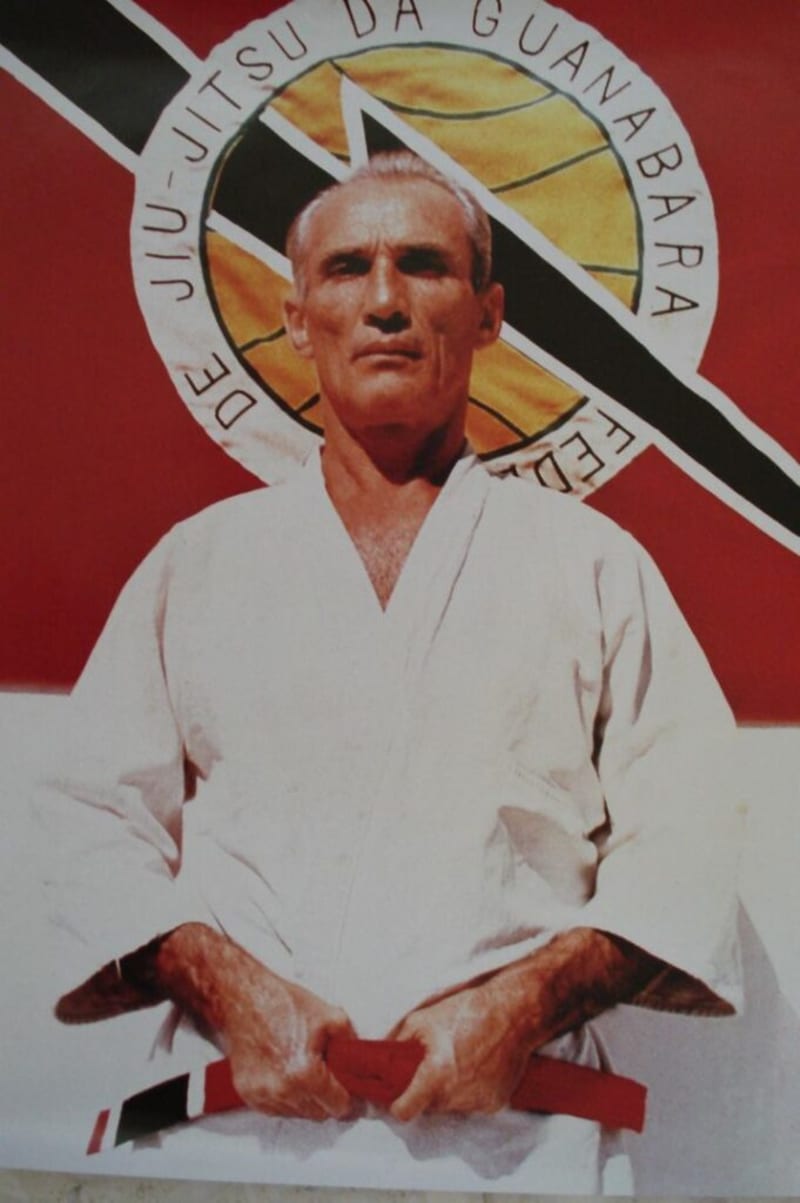
Helio Gracie — The Father of Brazilian Jiu-Jitsu
Helio Gracie (1913–2009) was too weak for classical Judo — so he invented a system placing leverage over strength, enabling the smaller to overcome the larger.
Contents
Overview
Helio Gracie is one of the most extraordinary figures in martial arts history: a physically weak, frequently fainting boy who — because he could not execute his brother Carlos’s techniques with strength — was forced to solve them with leverage. This necessity became a revolution. Helio developed a ground fighting system explicitly designed for the physically disadvantaged; a system that proved a 65-kg man can control a 100-kg opponent — not through muscle, but through mechanics. He demonstrated this in dozens of real fights and trained until a few days before his death at age 95.
| Full name | Hélio Gracie |
| Born | October 1, 1913, Belém do Pará, Brazil |
| Died | January 29, 2009, Petrópolis, Brazil (age 95) |
| Martial art | Gracie Jiu-Jitsu / Brazilian Jiu-Jitsu |
| Teachers | Carlos Gracie (brother), Mitsuyo Maeda (indirect) |
| Notable students | Rorion Gracie, Rickson Gracie, Royce Gracie |
Early Life and Training
Helio was the youngest child of the Gracie family — and the weakest. He suffered from chronic fainting spells as a child and was advised by doctors against physical training. When his brother Carlos had to miss a class, Helio stepped in — despite having no formal teaching credentials. The students enjoyed his instruction, and Carlos let him continue.
Helio began questioning the techniques he had learned from Carlos: Why does this throw not work when I’m not strong enough? How can I achieve the same effect with a different angle, a different lever position? These questions drove him to systematically rebuild the system.
Turning Points
In 1932 — at age 18 — Helio fought his first public match against a Judo black belt and won. Dozens of vale tudo challenges followed against boxers, wrestlers, Judo masters.
His most famous fight: 1951 against Japanese Judo World Champion Masahiko Kimura — then considered unbeatable. Kimura weighed 80 kg, Helio 62 kg. The fight ended after 13 minutes by submission — Kimura broke Helio’s arm with an armlock that has since been named the Kimura lock in Helio’s honor. Helio refused to tap, until his brother Carlos threw in the towel. The defeat became a moral victory: Helio had lasted 13 minutes against a world champion.
In 1993, his son Rorion founded the UFC — explicitly to test Helio’s system against all other martial arts. Royce Gracie, Helio’s son, won UFC 1, 2 and 4, proving ground fighting dominance against unprepared opponents.
Techniques and Principles
Helio’s key innovation: reducing strength requirements to a minimum through maximum lever mechanics:
| Innovation | Description |
|---|---|
| Guard position | Back-lying with controlled legs around the opponent — Helio’s most important invention |
| Lever purity | Every technique adapted to function without strength |
| Positional hierarchy | Mount → Back mount → Side control — systematic dominance ladder |
| Chokes | Rear naked choke, triangle — safe finishers without strength |
| Self-defense | Every technique tested against street scenarios |
Philosophy
Helio’s entire work rests on a single philosophical premise: “A small, weak person must be able to defend themselves against a larger attacker.” This premise is not merely technical — it is a statement about dignity and equality.
He taught BJJ as a birthright: every person — regardless of size, gender, or age — has the right to self-defense. The system must work to physically deliver that right. Helio trained daily into his 90s and said Jiu-Jitsu was his secret to health and longevity.
Students and Legacy
- Rorion Gracie — UFC co-founder; brought BJJ to the United States
- Rickson Gracie — Considered the family’s most technically complete fighter; over 400 fights without defeat
- Royce Gracie — Won UFC 1, 2 and 4; made BJJ globally known
- Royler Gracie — Multiple BJJ World Champion
Connections to Other Arts
Judo (Kano) is the direct parent discipline, transmitted through Mitsuyo Maeda to Carlos. Helio’s adaptation deliberately moved away from Judo’s throwing emphasis, focusing on ground fighting — a direction that would dominate MMA decades later. Catch Wrestling shared with Helio the belief that lever techniques trump strength.
Today
BJJ is one of the fastest-growing martial arts in the world. No MMA fighter’s profile is without BJJ as a foundation. Helio’s philosophy — technique beats strength — is the core principle of modern combat sports. He died in 2009 at 95, on his way to the next training session.