Muay Thai — The Art of Eight Limbs
Muay Thai is Thailand's national martial art — the art of eight limbs deploys fists, feet, elbows and knees as weapons, battle-tested across centuries of warfare and ritual combat.
Lineage
Contents
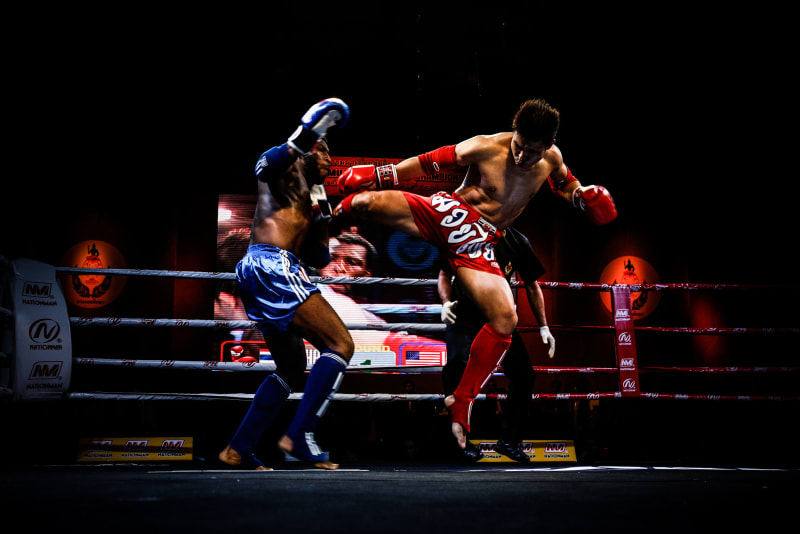
Muay Thai — มวยไทย, “Thai boxing” — is Thailand’s traditional martial art and one of the most effective stand-up fighting systems in the world. Its epithet, “the art of eight limbs” (Silapin Paed Ga), describes its weapons inventory: fists, forearms, elbows, shins, feet and knees — eight points of contact against the two of Western boxing or four of kickboxing.
Muay Thai has roots reaching back to the 13th century, when Siamese warriors developed unarmed combat systems for the battlefield. What is practised today as a ring sport was forged in the crucible of endless inter-kingdom warfare. The formalisation of modern rules — gloves, weight classes, timed rounds — began only under King Rama VII in the early 20th century.
Today Muay Thai is Thailand’s national sport, a mandatory component of most serious MMA training, and globally organised through major promotions such as ONE Championship and Glory. Bangkok’s Rajadamnern and Lumpinee stadiums remain the sport’s sacred centres.
History and Origins
Muay Boran — The ancient boxing: The predecessor to Muay Thai was Muay Boran (มวยโบราณ, “ancient boxing”), an unrestricted combat system encompassing strikes, kicks, knees, elbows and grappling — including head butts and biting. It developed alongside Krabi-Krabong, the Siamese weapons system.
Nai Khanom Tom (1767): The most celebrated legend of Muay Thai. When Burma destroyed Ayutthaya in 1767, many Siamese were captured — among them the fighter Nai Khanom Tom. Presented before the Burmese king Hsinbyushin, he reportedly defeated ten Burmese fighters in succession. His memorial day, 17 March, is Thailand’s National Muay Thai Day.
King Naresuan (1590): The warrior king himself practised Muay Thai and promoted it among his troops. Successive Chakri dynasty kings fostered and patronised the art.
Formalised rules (1910s–1920s): Under Rama VI and VII, rules were codified: timing systems, weight classes, hemp bandages (later gloves), groin protection. 1929 marked the official end of the hemp-bandage era.
Modern era: Rajadamnern Stadium (1945) and Lumpinee Stadium (1956) became the two primary arenas in Bangkok. Their champions have long been considered the finest Muay Thai fighters in the world.
Technical Foundations
| Weapon Group | Techniques | Target Areas |
|---|---|---|
| Chok (punches) | Jab, cross, hook, uppercut | Head, body |
| Te (kicks) | Teep, roundkick, axe kick | Head, body, legs |
| Sok (elbows) | Sok Tong, Sok Tad, Sok Ngad | Head, face |
| Khao (knees) | Khao Trong, Khao Loi, Khao Yab | Body, head |
| Thaib (clinch) | Plum clinch, sweep, dump | Control position |
The shin — not the foot — is the primary striking surface for roundhouse kicks. Years of conditioning the shin against banana trees and pads is traditional.
The clinch (Plum clinch, chap kho) is the heart of Muay Thai: with both hands clasped behind the opponent’s neck, controlled knee strikes are delivered from close range. This clinch work fundamentally distinguishes Muay Thai from kickboxing and boxing.
Core Techniques
Teep — “Foot jab” or push kick; the primary distance weapon. Interrupts the opponent’s rhythm and resets range.
Roundkick (Tae Tad) — Rotating shin kick to leg, body or head. More powerful than any foot-based kick due to shin density and hip rotation.
Sok Tong — Descending elbow; drives down onto the skull from above, producing the characteristic Muay Thai cuts.
Sok Tad — Horizontal elbow; sweeps across the face like a short blade.
Khao Trong — Straight knee to the body; delivered repeatedly in the clinch.
Khao Loi — Flying knee; spectacular and difficult to defend against.
Wai Kru Ram Muay — The ritual war-dance performed before every bout. Each fighter has a unique version honouring their gym and lineage. Performed wearing the Mongkol (sacred headband) and Prajioud (arm bands), it is both spiritual preparation and the fighter’s visible identity.
Philosophy
Muay Thai is more than sport — it is an expression of national identity and spiritual discipline. Central is respect: for the opponent, the Kru (trainer), the King and the country.
Nam Jai (น้ำใจ) — “Water of the heart,” generosity of spirit; a core Thai cultural value expressed in the gym through mutual support and encouragement.
Kreng Jai — Consideration and empathy; a fighter does not press an advantage unnecessarily against a clearly inferior opponent.
The Mongkol (มงคล) — the sacred headband — is tied by the Kru and contains blessings. It is worn only during the Wai Kru and removed before the bout; only the Kru may pass it over the ropes.
“Muay Thai is a mirror of the Thai character: hard but respectful, brutal but honourable.”
Regional Styles
Traditional regional variations existed within Thailand:
| Region | Style | Characteristic |
|---|---|---|
| Muay Korat | North-east | Heavy punches, “buffalo-tail” kick |
| Muay Lopburi | Central | Tactical, all-round |
| Muay Chaiya | South | Strong guard, elbow-centric |
| Muay Thasao | North | Fast, evasive |
Connections to Other Martial Arts
- Kyokushin Karate — Oyama integrated Muay Thai techniques (low kicks, knees); K-1 emerged from the synthesis of both systems
- MMA — Muay Thai is the standard striking component in modern mixed martial arts; its clinch work is irreplaceable
- Kickboxing — A direct descendant; Japanese and American kickboxing originated as rule-simplified versions of Muay Thai
- Krabi-Krabong — The Siamese weapons system is a sister art; many movement principles are shared
Today — Global Reach and Critique
Muay Thai is now a global phenomenon: in Europe, the Americas and Asia, Muay Thai gyms are ubiquitous. It is a cornerstone of every serious MMA curriculum. ONE Championship and Glory Kickboxing have elevated Muay Thai fighters to international stardom.
Olympic campaign: The IFMA has campaigned for Olympic inclusion for years. Recognition by the Global Association of International Sports Federations (GAISF) has been achieved, but full Olympic status remains elusive.
Critique: Commercial gyms frequently market “Muay Thai” as a fitness class with no serious combat training. Traditional techniques — especially elbow strikes — are often removed from Western competition for safety reasons. Meanwhile, K-1 and MMA influence is gradually reshaping the classical Muay Thai competition profile.
Related Articles
- Kyokushin Karate — Japanese full-contact system with Muay Thai influences
- Taekwondo — East Asian kicking art for comparison
- Judo — The grappling dimension that Muay Thai does not address
- The Roundhouse Kick in Six Systems — why the kick was measured as the fastest here, not the slowest
- The Fist — Hikite Versus the Boxing Guard — why the guard sits furthest forward here
- Grading Systems Compared — why no grade is awarded here — and in the West immediately was
- Kicking Programme — the whip engine — and why it is the faster one, not the slower
- Bare-Knuckle Boxing — the same transition in another tradition: from wrapped hands to the glove
- Pradal Serey — the neighbour the 2023 dispute was about — over the name, not the technique
- Footwork Compared — the switch step that changes the lead side mid-fight — and crosses while doing it
Further Reading
As an Amazon Associate I earn from qualifying purchases. This costs you nothing extra.