Bōjutsu — The Japanese Art of Staff Fighting
Bōjutsu is the Japanese art of staff fighting — from humanity's most ancient weapon to a refined system that once brought Miyamoto Musashi to a standstill.
Lineage
Contents
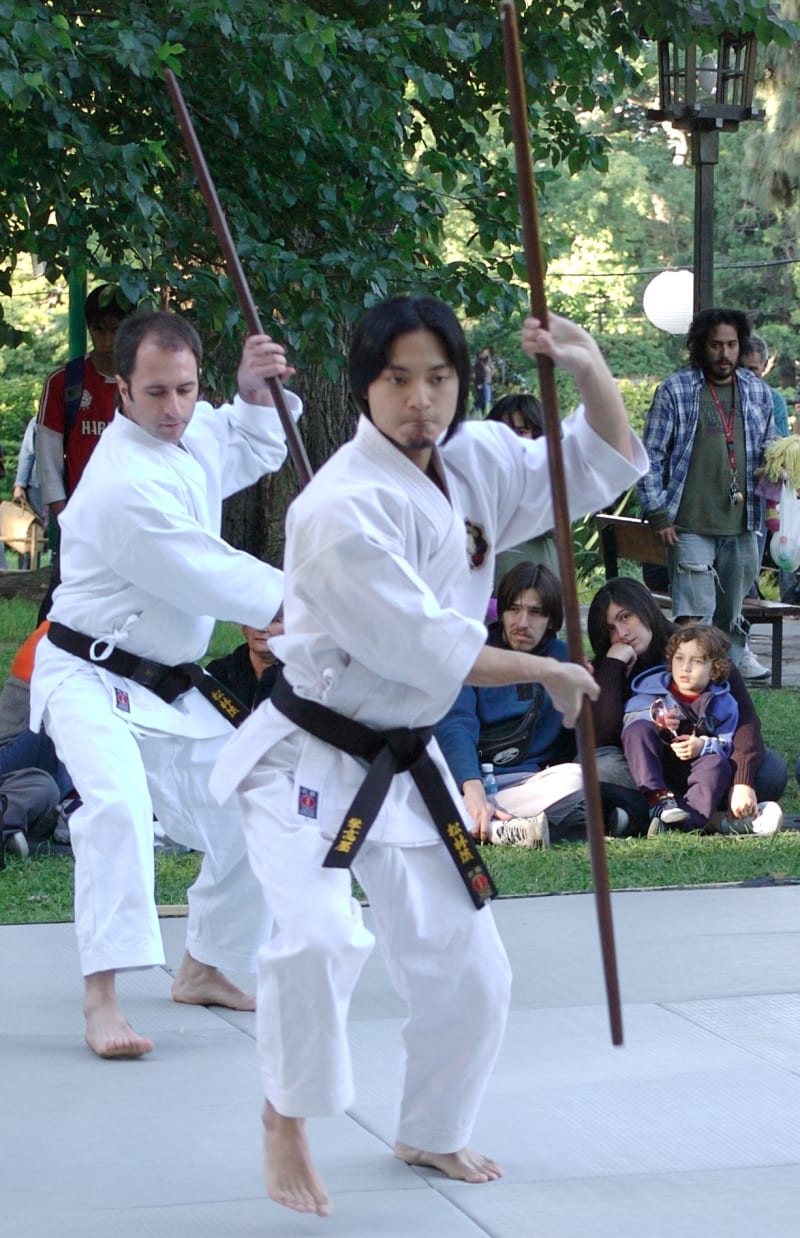
Bōjutsu (棒術, “art of the staff”) is the Japanese martial art of the long and short wooden staff — one of humanity’s oldest weapon forms, refined in Japan into a sophisticated combat art. Bōjutsu distinguishes two primary weapons: the Bō (棒, ~180 cm, the classical long staff) and the Jō (杖, ~128 cm, the shorter mid-staff). While the Bō appears as a general tool in many cultures, the Jō is a Japanese-specific development — created to fulfill a single task: defeating the swordsman. That task was given to the Jō by Musō Gonnosuke Katsuyoshi after he lost to Miyamoto Musashi — Japan’s greatest swordsman. From divine inspiration he developed five secret techniques and defeated Musashi in a second duel. From that moment arose Shintō Musō-ryū — the world’s most significant Jōjutsu school.
History and Founders
Musō Gonnosuke Katsuyoshi (fl. ~1605) had studied at Tenshin Shōden Katori Shintō-ryū and Kashima Jikishinkage-ryū, mastering Kenjutsu, Naginatajutsu, Sōjutsu and Bōjutsu to expert level. According to tradition he challenged Miyamoto Musashi to a duel — and lost. Musashi deflected Gonnosuke’s Bō attack with bare hands (or crossed swords, depending on the source) — the sheer length of the Bō had provided no advantage.
After his defeat, Gonnosuke retreated to sacred Mount Kamado in Chikuzen Province and practiced in ascetic isolation. There he received a divine vision: “A round wooden staff with knowledge of sun and moon.” He interpreted this as instruction to develop a new staff of intermediate length — neither as long as the Bō, nor as short as the sword.
He measured 4 shaku, 2 sun, 1 bu (approximately 128 cm) — the Jō was born. He then developed five secret techniques (Hiden Gyo-i) that exploited the Jō’s strengths against swords. He challenged Musashi to a second duel and won — or at least achieved a draw that caused Musashi to forgo the counter-attack.
From his school emerged Shintō Musō-ryū, reserved for two centuries as the exclusive martial art of the Fukuoka domain (Kuroda clan) — a so-called otome ryū (martial art for the exclusive use of the domain, never to be shown to outsiders).
Technical Foundations
The Bō (180 cm)
The classical long staff, from oak, bamboo, or fine wood. Taught in many Koryu schools as an integral part of the combat system (Tenshin Shoden Katori Shinto-ryu). Range and rotational force are its strengths.
The Jō (128 cm)
The shorter staff of Shintō Musō-ryū. Shorter than the opponent’s sword in extension, but more nimble. Longer than a short club, with more reach than the bare hand.
| Concept | Meaning |
|---|---|
| Ma-ai | Fighting distance — Jō can fight at multiple ranges |
| Harai | Deflect: Jō redirects the sword |
| Tsuki | Thrust: direct attack to vital point |
| Uchi | Strike: blow with the shaft |
| Osae | Suppress: Jō pins the opponent |
Shintō Musō-ryū — 64 Kata
The Shintō Musō-ryū system comprises 64 Kata (partner exercises), divided into several series:
- Omote (12 Kata) — fundamental techniques
- Chudan (12 Kata) — middle level
- Kage (12 Kata) — “shadow” techniques
- Samidare (6 Kata) — “spring rain” techniques
- Oku-iri (6 Kata) — advanced techniques
- Gohon-no-midare (5 Kata) — free variations
Additionally: Okuden (hidden transmissions) and integrated companion schools: Uchida Ryō Tanbō-jutsu (short staff), Ikkaku-ryū Juttejutsu, Shintō-ryū Kenjutsu, Kasumi Shintō-ryū Kenjutsu, and Isshin-ryū Kusarigamajutsu.
Core Techniques
Gonnosuke’s five secret techniques against the sword:
- Honte Uchi — normal-grip strike, exploiting superior reach
- Gyaku Te Uchi — reverse-grip strike
- Hikiotoshi Uchi — pulling-down strike
- Kaeshi Tsuki — returning thrust
- Gyaku Te Tsuki — reverse-grip thrust
Characteristic: the Jō has no preferred end — both ends are used equally. Switching between grip-end and tip is part of the technique.
Philosophy
Bōjutsu in the Koryu tradition carries the complete Budo heritage: technique, etiquette, spiritual cultivation. Gonnosuke’s development of the Jō is a model example of the Budo spirit: defeat as teacher, solitude as laboratory, divine inspiration as catalyst.
“The staff has no blade — it kills through force and contradiction. That makes it more honest than the sword.” — Shintō Musō-ryū tradition
Styles and Schools
| School | Weapon | Distinctive Feature |
|---|---|---|
| Shintō Musō-ryū | Jō (128 cm) | Largest Jōjutsu school in the world |
| Tenshin Shoden Katori Shinto-ryu | Bō (180 cm) | Part of comprehensive system |
| Kukishin-ryū | Bō | Ninjutsu context, also in Bujinkan |
| Okinawa Bōjutsu | Bō (182 cm) | Okinawan tradition, precursor of Karate Bō |
Connections to Other Martial Arts
- Sōjutsu — spear and staff share many fundamental movements; taught together in many Koryu schools
- Naginatajutsu — similar polearm but bladed; fundamental range-control principles are identical
- Kenjutsu — Gonnosuke’s Jō was explicitly developed against the sword; Shinto Muso-ryu is inherently anti-Kenjutsu
- Okinawan Karate — Okinawan Bōjutsu developed independently but in parallel; today part of the Kobudo system
Today
Shintō Musō-ryū is practiced worldwide, particularly in Japan, the Netherlands (where Donn Draeger spread it after World War II), and the United States. The Zen Nihon Kendo Renmei integrated a simplified Jō form (Jodo Seitei) into its curriculum — making Jōdo available in numerous Kendo dojos worldwide.
Okinawan Bōjutsu — part of Ryukyu Kobudo — lives separately and is closely connected with the Karate weapons system.
Related Articles
Verwandte Artikel