Canne de Combat — French Stick Fighting
Canne de Combat is French stick fighting — developed in 19th-century Paris as self-defense for the elite, closely related to Savate, today an official competition sport.
Lineage
Origins
Contents
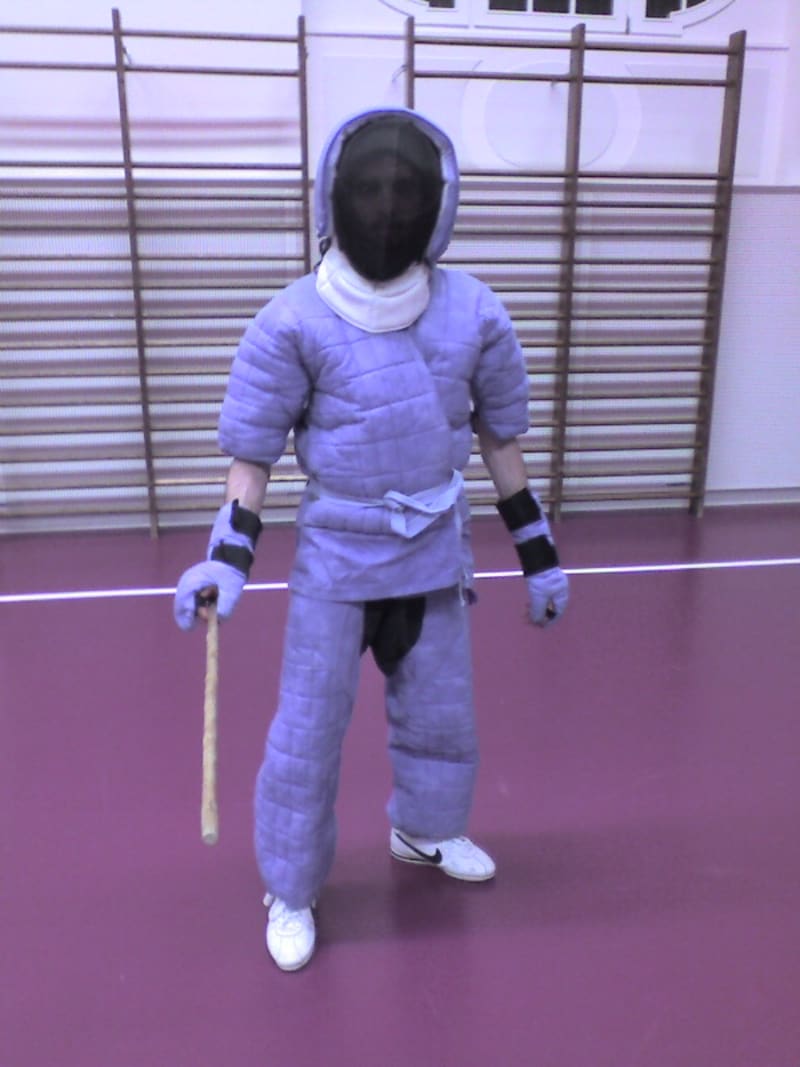
Canne de Combat (French: “stick combat”) is the French art of fighting with the walking cane (Canne) — an elegant, highly specific system that developed in early 19th-century Paris, when the walking stick was the everyday accessory of the bourgeois man. The cane was not merely a fashion accessory but a real defensive tool in the unsafe streets of post-revolutionary Paris. Canne de Combat is closely connected to Savate (French boxing) — both arose in similar milieu, were taught by similar masters, and together form the classic French combat system. The cane — a light, slightly tapered chestnut wood stick — is wielded one-handed, with fast, precise horizontal and diagonal strikes to three target zones: calves, torso, head. No thrusting allowed. The technique resembles fencing more than stick boxing. Maurice Sarry (1935–1994) revitalized and standardized Canne de Combat in the 1970s for modern competition and co-founded the Fédération Française de Savate, Boxe Française.
History
18th–19th Century — The Golden Age of the Cane
In pre-revolutionary France, nobility and bourgeoisie carried sword-canes (walking sticks with hidden blades) as social accessory and discreet defensive tool. After the Revolution and with increasing restrictions on sword-carrying, Parisian fighting schools developed the art of stick fighting.
In the early 1800s, Canne (or “La Canne”) developed parallel to Savate in the fighting schools of Paris. Masters like Larribeau and Michel Casseux (also known as Savate pioneer) taught stick and foot as an integrated system. From the outset the canne came paired with the bâton français, the long two-handed staff; the two are still taught together — the French federation calls its discipline “Canne de Combat et Bâton”.
Military and Police Use
The combined techniques of Savate and Canne were officially trained by French military and police forces until World War I. The First World War (1914–1918) killed many of the best practitioners and left the tradition nearly extinct.
Revival (1950s–1970s)
Maurice Sarry (1935–1994) discovered Canne de Combat in the 1950s and devoted his life to its revival. He codified the technique, developed competition rules, and standardized training. His system was officially anchored in the Fédération Française de Savate, Boxe Française.
The Canne — The Weapon
The competition Canne:
- Material: Chestnut wood (Châtaignier), light and flexible
- Length: ~95 cm
- Weight: ~120–140 g (very light!)
- Form: Slightly tapered — thinner at the lower end
Protective equipment: padded suit + fencing mask.
Technical Foundations
Canne de Combat permits only one-handed weapon guidance, with a free arm. The weapon may be switched between right and left hand.
Permitted strikes:
- Horizontal (from left or right)
- Diagonal (from upper-left or upper-right)
Forbidden: Thrusting/stabbing blows — only strikes permitted.
Target zones:
- Head (3 points)
- Torso (2 points)
- Calves/lower legs (1 point)
Basic techniques (based on stick guidance principle):
| Technique | Description |
|---|---|
| Latéral croisé | Crossing side strike |
| Latéral extérieur | Outer side strike |
| Brisé | Downward strike to head |
| Enlevé | Upward strike to calves |
| Fouetté | Whip strike, rotational force |
Philosophy
Canne de Combat is elegant efficiency — the aesthetics of the French mind applied to combat sport. Speed, precision, elegance: no raw force, no brutality. The connection with Savate makes the system a complete stand-up combat system: feet (Savate) + stick (Canne) = complete long-range combat.
“La canne est l’art de toucher sans être touché.” — “The cane is the art of hitting without being hit.” — French Canne tradition
Connections to Other Martial Arts
- Savate — inseparably connected; both arose in Paris, both taught by the same masters; Savate = feet, Canne = stick
- Escrima/Arnis — also one-handed stick martial art; Escrima is more aggressive and complete, Canne more formal and sport-oriented
- Bōjutsu — Japanese parallel: staff as primary weapon; Bō is held two-handed, Canne one-handed
Today
Canne de Combat is actively practiced in France and the Francophone world. The Fédération Française de Savate Boxe Française et Disciplines Associées manages Canne as an official sub-discipline. International spread through Savate schools in Europe, America, and Asia.
Related Articles
- Savate
- Escrima / Arnis / Kali
- Silambam
- Bōjutsu
- Stick Fighting in Eight Systems — a hundred grams — and what that says about the aim
- HEMA — the European neighbour whose line broke — and who retrieves it from books
- Bartitsu — Pierre Vigny’s stick method — the best-documented part of Bartitsu
- Sport Fencing — the neighbour that went the same way: a weapon art becomes a sport and survives by it
- Jogo do Pau — the same substitution logic in the same century, with the herder’s staff instead of the walking stick