Laamb — the National Sport a Cinema Owner Invented
The striking form of Senegalese wrestling goes back to a French cinema owner. It became the national sport all the same.
Contents
Overview
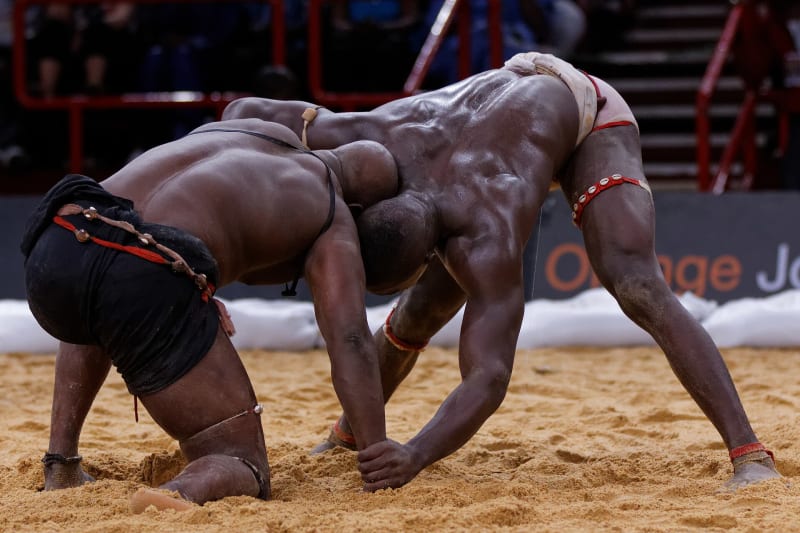
Laamb (Wolof làmb, Serer njom, French lutte sénégalaise) is Senegalese wrestling — and in its urban form one of the strangest combat sports in the world: wrestling in which punches are allowed.
That form is called lutte avec frappe and fills the sand arenas of Dakar. Beside it the punchless form, lutte sans frappe, continues, above all in the countryside.
This article is here for a particular reason. The stock carries in From Folk Wrestling to Sport a comparison that orders seven folk wrestling forms by who wrote the rules down — and that expressly records what it lacks: “a case where the trigger is known and the later development does not fit the type”. Among the candidates it names is laamb.
Laamb is that case. The trigger is known, it is dated, and the outcome is a different one from what the typology predicts.
Before the colonial period
The root lies with the Serer of west-central Senegal and reaches back into pre-colonial times. Wrestling took place in the village, under the name mbapat, and the occasions were the usual ones: the end of the harvest and the end of Ramadan.
The audience was not select. Men, women and children watched; the wrestlers were young men, and the bout was recreation and status-getting at once.
Up to this point laamb is a folk wrestling form like schwingen, glíma or ssireum: a rural practice at the edge of the farming calendar.
1924: the cinema owner
And then comes the trigger, and it is unusually concrete.
Maurice Jacquin, a French film producer and keen boxer, opened a cinema in Dakar in 1924. On its grounds he had boxers train — and wrestlers joined them.
Jacquin had the idea of combining the two. Wrestling plus boxing produced the form that dominates the sport today. In 1927 he became the first to set up a wrestling ring inside a cinema hall.
That makes the trigger the “commercial promoter” type — the same type under which the comparison files lucha libre, whose institutionalisation in 1933 was the founding of a company.
The difference is what came of it.
The two forms
| Lutte sans frappe | Lutte avec frappe | |
|---|---|---|
| Strikes | none | punches above the belt |
| Where | rural; international competition | urban arenas, Dakar |
| Audience | village, festival | stadium, television, sponsors |
| Relation to wrestling elsewhere | comparable | without parallel |
The punches are what makes laamb unique. No other of the great folk wrestling forms allows them. Headbutts and clawing were excluded when the rules were codified; the fists stayed.
How a bout is won
A bout ends the moment the opponent falls, and “falling” is precisely defined:
- head, buttocks or back touch the ground, or
- four points of support — both hands and both knees — are on the ground at once.
That is a fall criterion like schwingen’s and ssireum’s, not a points system. The comparison of throwing principles shows what such a criterion does to an art: it rewards tipping the opponent over and penalises any ground game, because there is none.
And the punches change nothing about that — they serve the fall. A blow that dazes the opponent is not a win; it is the preparation of the throw.
The apparatus around the fight
What distinguishes laamb from a sporting fixture stands largely before the bout.
The bàkk is the wrestler’s self-praise — a performed, often sung form in which he boasts of himself, names his descent and challenges the opponent. It belongs to the appearance as much as the fight does.
Then come the protections. Gris-gris, amulets, are worn on the body; marabouts and religious specialists prepare the wrestlers; liquids are poured over the body and into the sand. Drummers and dancers fill the arena, among them the simb, the “false lions”.
The comparison with dambe is close at hand and it holds. There as here a ritual apparatus belongs to the preparation, there as here specialists work at it, and there as here it has survived codification. What Western reports take for folklore is a component of the practice.
1994: the second trigger
And here the case gets interesting for the typology, because laamb has two triggers in sequence.
After independence associations took over the rules; on 21 March 1994 a decree created the Comité National de Gestion de la Lutte (CNG). Its remit is stated in the text: to revive wrestling in all its forms, to regulate the organisation of bouts — and in doing so to maintain the standards for wrestlers’ fees.
A supervisory body whose founding remit expressly names fighter pay says something about the state it found. The commercial operation came first; the state came afterwards and regulated it.
2018: an arena from China
The most recent chapter is one of foreign policy.
The Arène Nationale in Pikine near Dakar holds 20,000 spectators. The first stone was laid on 7 April 2016 by President Macky Sall together with the Chinese ambassador; it was built in 28 months by Chinese companies. On 22 July 2018 Xi Jinping handed the keys to Macky Sall.
It was financed by a donation from the People’s Republic of China of 32 billion CFA francs.
That is the point at which a folk contest has definitively become a matter of state: when its arena is a diplomatic gift.
The fees match. For the biggest bouts they reach several hundred million CFA francs — several hundred thousand euros for an evening.
What laamb does to the comparison
And now the reckoning this article owes.
From Folk Wrestling to Sport orders seven cases by trigger and predicts what becomes of them:
| Type | Prediction |
|---|---|
| national revival | national symbol, archaic grips preserved, barely exported |
| state programme | standardised, exportable, competition-oriented |
| commercial promoter | a show form, the outcome secondary |
| no trigger | remains tradition |
Laamb has the trigger of type 3 and the outcome of type 1.
The cinema owner is documented and dated. But in laamb the outcome is anything but secondary — the bouts are real contests with real defeats, and careers, fees and national standing hang on them. At the same time the art has preserved archaic components (the bàkk, the gris-gris, the drums) and has been barely exported — both features the typology assigns to national revival.
Three conclusions follow, and the second is the important one.
First: the prediction for type 3 is drawn too narrowly. It comes from a single case, lucha libre. A commercial promoter can build a show form — but he need not. What he builds depends on whether his audience is meant to believe the outcome.
Second: the typology assumes one trigger per case, and that is too few. Laamb has a chain: commercial promoter 1924, state supervision 1994, state prestige 2018. Anyone seeing only the first trigger predicts a show form; anyone seeing only the second predicts a state programme. Either alone is wrong.
Third: the typology remains usable all the same — but as a description of what a trigger makes possible, not of what it compels. The comparison article asked for exactly this, and laamb is the answer. It is recorded there as an addendum.
Common fallacies
“Laamb is ancient African wrestling.” The punchless wrestling is old. The form that fills the arenas today arose from 1924 out of the combination with boxing — and the man who combined them was a French cinema owner.
“If a Frenchman invented it, it is not Senegalese.” The same false step as with gongkwon yusul. What decides is not the descent of the ingredients but who carries the art — and for a hundred years that has been Senegalese wrestlers before Senegalese audiences.
“The punches make it MMA.” No. The criterion for victory is the fall, not the knockout, and there is no ground game. The punch serves the throw.
“The ritual part is a show for tourists.” It is older than the arena, it has specialists of its own, and it has survived three waves of codification.
“It is a national sport, so the state made it.” The state arrived seventy years after the promoter. What it regulated in 1994 was a commercial operation already running.
Related Articles
- From Folk Wrestling to Sport — the comparison whose missing test case laamb supplies
- Schwingen — national revival, 1805, and the same fall criterion
- Glíma — the same type, a different gripping garment
- Pehlwani — the null case with no codification at all
- Ssireum — fall criterion and national symbol, but without the commercial origin
- Dambe — the other West African case with ritual preparation and a professional circuit
- Musangwe — African fist fighting without an association and without an arena
- Engolo — an African combat game that took the opposite road
- Throwing Principles Compared — what a fall criterion does to a throwing art
- Lucha Libre — the other case with a commercial trigger, and the one with the expected outcome
- Gongkwon Yusul — the same question in Korea: does the descent of the ingredients make the art foreign
- Salvador Lutteroth — the other commercial trigger, and what it produced