Kuk Sool Won — Korea's Most Complete Martial Arts System
Korea's most comprehensive system, ordered in 1958 by In Hyuk Suh. He traces it to three old traditions — the founding is documented, the ancestry is not.
Lineage
Origins
Contents
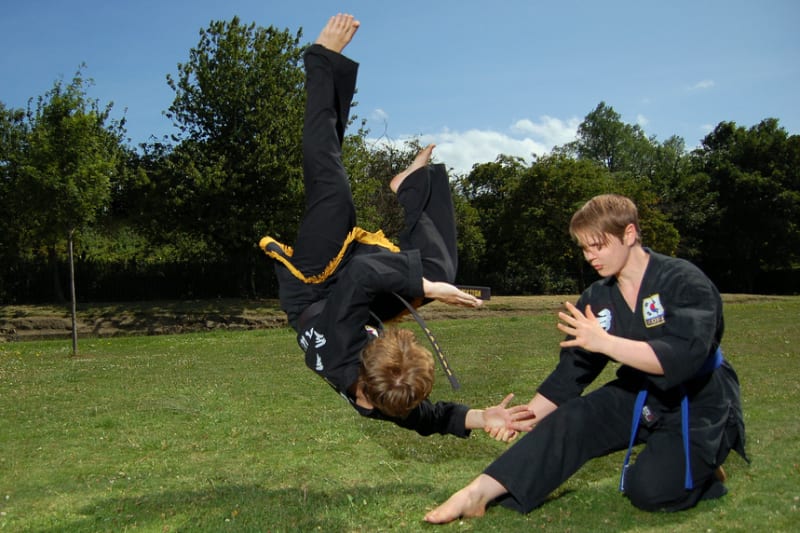
Kuk Sool Won (국술원, “Institute of National Martial Arts”) is Korea’s most comprehensive traditional martial arts system — an ambitious project uniting all classical Korean martial arts in one coherent system. Founded in 1958 by In Hyuk Suh, Kuk Sool Won rests on three historical sources: the folk art traditions (Sah Doh Mu Sool), the Buddhist martial arts of Korean monasteries (Bool Kyo Mu Sool), and the Royal Court martial arts of the Korean dynasties (Koong Joong Mu Sool). This synthesis makes Kuk Sool Won one of Asia’s most content-rich martial arts systems: 24 traditional Korean weapons, joint lock and throwing techniques from the Hapkido heritage, kicking and striking techniques, healing arts, and inner energy development — all in one structured system. The Korean government officially recognized Kuk Sool Won in 1963. The association reports schools in more than 50 countries; its headquarters is in the USA.
History and Founders
In Hyuk Suh (born likely 1940s) grew up under extraordinary circumstances: his grandfather Myung Deuk Suh was a martial arts instructor to the Korean Royal Court (the royal family of the Joseon Dynasty). Through him, In Hyuk Suh received early access to the secret Royal Court martial arts.
When his grandfather died in the Korean War, Suh traveled throughout East Asia — visiting Buddhist monasteries in Korea, Japan, and China, studying martial traditions preserved in these spiritual communities.
1958: he founded the first Kuk Sool Won in Korea — with the vision of preserving all authentic Korean martial arts in a system that would otherwise be lost through modernization and forgetting.
1963: First official recognition by the Korean government.
1974: In Hyuk Suh emigrates to the USA and in 1975 establishes the World Kuk Sool Association — to this day the association’s seat, in Magnolia, Texas.
Three Sources of the System
The threefold division below is the system’s own account. It sets out where Kuk Sool Won derives its components from — it is not an independently documented origin. What can be dated follows underneath.
| Source | Korean | Content |
|---|---|---|
| Folk arts | Sah Doh Mu Sool (사도무술) | Tribal and family tradition martial arts |
| Buddhist arts | Bool Kyo Mu Sool (불교무술) | Monastery martial arts of Buddhist monks |
| Royal Court arts | Koong Joong Mu Sool (궁중무술) | Martial arts of the Korean Royal Court |
What is documented and what is claimed. Documented are the founding of the curriculum from 1958, the state recognition, and the building of the association in the United States. Not independently documented is the origin story: neither the grandfather’s office at the royal court — the Korean court ended in 1910 — nor a family line running through sixteen generations, nor the existence of the three Mu Sool categories as separate historical traditions. The same case appears twice more in this encyclopaedia: Hwarangdo and Haidong Gumdo, both founded after 1960 and both invoking seventh-century warriors. This does not make the system worse. It only makes its history shorter than the telling.
Technique Categories
Kuk Sool Won encompasses over 3,608 techniques in various categories:
Joint locks and control: From the Hapkido heritage — wrist, elbow, shoulder, knee, hip, and ankle.
Throws and takedowns: Shoulder, hip, and leg throws from various starting positions.
Kicks and strikes: Korean kicking techniques with emphasis on efficiency and endurance.
Weapons (24 traditional): Ssang Jol Bong (nunchaku) · Jang Bong (long staff) · Gum (sword) · Dan Gum (short knife) · Jool Bong (chain staff) · Chang (spear) · Jung Bong (middle staff) · and 17 more.
Inner force and healing: Ki development, breathing exercises, Korean healing arts (Chiryo).
Philosophy
Kuk Sool Won has an explicit ethical code:
- Loyalty to country and parents
- Respect for teachers and elders
- Trust among friends
- No retreat in combat
- No unnecessary violence
The goal: holistic development — physical, mental, and spiritual. Kuk Sool Won is not only a combat system but a complete way of life in the Korean tradition.
“Kuk Sool Won is not for winning competitions. It is for developing the complete human potential.” — attributed to In Hyuk Suh; no source for it can be found. The only documented line of his comes from the foreword to the association textbooks
Connections to Other Martial Arts
- Hapkido — closest relative; Kuk Sool Won contains the complete Hapkido heritage plus Royal Court and monastery arts
- Taekkyeon — integrated as part of the folk arts system
- Escrima/Arnis — structurally similar concept: synthesizing a complete system from various sources
Today
Kuk Sool Won has schools in over 50 countries, with focus in the USA and United Kingdom. The World Kuk Sool Association in San Marcos, Texas is the international headquarters.
The association still lists In Hyuk Suh as its head; his children are involved in the leadership. The system grows steadily — particularly in the Anglophone world.
Related Articles
- Hapkido
- Taekkyeon
- Taekwondo
- Budo
- Haidong Gumdo — the other modern Korean synthesis with a large weapons component
- Sibpalgi — the attested canon of the Joseon military — 24 methods, named and illustrated
- Hwarangdo — the same claim to an unbroken line, checked against the sources
- Gongkwon Yusul — a Korean art that does without any claim to transmission