Subak — Korea's Most Cited and Least Known Martial Art
Subak is called the ancestor of Korea's martial arts. What the sources actually contain is remarkably little — and that is what makes the case interesting.
Contents
Subak (수박, “hand striking”) is the name that stands at the beginning of most accounts of Korean martial arts history — and the one about which the least is securely known. In the historical records of the Goryeo and Joseon periods, subak appears as a military exercise and as a form of contest, staged by officials and occasionally attended by the court itself. Then it disappears. What is taught as subak today is reconstruction.
This article therefore treats subak as what it historically is: a well-documented mention with no transmitted technique. That is not a shortcoming of the subject but its actual content — because no other Korean term shows so clearly how a gap in the sources turned into a line of ancestry.
History
Subak appears in the Korean state annals across several centuries. The Goryeosa, the history of the Goryeo dynasty (918–1392) compiled in the 15th century, records subak contests (수박희, subakhui) in which soldiers competed; successful fighters could be promoted. The Annals of the Joseon Dynasty (1392–1897) document subakhui events staged by local officials for the selection of soldiers.
That is a remarkably concrete transmission — it tells us what subak was for: it was a selection procedure, a demonstration of competence in military service.
It simply says nothing about how people fought. The annals are administrative writing, not instruction manuals. They record that a contest took place, who won and what followed from it — not which techniques were permitted or customary.
In the later Joseon period, subak vanishes from the records. The usual explanation is the Confucian revaluation under which military skills lost standing against the scholarly career. What is certain is that the mentions stop.
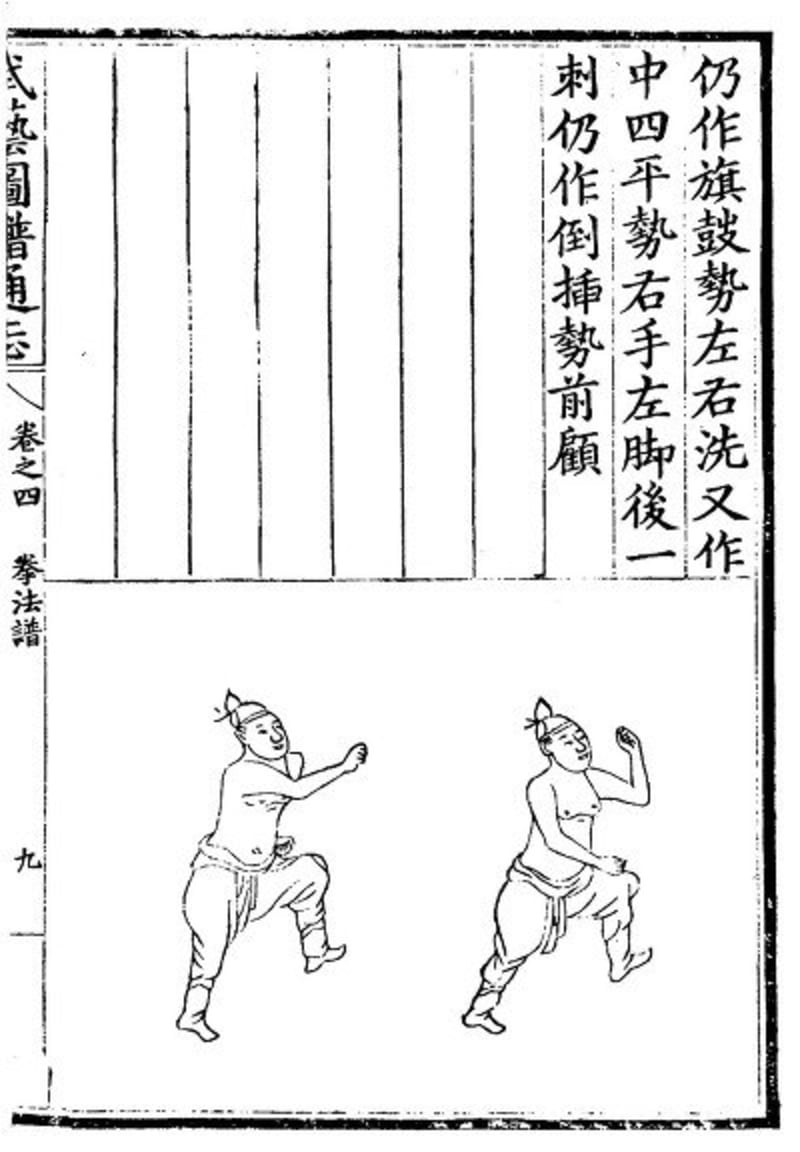
The special case of the Muyedobotongji. The military manual Muyedobotongji (무예도보통지), compiled by royal commission in 1790, contains a chapter on unarmed combat, Gwonbeop (권법). It is frequently cited as evidence for subak. This is problematic for two reasons: the chapter is not called subak, and its content derives in substantial part from the Chinese Jixiao Xinshu of General Qi Jiguang, written in the 16th century — a source its predecessor, the Muyejebo of 1598, had already used. The manual therefore proves that unarmed combat was taught in 18th-century Korea. As the continuation of an independent subak lineage, it does not serve.
Technical basis
What the sources permit us to say about technique fits into a short table — and the “evidence” column is the actual point.
| Item | What the sources give us |
|---|---|
| Name | 수박 “hand striking” — suggests open hand or fist |
| Purpose | Military selection, promotion, public contest |
| Form | Subakhui — a contest between two men |
| Techniques | no description transmitted |
| Teaching system | no school, no curriculum, no lineage transmitted |
| Pictorial sources | no contemporary depiction labelled as subak |
It is often inferred from the name that subak was a pure striking system. That is possible, but it is a deduction from a word, not from a description. The names of martial arts rarely denote their full repertoire — Korean ssireum is not named after its techniques, and “boxing” says nothing about footwork.
Core techniques
Honestly: there are none. No transmitted inventory of techniques, no kata, no set of forms, no didactic verse.
What modern schools teach under the name subak comes from three sources: the Gwonbeop chapter of the Muyedobotongji, taekkyeon, and the general stock of modern Korean martial arts. That can be good training. It simply is not transmission.
The question of continuity
Subak sits at the centre of a dispute that reaches far beyond the term itself: how old are the Korean martial arts?
The common account draws a line from the Goguryeo tomb murals through subak and taekkyeon to modern taekwondo. Research in sports history — including work by Udo Moenig and Steven Capener — reaches a different conclusion: modern taekwondo emerged after 1945 out of Japanese karate, which Korean founders had learned in Japan during the colonial period. The early forms are largely identical to those of Shōtōkan; only later were they replaced and the Japanese origin removed from the official account.
The historical process is therefore well traceable, and it is no Korean peculiarity — the search for a national ancestry for a young art is found in many countries. For subak this means:
The mentions are genuine. The line from them to present-day systems is not established.
Both statements can stand side by side. Subak existed, it was part of Korean military life for centuries, and it disappeared without leaving a technique behind.
Connections to other martial arts
- Taekkyeon — the only Korean folk martial art with a documented chain of transmission into the 20th century; often equated with subak, but attested separately
- Ssireum — Korean wrestling, mentioned in the same sources and with its practice preserved; the comparison shows what a transmitted art looks like
- Taekwondo — claims subak as a predecessor; the state of research argues against it
- Kung Fu / Wushu — via the Jixiao Xinshu, the demonstrable source of the Gwonbeop chapter
Today
Several modern systems exist under the name subak, in South Korea and in the diaspora; North Korea also saw attempts at reconstruction. They differ considerably from one another in technique — which is what one would expect when a common model is missing.
The value of the term today lies less in training than in source criticism. Anyone who wants to know how robust a martial art’s historical narrative is has a good test case in subak: the mention is impeccably documented, the art itself is not transmitted — and it is precisely this distinction that disappears in most accounts.