Miyamoto Musashi — The Undefeated Swordsman
Miyamoto Musashi (c.1584–1645) won over 60 duels undefeated, then retreated to a cave to write the Book of Five Rings — a work on strategy, spirit, and the way of the warrior.
Contents
Overview
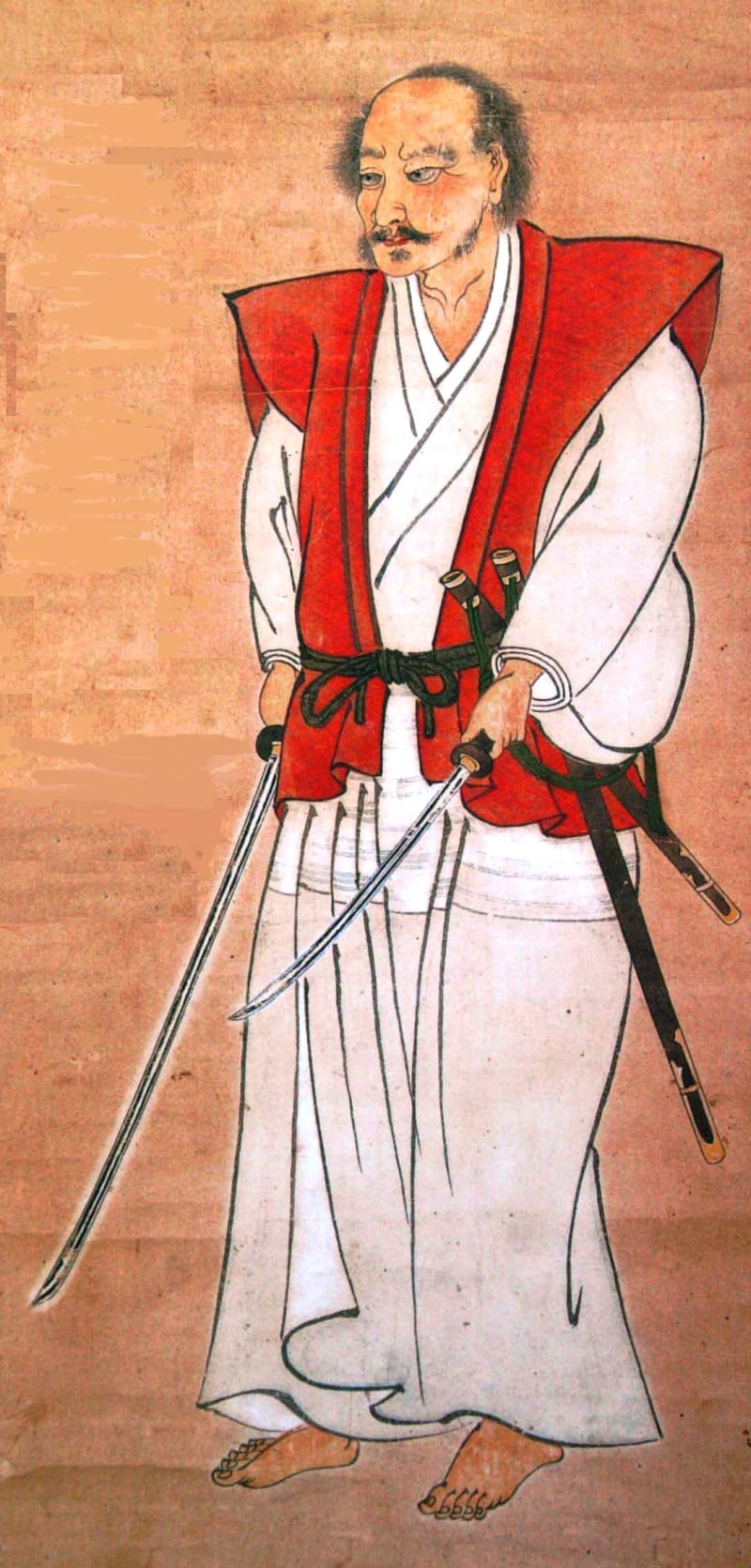
Miyamoto Musashi is the most mythologized figure in Japanese martial history. The ronin (masterless samurai) who won over 60 duels without a single defeat, then in old age retired to a cave and wrote a treatise on strategy, spirit, and the warrior’s way — Go Rin No Sho (The Book of Five Rings). Musashi was not only a swordsman; he was a painter, sculptor, strategist, and philosopher. His name combines mu (emptiness) and sa (spirit) — a self-description that captures his approach: in the state of emptiness lies the highest capacity for action.
| Birth name | Shimmen Takezo (later: Miyamoto Musashi) |
| Born | c. 1584, Harima or Mimasaka, Japan |
| Died | May 19, 1645, Higo, Japan |
| Martial art | Niten Ichi-ryu (founder), Kenjutsu |
| Major works | Go Rin No Sho (1645), Dokkōdō (1645) |
| Famous duels | vs. Sasaki Kojiro (1612), vs. Yoshioka school (1604–05) |
Early Life and Training
Musashi’s birth and childhood are shrouded in legend. What is certain is that he won his first duel at age 13 — against the experienced fighter Arima Kihei. At 16 he embarked on musha shugyō (martial pilgrimage), challenging rivals across Japan.
He had no single primary teacher; Musashi forged his style through relentless practice, observation of nature, and learning from experience — which he claimed never included defeat. His unconventional approach rejected the single-sword Ichi-no-tachi tradition and developed Niten Ichi-ryu: fighting with two swords simultaneously.
Turning Points
The most famous duel in Japanese history: Musashi vs. Sasaki Kojiro (1612) on the island of Ganryūjima. Kojiro was a master of the long sword Monohoshi-zao and considered unbeatable. Musashi arrived deliberately late — and carved a wooden training sword from a boat oar during the crossing. He struck Kojiro down with a single blow. Whether the late arrival was psychological strategy or genuine disregard, historians still debate.
In 1645, aware of his approaching death, Musashi withdrew to the Reigandō cave in Kumamoto. In 60 days he wrote Go Rin No Sho, and seven days later Dokkōdō (The Way of Walking Alone) — 21 rules for an independent life.
Techniques and Principles
Musashi’s school Niten Ichi-ryu survives today, preserved by a small number of guardians:
| Principle | Description |
|---|---|
| Hyōhō (strategy) | Combat as chess; composure beats strength |
| Two-sword technique | Daishō (long + short sword) wielded simultaneously |
| Suki (gap) | Exploiting the opponent’s moment of inattention |
| Ma-ai (distance) | Precise spatial awareness as tactical advantage |
| State of mind | Empty mind — no preconception, total responsiveness |
Philosophy
Go Rin No Sho is divided into five books: Earth, Water, Fire, Wind, Void — the five elements of Japanese cosmology. The fifth book, Void (Kū), is the heart of the work: Musashi describes a state of mind beyond all concepts in which the warrior acts intuitively and without hesitation.
Dokkōdō — written seven days before death — contains 21 principles, including:
- “Do not seek personal gain.”
- “Do not harbor jealousy.”
- “Detach yourself from desire.”
- “Accept everything just as it is.”
These principles sound Buddhist — Musashi was no religious man, but his discipline bordered on asceticism. He rarely bathed, never married, and died alone.
Students and Legacy
Musashi left no school in the institutional sense. Niten Ichi-ryu survived through a few direct students:
- Terao Magonojo — first successor
- Furuhashi Sozaemon — second generation
Active Niten Ichi-ryu lineages exist in Japan today under 12th-generation master Kajiya Takanori.
Connections to Other Arts
Musashi’s Go Rin No Sho influenced Kenjutsu and all subsequent Japanese sword-fighting schools. Its strategic principles found their way into Iaijutsu and modern Kendo. His philosophical influence extends beyond martial arts into business strategy, military doctrine, and Zen literature.
Today
Go Rin No Sho is one of the most widely read books on strategy in the world — among managers, military officers, and athletes alike. Musashi’s figure has inspired countless novels, mangas (especially Vagabond by Takehiko Inoue), films, and video games. His historical truth is difficult to separate from legend — which only amplifies his myth.
Related Articles
- Kenjutsu — The Art of the Sword
- Iaijutsu — The Draw of the Sword
- Bushido — The Way of the Warrior
- Mushin — Mind Without Mind
- Musō Gonnosuke — his challenger, whose only surviving portrait hangs in Musashi’s shrine