Mushin — The Empty Mind
Mushin, Zanshin, Fudoshin — the four mental states of the Japanese warrior describe the inner disposition that constitutes true mastery: emptiness as strength.
Contents
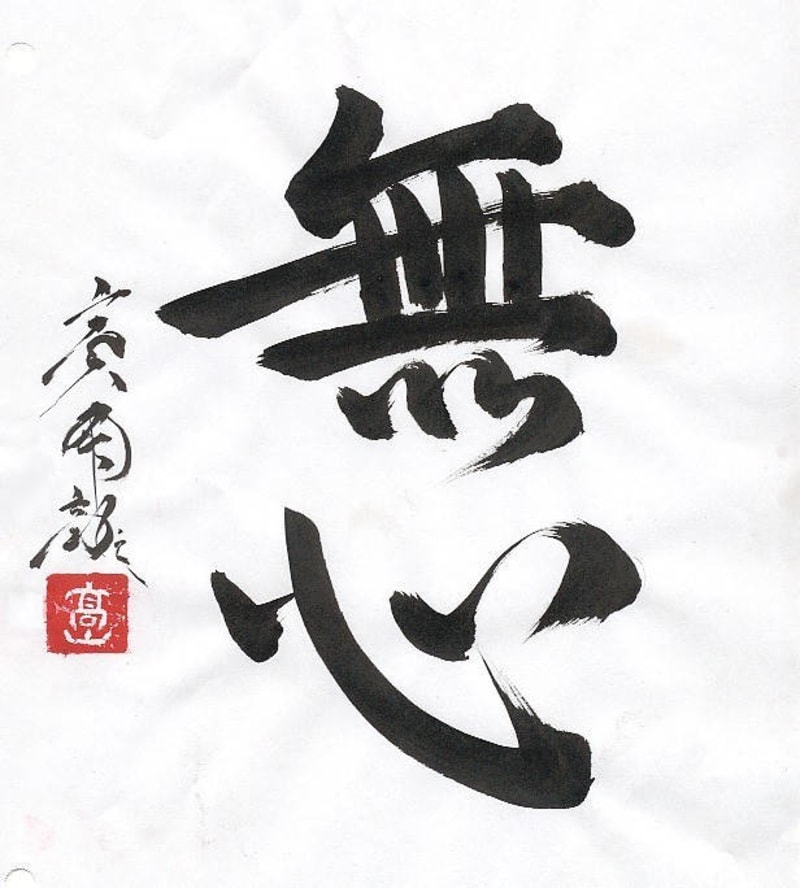
Mushin (無心) — “no mind” or “empty mind” — is perhaps the most important concept for the inner life of the martial artist. Mu (無) means “nothing,” “without”; Shin (心) means “mind,” “heart,” “consciousness.” Together they describe not thoughtlessness or unconsciousness, but the opposite: a mind held by no single thought, no emotion and no fixed intention — and therefore able to respond with complete speed and clarity.
The concept originates in Chan Buddhism (the Chinese precursor of Zen) and entered the martial arts through Japan’s swordsmanship schools of the 16th and 17th centuries. Sword masters such as Yagyu Munenori and Miyamoto Musashi wrote about the relationship between mental state and combat ability with a depth that remains unsurpassed.
Mushin is not alone — it is embedded in a system of four mental states (Shin concepts) that together describe the complete inner disposition of the warrior.
The Four Mental States
| Term | Characters | Meaning | Function |
|---|---|---|---|
| Mushin | 無心 | No fixed mind | Free response flow in combat |
| Zanshin | 残心 | Remaining mind | Alertness after the technique |
| Fudoshin | 不動心 | Immovable mind | Inner stability under pressure |
| Heijoshin | 平常心 | Everyday mind | The ordinary mind as ideal |
These four states are not mutually exclusive — they are different facets of the same inner maturity. An experienced practitioner moves fluidly between them.
Mushin — The Free Mind
Mushin is the state in which the mind clings to nothing. It is not empty in the sense of numb or absent — it is empty in the sense of open: ready to respond immediately to any stimulus without the delay of analysis and intention.
A student who thinks during sparring: “Now roundkick left, then…” — that student is not in Mushin. He thinks while the opponent strikes. A master in Mushin responds before the conscious mind has categorised the threat.
Takuan Soho (1573–1645), Zen monk and close friend of the swordsman Yagyu Munenori, described this state in his work Fudochi Shinmyoroku (The Unfettered Mind):
“The mind that rests nowhere: this is the most important point of all.”
He called the mind’s clinging — to a technique, to fear, to a desire for victory — tomari (dwelling). Mushin is the overcoming of tomari.
Connection to Shu-Ha-Ri: Mushin does not arise through direct striving. It is a result of long Jutsu training (Shu): when a technique has been so deeply practised that it requires no more conscious attention, the mental space we call Mushin emerges.
Zanshin — The Remaining Mind
After a technique — a throw, a counter, a strike — there is a moment when beginners relax. The danger seems past. Precisely this moment is the most dangerous gap.
Zanshin (残心, remaining mind) is the alertness that continues after the technique. Awareness remains with the opponent, the space, the situation — completely, without pride or relief.
In modern Kendo, every technique ends with Zanshin: the fighter maintains his posture, focus and space after the strike — as if the fight continues. A hit without Zanshin is not scored. This rule encodes a deep principle: an action is only complete when awareness is maintained afterward.
Zanshin applies to daily life as well: one who conducts a conversation and immediately switches off afterward has no Zanshin. One who completes a task and immediately jumps to the next loses the quality of the completion.
Fudoshin — The Immovable Mind
Fudo (不動) means “not moving,” “unshakeable.” Fudoshin is the mind that cannot be thrown off balance by threat, pain, surprise or pressure.
Fudoshin is not rigidity or stubbornness — that would be its opposite. It is the inner stability that makes flexibility possible: one who is inwardly unshakeable can respond outwardly with complete flexibility without losing their centre.
Kano Jigoro called this the Judo spirit: the fighter yields, but the centre holds. From this stability comes the force that seems effortlessly to bring the opponent to the ground.
In the dojo: Fudoshin is trained through extreme situations: the 100-man Kumite in Kyokushin, sustained Randori in Judo, Kendo kata under maximum pressure. The mind learns to remain calm under extreme conditions — and transfers this capacity to life.
Heijoshin — The Everyday Mind
The most paradoxical of the four concepts: Heijoshin literally means “the everyday, ordinary mind” — and this is the goal.
In Zen Buddhism there is the concept Nichi-Nichi Kore Kojitsu — “Every day is a good day.” Not because nothing bad happens, but because the mind lives completely in the present. Heijoshin is exactly this state: the mind is in no special state, not pumped up by adrenaline, not focused through exertion of will — it is simply there, ordinary, quiet, awake.
Miyamoto Musashi wrote in the Dokkodo (独行道):
“Do not let any single direction predominate.”
Heijoshin is the ideal that transcends all other mental states — because it is the mind that is complete and clear without special circumstances, without competition, without threat.
Connections to the Martial Arts
- Aikido — O-Sensei Ueshiba taught Mushin explicitly: the technique arises by itself when Ki and mind flow freely
- Kendo — Zanshin is a codified examination criterion; Fudoshin is required in examination etiquette
- Kyokushin — The 100-man Kumite is a brutal test of Fudoshin and Heijoshin: can the mind remain calm after 80 fights?
- Kyudo (Zen archery) — Eugen Herrigel’s experience in Kyudo is a direct description of the path to Mushin
Today — Psychological Parallels
Mushin has structural parallels to the psychological concept of Flow (Mihaly Csikszentmihalyi): complete absorption in an activity, self-forgetfulness, apparently effortless peak performance.
Mindfulness — the Western meditation movement — cultivates similar qualities: non-clinging awareness, presence without judgement.
The difference: Mushin is combat-tested. It does not arise on the meditation cushion but under the pressure of a real opponent — and is therefore more robust and specific than pure sitting meditation.
Related Articles
- Zen in Budo — The tradition from which Mushin comes
- Budo — The system in which Mushin is cultivated
- Ki, Chi and Prana — Life energy and mental state as unity
- Aikido — Mushin as lived martial philosophy
- Kime — how hesitation of mind becomes measurable as opposing tension in the body
- Shoshin — two states of mind on different time scales
Further Reading
As an Amazon Associate I earn from qualifying purchases. This costs you nothing extra.