Takeda Sōkaku — the Master Who Kept the Books
Takeda kept attendance and fee ledgers for his seminars. That is why his life is documented as few others are — and the lineage before him not at all.
Contents
Overview
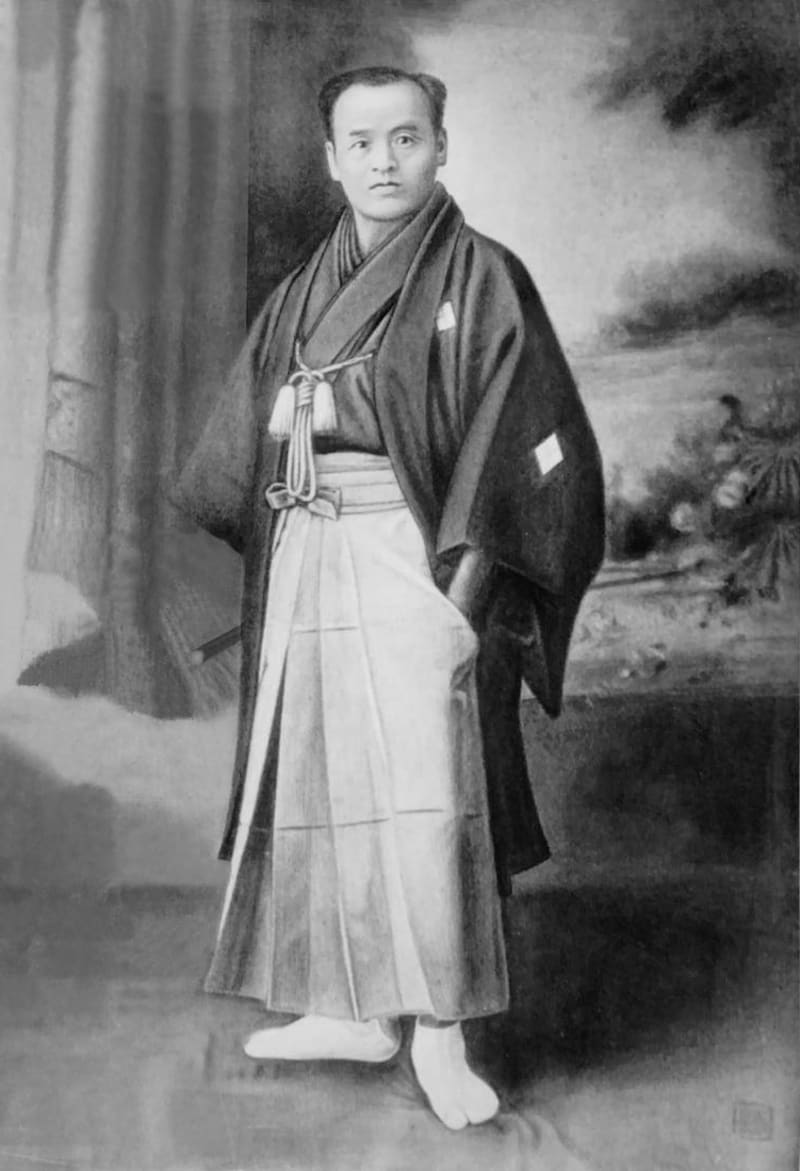
Takeda Sōkaku (武田惣角, 10 October 1859 – 25 April 1943) counts as the founder of Daitō-ryū Aiki-jūjutsu — more precisely, as the man who produced it in its present shape. His best-known student was Morihei Ueshiba, the founder of aikidō.
He is the best-documented figure in this series of portraits — and the reason is unromantic: he charged fees.
Takeda kept attendance and fee ledgers for his teaching, the eimeiroku and shareikoku. Whoever studied with him signed in and paid. From those books his activity can be reconstructed down to individual seminars.
And the same books make visible what is not documented: the lineage claimed before him has none.
Aizu, and a war in which everything was lost
Takeda was born in 1859 in Aizu, in today’s Fukushima Prefecture — and thus immediately before the Boshin War. Aizu was on the losing side; the domain was broken up, its warrior class dispossessed and scattered.
His father Takeda Sōkichi was a samurai who worked a farm and taught at a temple school. He was skilled with sword and spear and had a dōjō on the family property — that is where Sōkaku received his first training.
The sword ban, and what followed from it
The decisive external intervention came with the Haitōrei, the edict prohibiting the carrying of swords.
Takeda’s answer was a technical one: he shifted the emphasis to the empty-handed, jūjutsu-oriented techniques of the family tradition.
That is the same mechanism the stock shows in several places, applied at a different point: Ankō Itosu adapted karate to the school because the kingdom had vanished; Takeda adapted his art to a prohibition. In both cases a state decision shapes the technique, not an insight about fighting.
An itinerant life that was invoiced
Takeda did not teach in a dōjō with a fixed body of students. He travelled the country giving seminars — to military officers, police officers and martial arts enthusiasts, often of high social standing.
| start of Daitō-ryū teaching | 1899 |
| usual seminar length | ten days |
| record | eimeiroku (attendance), shareikoku (fees) |
At police departments he taught only jūjutsu techniques — presumably those suited to making arrests, from his basic curriculum. An entry from 1904 records instruction at the Yoshioka police department.
What makes these books a special source is their purpose. They were not kept to preserve a tradition but to collect money. A fee list has no reason to flatter — and precisely for that reason it carries more weight than any school chronicle.
That is the rule of thumb formulated in the portrait of Musō Gonnosuke, here in its strongest form: what was administered is verifiable. Takeda is the model case.
The entry where a term appears
The most revealing finding from the books is a word.
The term aiki appears in the entries only from 1922 — at the time Takeda was teaching at Morihei Ueshiba’s dōjō.
Before that they say jūjutsu. That does not mean the principle was not practised earlier; it means that the name defining the art today can be dated within the art’s own records — to the years of the encounter with Ueshiba.
This fits a pattern the stock shows repeatedly. The comparison of dō and jutsu records that aikidō has borne that name only since 1942, and that its predecessor is not a generic term but a named school. The ledgers show the step before: in 1922 the aiki enters the records, in 1942 the dō enters the name.
Ueshiba studied with Takeda from 1915 — the aikidō article names that encounter as the technical foundation. Takeda later appointed him kyōju dairi, teaching representative.
And the part that has no books
Tradition traces Daitō-ryū back to Minamoto no Yoshimitsu in the eleventh century and counts Takeda as the thirty-second of his line.
For that chain there are no historical documents. The claimed training relationships before Takeda are unattested, and the article on Daitō-ryū accordingly lists the origins expressly as legendary.
That places Takeda Sōkaku at a remarkable break: before him a line without papers, with him papers in unusual density. For this art the transition from legend to archive coincides with a single person — and that person is also the one who started the ledgers.
Which is the reason not to list him as the 32nd heir but as what he demonstrably was: the man who brought Daitō-ryū into verifiable history.
Influence
Through his students Takeda’s influence reaches far beyond Daitō-ryū:
- Morihei Ueshiba — whose further development became aikidō
- Choi Yong-sul — to whom Korean hapkido traces itself
- numerous police and military instructors whose names stand in the eimeiroku
He died in 1943, aged 83.
Related Articles
- Daitō-ryū Aiki-jūjutsu — the art he brought into verifiable history
- Morihei Ueshiba — his best-known student, from 1915, later kyōju dairi
- Aikidō — what became of what Ueshiba learned from him
- Jūjutsu — the genus under which his books record until 1922
- Hapkido — the Korean line via Choi Yong-sul
- Dō and Jutsu Compared — in 1922 the aiki enters the books, in 1942 the dō enters the name
- Musō Gonnosuke — the opposite case to the rule Takeda confirms: what was administered is verifiable
- Grading Systems Compared — the same era, in which associations demanded papers