Sanda — China's Modern Full-Contact Combat System
Sanda is China's official full-contact combat sport — developed from traditional Kung Fu and modern combat sport methodology by the People's Liberation Army, now an Olympic candidate.
Lineage
Contents
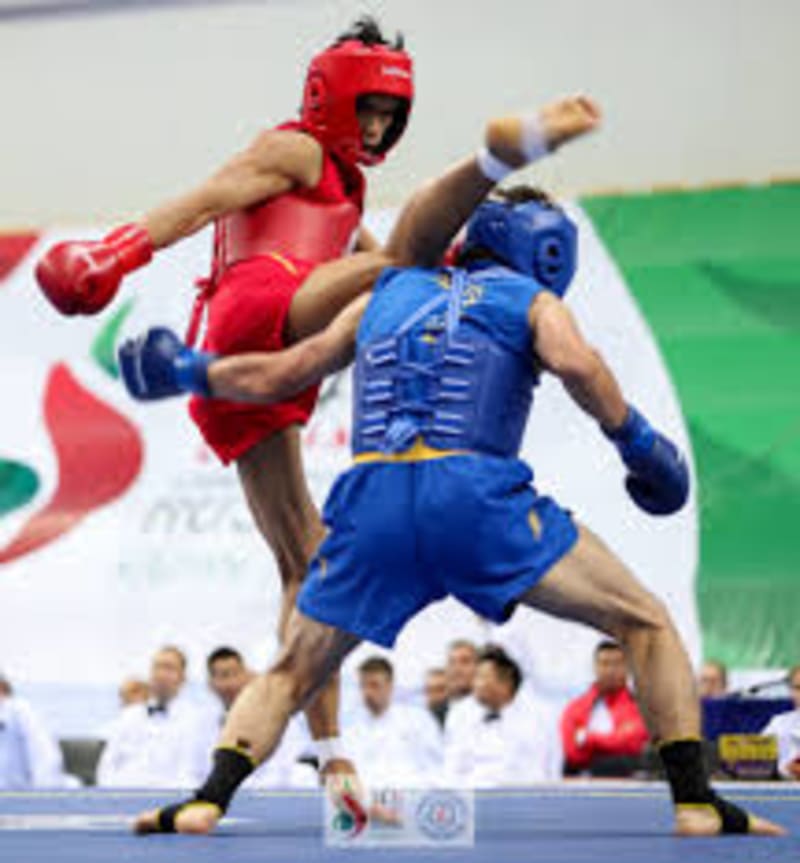
Sanda (散打, “free striking” or “free combat,” formerly: Sanshou, 散手) is China’s official full-contact combat sport — the practical combat component of modern Wushu. While Wushu Taolu (forms) emphasizes aesthetics and technique, Sanda is the proof in the ring: striking, kicking, takedowns, throws — all under competition conditions. The system arose in the 1950s when the Chinese People’s Liberation Army (PLA) needed an effective close-combat system — combining the traditions of the historical Leitai (高台, raised platform fights) with modern combat sport methodology. Sanda unites three dimensions: boxing (fist techniques), kickboxing (leg and foot techniques), and Shuai Jiao (Chinese wrestling, throws, and takedowns). The result is a complete combat system that competes against Muay Thai, kickboxing, and other combat sports in international competition.
History
Leitai Tradition
The historical precursors to Sanda are the Leitai fights — open challenge matches on raised platforms (Leitai) held in imperial China. On the Leitai nearly all techniques were permitted: strikes, kicks, throws. This tradition gave Sanda its pragmatic, rule-free spirit.
PLA Development (1950s–1970s)
After the founding of the People’s Republic of China (1949), the People’s Liberation Army sought an effective close-combat system for its soldiers. Traditional Kung Fu was too complex and difficult to standardize. The PLA developed in the 1950s to 1970s a new system — combining the most effective elements of various Kung Fu styles with modern combat sport principles.
1979: First official Sanshou competitions in China.
1989: Introduction into the national Wushu competition system.
2000s: Renamed from Sanshou to Sanda for international dissemination.
2026 Youth Olympics, Dakar: Planned inclusion of Sanda — a step toward full Olympic recognition.
Technical Foundations
Sanda combines three combat areas:
| Area | Techniques | Chinese Term |
|---|---|---|
| Boxing | Jabs, straights, hooks, uppercuts | Quan Fa |
| Kicks | Front, side, round, back kicks | Tui Fa |
| Takedowns/Throws | Body throws, leg grabs, sweeps | Shuai Fa |
Jie Tui Shuai (截腿摔) — Kick-Catch-Throw: Sanda’s most characteristic technique: catching the opponent’s kick and throwing them with it. This technique gives Sanda a unique tactical dimension compared to pure kickboxing.
Leitai special rule: In traditional Sanda competitions on the platform, one also wins by throwing the opponent off the platform — a direct legacy of the Leitai tradition.
Competition Rules
Points system:
- 2 points: kick + throw combination or throw alone
- 1 point: punch or kick
Forbidden: elbows, knees (in most formats), headbutts, grips longer than 2 seconds
Victory by: KO · TKO · points win
Philosophy
Sanda has no traditional martial arts philosophy — it is primarily sport and military training. But its connection to Wushu gives it a cultural dimension: Sanda should prove and preserve the practical combat power of traditional Chinese martial arts.
“Sanda is the living test of Kung Fu — form without function is dance, not martial art.” — Chinese Sanda trainers
Connections to Other Martial Arts
- Muay Thai — closest international competitor; Sanda permits throws/takedowns, Muay Thai permits knees and elbows
- Kickboxing — structurally similar; Sanda has the Chinese wrestling component (Shuai)
- Kung Fu / Wushu — direct parent; Sanda is the fighting competition, Taolu the forms competition
- Sambo — similar combination of striking and throwing; Sambo more Russian/grappling-oriented
Today
Sanda has millions of practitioners worldwide and strong competition culture in China, the USA, and Europe. The IWUF (International Wushu Federation) regulates international competition. Prominent Sanda fighters like Yi Long and Xu Can have shown success in international MMA and kickboxing organizations.
Related Articles
- Muay Thai
- Kyokushin Karate
- Kung Fu & Wushu
- The Roundhouse Kick in Six Systems — the same kick under throwing rules
- Changquan — taolu and sanda — the two separate disciplines of the same federation
- Kicking Programme — support leg, hip, striking surface — three decisions, three risks