Savate — French Boxing with the Feet
Savate is Europe's only indigenous martial art using kicks as a primary tool — born in the harbors of Marseille, refined into an elegant dueling system with colored glove grades.
Lineage
Origins
Contents
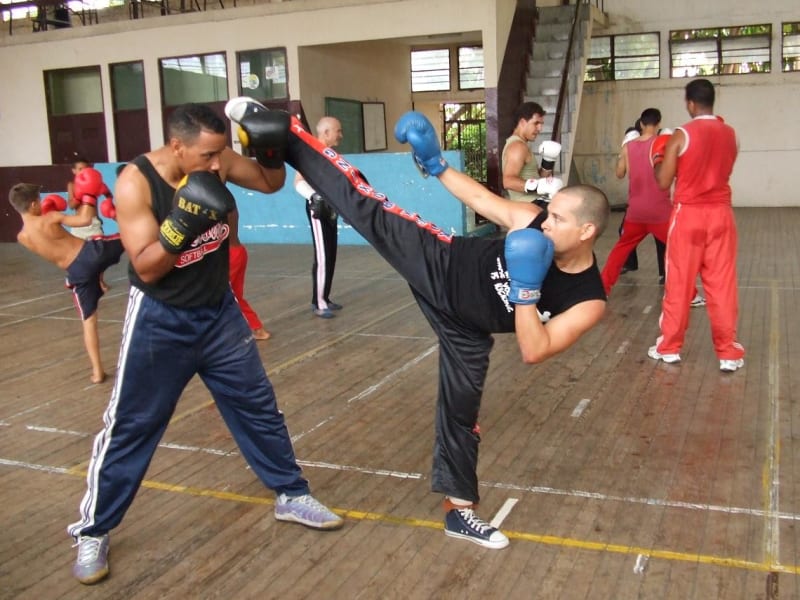
Savate (also: Boxe Française, “French Boxing”) is Europe’s only indigenous martial art using kicks as its primary combat method — and exclusively with the foot, never with knee or shin. Born in the harbor districts and poor neighborhoods of Marseille in the 18th century, where sailors returning from voyages to the Indian Ocean and Chinese Seas developed their own strike-kick combination, Savate was refined into an elegant sport by two key figures: Michel Casseux opened the first Savate school in Paris in 1825, Charles Lecour synthesized it with English boxing in 1838 to create modern Savate. The result: a combat system combining precise footwork, long kicks, and elegant English boxing — with a grading system using colored leather gloves (Gants). In the 19th century, Savate was the preferred combat system of the French aristocracy and military.
History
Chausson — The Harbor Art (18th century)
Savate arose from Chausson (named after the light shoes of sailors) — a fighting style developed by Marseille sailors after witnessing martial arts during voyages to the Indian Ocean and Southeast Asia. Chausson combined kicks (at a time when European street fighting was almost exclusively with fists or sticks) with simple striking.
In the slums and harbor districts of Marseille and later Paris, Chausson spread as self-defense of the lower classes — Savate (literally: old shoe) was initially a derogatory term for this crude street-fighting technique.
Michel Casseux and Institutionalization (1825)
Michel Casseux (1794–1869), known as “le Pisseux,” opened the first establishment for regulated Chausson and Savate practice in Paris in 1825. He was the first to lift the art from its street context into a regulated training framework.
Charles Lecour and the Synthesis (1838)
Charles Lecour (1808–1894) was the decisive reformer. In 1838 he witnessed a boxing match between English pugilists Owen Swift and Jack Adams — and recognized the superiority of English fist boxing over contemporary French hand techniques. He integrated English boxing into Savate and created modern Savate: boxing gloves, regulated hand techniques, and precise footwork in synthesis.
The name “Boxe Française” (French Boxing) emerged in this phase to distinguish the art from English boxing.
Technical Foundations
Savate’s fundamental principle: only the foot strikes — knees and shins are forbidden (unlike Muay Thai). All kicks are executed with the instep or sole.
| Kick | Term | Description |
|---|---|---|
| Fouetté | Whip kick | Rotating kick with the instep — Savate’s most characteristic kick |
| Chassé | Side push kick | Straight pushing force with the sole |
| Coup de Pied Bas | Low kick | Kick against opponent’s knee or shin |
| Revers | Hook-like kick | Reversed angle, surprising |
| Frontal | Front kick | Straight front kick with sole |
Boxing hand techniques: Direct (straight punch) · Crochet (hook) · Uppercut
Philosophy
Savate has an explicitly aesthetic dimension: in the 19th century it was the martial art of elegance — aristocrats and artists (Alexandre Dumas the writer reportedly trained Savate) appreciated the sporting refinement.
The grading system shows this distinctive quality: one competes with colored Gants (gloves):
- Blue → Green → Red → White → Silver → Gold (master level)
Disciplines
| Discipline | Description |
|---|---|
| Assaut | Controlled technique, points without force — sport form |
| Combat | Full power contact, competition |
| Canne de Combat | Staff fighting (La Canne) — often part of Savate curriculum |
| Défense | Self-defense applications |
Connections to Other Martial Arts
- Muay Thai — both are kick-striking systems; Muay Thai allows knees and elbows, Savate does not; Savate uses shoes, Muay Thai uses legs
- English boxing — Charles Lecour integrated English boxing principles; Savate hand techniques derive directly from English boxing
- La Canne — staff fighting, traditionally part of Savate training
Today
Savate is practiced in clubs worldwide and has international competitions (WSAF — World Savate Federation). In France it has been a fixture of the martial arts scene since the 19th century.
Related Articles
Verwandte Artikel