Taekwondo Kicking Techniques — Biomechanics, Classification and Training
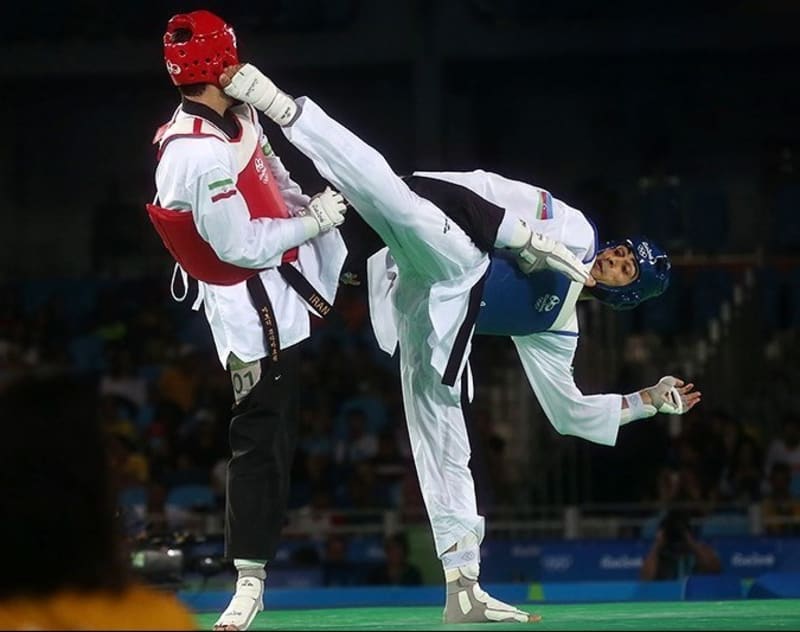
Taekwondo possesses the most complex leg-fighting system of any martial art — grounded in Choi Hong Hi's encyclopedia and modern biomechanical research.
Contents
- Overview
- The ITF Classification System
- The Sine Wave Principle
- Ap Chagi — The Front Kick
- Naeryeo Chagi — The Axe Kick
- Dwi Chagi — The Back Kick
- Dollyo Chagi — The Roundhouse Kick
- Training System per Choi’s Encyclopedia
- Common Errors and Their Causes
- Connections to Modern Sports Science
- Further Reading
- Related Articles
Overview
No combat system in the world has developed, classified, and grounded kicking techniques on a philosophical basis as systematically as Taekwondo. General Choi Hong Hi, founder of ITF Taekwondo, wrote in his 15-volume “Encyclopedia of Taekwon-Do” (1983) the most comprehensive technical manual ever produced for a martial art. The condensed single-volume version (Condensed Encyclopedia, 1999, approx. 770 pages) remains the official reference of the International Taekwon-Do Federation.
Choi’s system rests on a premise drawn from classical physics: “The force of a strike or kick is proportional to mass multiplied by the square of velocity” (F = ½mv²). Technical refinement generates more force than raw muscle — that is the theoretical core of the entire Taekwondo system.
This article deconstructs the most important kicking techniques at the biomechanical level and explains why certain mechanisms work — and which training principles are necessary to develop them.
The ITF Classification System
Choi Hong Hi classifies kicking techniques according to five fundamental principles of leg motion:
| Class | Korean | Direction | Main Example |
|---|---|---|---|
| Straight | Ap Chagi | Linear (forward) | Front kick |
| Sideward | Yop Chagi | Linear (sideward) | Side kick |
| Circular | Dollyo Chagi | Arc (horizontal) | Roundhouse kick |
| Downward | Naeryeo Chagi | Arc (vertical, downward) | Axe kick |
| Backward/Spinning | Dwi/Bandae | Rotation + linear/arc | Back kick, spinning heel kick |
These five classes produce over 30 distinct kicking techniques through variations and combinations in the ITF system.
The Sine Wave Principle
ITF Taekwondo distinguishes itself from WTF/WT style through the Sine Wave Principle (Sine Wave Motion), introduced by Choi Hong Hi in the 1980s as a central concept. It describes a rhythmic up-down movement of the body’s center of gravity that, combined with breath control, generates maximum force.
The Mechanism
The sine wave follows three phases:
- Rising — slight elevation of the body’s center (leg unloading, preparation)
- Sinking — body drops through (dropping), gravity amplifies striking force
- Rising — closing impulse through extension
The principle leverages ground reaction force (Newton’s 3rd Law): the ground pushes back. A practitioner who drops their body weight in a controlled manner and actively incorporates the floor generates more total impulse than a statically executed kick.
Criticism and Context
The sine wave principle is contested within the Taekwondo world. WT athletes and many self-defense practitioners argue that the vertical movement telegraphs and restricts mobility in competition. Choi’s counter-argument: the principle is optimized for maximum force, not sport speed. For self-defense and patterns (Tul), force generation matters more than surprise.
Ap Chagi — The Front Kick
The Ap Chagi (“forward kicking”) is the most fundamental kick and the foundation for all linear kicking techniques.
Execution
- Knee raise: The knee is explosively raised to hip height or above — energy comes from the hip flexors (iliopsoas), not the thigh
- Extension: The knee extends; toes pulled back (ball of foot strikes)
- Rechamber: The leg is drawn back in a controlled manner before setting down — prevents grabbing and enables follow-up combinations
Biomechanical Keys
- Hip flexor speed: The fastest Ap Chagi comes from explosive iliopsoas contraction, not thigh strength. This explains why hip flexor flexibility is more critical than pure leg muscle.
- Ball vs. toes: ITF standard is the ball of the foot (Ap Koomp). This reduces the impact surface to approx. 5 cm², multiplying pressure force (force/area).
- Knee safety: The knee joint at full extension is injury-prone. Choi’s encyclopedia states explicitly: “Never extend the knee beyond its natural endpoint.”
Naeryeo Chagi — The Axe Kick
The Naeryeo Chagi (“downward striking”, Axe Kick or Hammer Kick) is one of the technically most demanding kicking techniques and the subject of several biomechanical studies.
Characteristics
Renato Fraga Moreira and colleagues describe the axe kick in their 2015 analysis (Journal of Physical Education and Sport) as a “whip-axe movement”: the leg is driven upward like a whip, then struck downward with the gravity-assisted force of a falling axe.
Execution (ITF Standard per Choi)
- Outer arc rise: The leg is led in a wide arc from inside to outside (like a reverse outside crescent kick) to maximum height — with full flexibility above head height
- Plateau: Brief holding or slowing at the highest point (control moment)
- Strike: The entire leg is actively struck downward — not simply dropped. The heel (Dwit Koomp) or sole strikes
Biomechanics in Detail
The force of the axe kick derives from:
- Gravity: The weight of the entire leg (10–15% of body weight) falls downward
- Muscle contraction: Hip flexors and quadriceps actively accelerate
- Lever arm: The higher the arc, the longer the acceleration path
Biomechanical measurements show peak forces of 300–500 N for trained ITF athletes at normal execution. On impacts to the shoulder or collarbone — classic targets of Naeryeo Chagi — energy is concentrated on a small area, enabling bone fractures.
Flexibility requirement: Hamstring flexibility is the absolute limiting factor for the axe kick. An athlete who cannot stretch their hip extensors beyond 120° will never develop the kick to full effect. Static stretching alone is insufficient: PNF stretching (proprioceptive neuromuscular facilitation) and dynamic ballistic exercises are more effective for combat-specific range of motion.
Dwi Chagi — The Back Kick
The Dwi Chagi (“backward kicking”, Back Kick) is biomechanically the most powerful kick in the Taekwondo repertoire.
Why the Back Kick Is the Strongest Kick
The rear view of the body uses the strongest muscle chain: gluteus maximus + posterior thigh (hamstrings). Unlike the roundhouse (using hip abductors) or front kick (hip flexors + quadriceps), the back kick can deploy the entire extensor chain of the body in one line.
Execution Detail per Choi
- Look back: Glance over the shoulder (eyes find the target before the kick starts)
- Knee raise: Knee is drawn to chest
- Drive: Ankle extends and heel is driven backward — the hip rotates through and assists
Choi’s encyclopedia emphasizes: “The body must fly like an arrow with the back kick — leg, hip, and shoulder in one line.” Any deviation from this line costs force.
Dollyo Chagi — The Roundhouse Kick
The Dollyo Chagi (“circular kicking”) is the most versatile and in competition most frequently used kick.
Two Variants
ITF variant: The foot strikes with the ball of the foot (Ap Koomp), knee stays chambered. The kick is more linear, more direct.
WT variant (competition): The instep (Bal Deung) strikes. The leg is more extended, offering more surface for helmet contacts. This variant is faster but less penetrating.
Biomechanics: The Key Lies in the Hip
The Dollyo Chagi generates its force not primarily from leg movement but from hip rotation. Studies measure hip rotation speed as the primary predictor of kicking force in the roundhouse. An athlete with slow hip rotation and strong legs is weaker than an athlete with fast hip rotation and moderate leg strength.
Training implication: Core rotation is more important than leg extensor strength. Medicine ball rotation exercises and explosive hip turns are more effective than pure leg pressing.
Training System per Choi’s Encyclopedia
Choi describes five training principles applicable to all kicking techniques:
1. Flexibility Training
The foundation. Without flexibility, kicks cannot develop their full range and force. Choi recommends daily stretching occupying 20–30% of training time.
2. Speed Training
Swing kicks without resistance — emphasis on the acceleration phase. Speed first, then force. Wrong order produces a slow, powerless kick.
3. Knee Control
All kicks begin with the knee raise. The moment of knee raising determines direction and force. Choi: “The knee is the source of the kick, not the foot.”
4. Power Development
Heavy bag, partner pads. Only once technique and speed are established is force explicitly trained.
5. Combination Practice
Individual kicks are rare. Mastery shows in combinations: 3, 4, 5-kick series where each kick flows from the rechamber of the previous.
Common Errors and Their Causes
| Error | Cause | Correction |
|---|---|---|
| No rechamber | Insufficient hip flexor control | Slow technical repetitions |
| Kick goes downward instead of forward | Shoulder tips backward | Consciously maintain upright posture |
| No force despite good technique | Missing hip rotation | Isolated hip rotation training |
| Knee pain during axe kick | Hamstrings too tight | 6-week PNF stretching program before axe kick training |
| Loss of balance after kick | Standing leg instability | Daily single-leg balance exercises |
Connections to Modern Sports Science
Biomechanical research on Taekwondo kicks has intensified over the past 20 years. Key findings:
- Maximum kick velocity in experienced athletes: 15–20 m/s for the ball of the foot in roundhouse (measured)
- Peak force for axe kick: up to 680 N in competition athletes (Moreira et al., 2015)
- Muscle activation sequence in Dollyo Chagi: hip flexors → iliopsoas → quadriceps → tibialis anterior (EMG studies, Kim & Lee, 2011)
- Sine wave effect: A biomechanical study at Seoul National University (2018) measures 12–17% more impulse with sine wave execution vs. flat technique — but at 8–15% slower execution time
Further Reading
- Choi Hong Hi: ITF Taekwon-Do Condensed Encyclopedia — the official reference, indispensable for any serious ITF practitioner
- Kyu Hyung Lee / Sang H. Kim: Complete Taekwondo Poomsae — deep technical analysis of patterns and their kicking applications
- Doug Cook: Taekwondo: Ancient Wisdom for the Modern Warrior — connects technical depth with philosophical context
- Moreira et al.: Biomechanics of the Taekwondo Axe Kick: A Review (2015) — scientific primary source
Related Articles
- Taekwondo
- Choi Hong Hi
- Muay Thai
- Hapkido
- Kicking Programme — the striking surface decides the risk, not just the reach
Further Reading
As an Amazon Associate I earn from qualifying purchases. This costs you nothing extra.