Escrima / Arnis / Kali — The Filipino Weapon Art
Escrima is the Filipino martial art of stick, blade, and empty hand — the first martial art to prove fatal to a European conqueror (Magellan) in documented history.
Contents
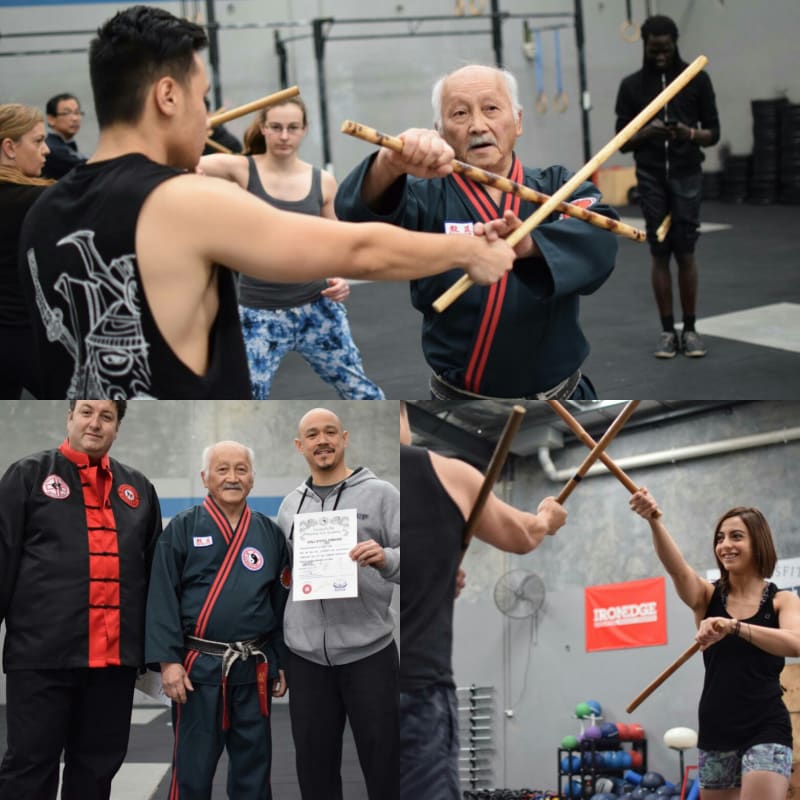
Escrima (also: Arnis, Kali) is the combat system of the Philippines — a weapon art of stick, blade, and empty hand developed over centuries across the Philippine archipelago. Escrima is the first Asian martial art to prove fatal to a European conqueror in documented history: on April 27, 1521, Filipino warriors under Datu Lapu-Lapu killed the explorer Ferdinand Magellan using sticks and blades — ending his circumnavigation of the globe. This encounter is Escrima’s historical debut on the world stage. The Philippine system’s defining characteristic: training begins with weapons, not empty hand — because a blade or stick extends reach and is more realistic in an actual conflict than bare fists. Empty-hand techniques are introduced later, derived from weapon movement.
History
Pre-Colonial Era
Escrima as a combat system existed long before European colonization. Filipino communities in the 14th century and earlier developed sophisticated combat techniques from locally available materials — rattan sticks, bamboo, blades — for tribal conflicts, defense, and warfare.
Magellan and Lapu-Lapu (1521)
The historically most significant encounter: Magellan landed on Mactan Island and was drawn into local conflict. Datu Lapu-Lapu refused submission to Spanish authority. In the battle of April 27, 1521, Magellan’s men were overwhelmed by Filipino warriors using sticks, spears, and blades — Magellan himself fell in combat.
Lapu-Lapu is today a national hero of the Philippines. The battle is the earliest documented proof of Filipino martial arts effectiveness.
Colonial Era — Suppression and Concealment
Spanish colonizers banned Escrima multiple times (1596, 1764) — they recognized that Escrima masters led uprisings. The art survived underground and concealed in religious ceremonial dances (Sinawali) and Moro-Moro theater pieces depicting fights between Christians and Muslims. Combat techniques were hidden in the choreography — similar to Capoeira in Brazil.
Modern Revival
In the 20th century, Arnis/Escrima experienced a renaissance. Grand Master Antonio Ilustrisimo (1904–1997) and other grandmasters systematized the art and brought it international attention. Arnis became the Philippines’ national martial art and sport in 2009.
Technical Foundations
Escrima teaches across three fighting ranges:
| Range | Term | Technique |
|---|---|---|
| Long range | Largo Mano | Sticks and blades at distance |
| Medium range | Medio | Quick strikes and counters |
| Close range | Corto | Joint locks, disarming, body contact |
The system is weapon-transferable: what one learns with the stick works with the blade, knife, or empty hand — the movement geometry remains the same. That is why Escrima training begins with the stick.
Core Techniques
12 Attack Zones (Angles of Attack): Escrima classifies attacks by their direction — not by weapon or technique. Every attack from Zone 1 (e.g. diagonal from upper right) is defended with the same pattern, regardless of whether a stick, blade, or fist comes.
Sinawali — double-stick exercises: two sticks simultaneously in weaving patterns — coordination and reflex training.
Defanging the Snake — disarming principle: attack the opponent’s weapon/hand before attacking the body.
Trapping and Clinch: In close range, joint locks, throws, and disarming are combined.
Philosophy
Escrima has no formalized philosophy system like Japanese Budo arts — it is pragmatic and community-oriented. The art was created for real combat situations, not for competition or spiritual cultivation. The core principle: adaptability — the same movements work with any weapon and without weapons.
“Show me your empty hand, and I’ll show you what the stick does. Show me your stick, and I’ll show you the empty hand behind it.” — Escrima saying
Regional Names and Variants
| Name | Region | Style |
|---|---|---|
| Arnis | Luzon | Formal name, nationally recognized |
| Eskrima | Visayas | More combat-focused |
| Kali | Mindanao / Western | Comprehensive term in the West |
| Sayoc Kali | — | Blade system, highly precise |
| Pekiti-Tirsia | — | Complete system, militarily oriented |
| Balintawak | Cebu | Short-stick specialization |
Connections to Other Martial Arts
- Silat — Southeast Asian neighboring art; many technical similarities through shared trade routes and cultural exchange
- Kenjutsu — both are primary weapon arts using steel or wood; Escrima sticks simulate blades
- Jiu-Jitsu / Jujutsu — Escrima close-range has joint locks and throws similar to Jujutsu
Today
Arnis was declared the Philippines’ national sport in 2009. Escrima/Kali is present worldwide in the martial arts and self-defense scene — particularly in police and military training (US Marines, FBI) as a knife-defense system.
In the MMA scene, Filipino Kali is frequently used for blade-combat simulation and reaction training.
Related Articles
- Kenjutsu
- Ninjutsu
- Sōjutsu
- Budo
- Stick Fighting in Eight Systems — stick techniques that are really blade techniques
- Maai — largo, medio, corto — the same question, a different answer
- Stick Fighting Programme — fundamentals across eight systems; its distance work comes from escrima
- Dumog — Filipino wrestling, the grappling side of the same tradition
- Jogo do Pau — the opposite pole: short and a blade substitute instead of long and a weapon in itself