Baguazhang — The Eight Trigram Palms
Baguazhang is the circular internal Chinese martial art — founded by Dong Haichuan, built on eight trigrams and the continuous practice of walking the circle.
Lineage
Origins
Contents
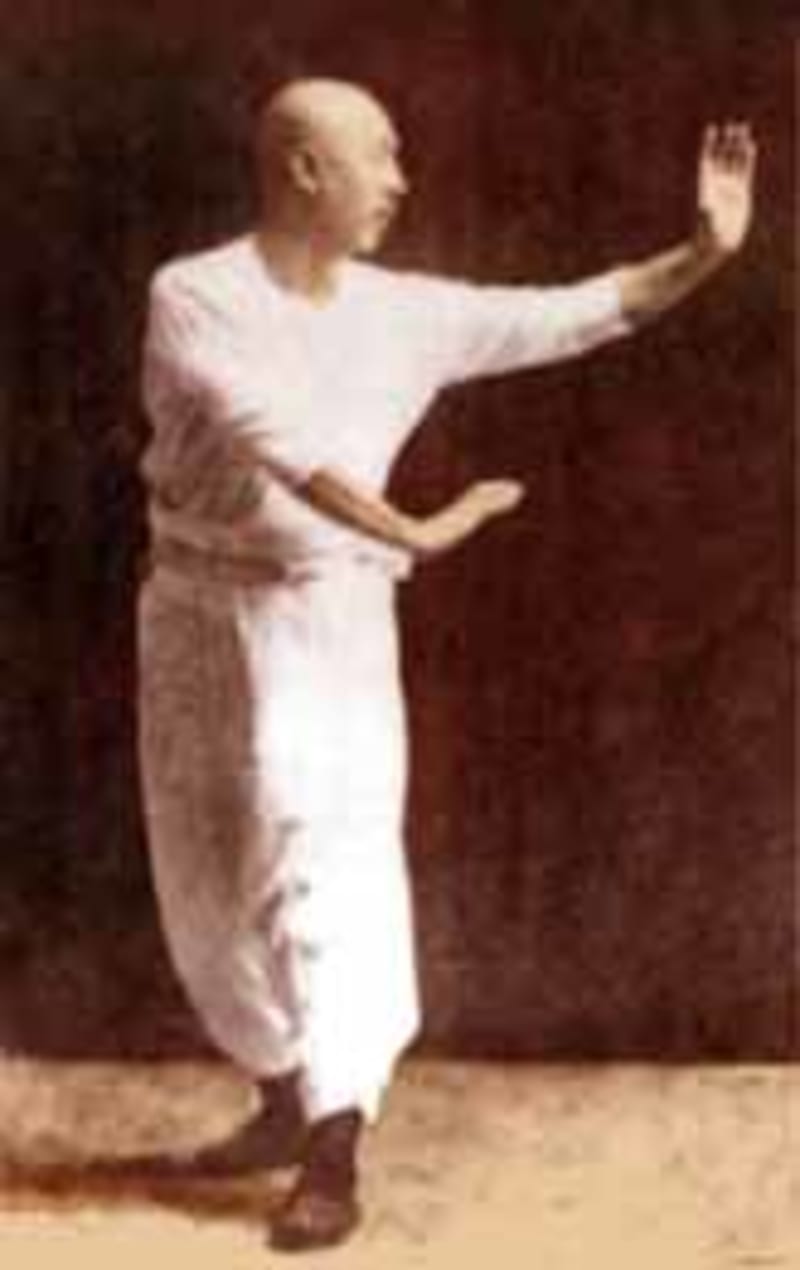
Baguazhang (八卦掌, “Eight Trigram Palms”) is the third of the classical internal Chinese martial arts — alongside Xingyiquan and Taijiquan. Its unmistakable hallmark: practitioners move constantly around a circle, shifting direction and posture, executing palm techniques in continuous flow. No static root stance, no holding position — Baguazhang is movement as principle. The name refers to the Bagua (八卦), the eight trigrams of the I Ching: each combat form corresponds to a cosmic fundamental principle. The art was synthesized in the mid-19th century by Dong Haichuan from Taoist circle meditation and martial experience. His students developed independent schools from it that have worldwide presence today. Baguazhang is considered the most technically complex of the three internal systems: its movement quality — spiral, coiled, unpredictable — distinguishes it fundamentally from Xingyiquan’s linearity and Taijiquan’s slowness.
History and Founders
Dong Haichuan (董海川, 1797–1882) is universally credited as the founder of Baguazhang. Already experienced in conventional martial arts growing up in Hebei Province, he encountered Taoist and Buddhist masters in the mountains during his wandering years. From the synthesis of Taoist circle meditation (Zhuan Zhang — “Turning Palms”) and his martial practice, a radically new system emerged.
Dong Haichuan entered the service of Qing Prince Su in Beijing and became court instructor. He initially taught in great secrecy. When his martial art was discovered, he was compelled to demonstrate publicly — and convinced the court with extraordinary skill.
Among Dong’s many students, two dynastic main lineages emerged:
Yin Fu (尹福, 1840–1909) — his first student, known for “threading” palm techniques. Founder of Yin Style. Yin Fu served as bodyguard to Empress Dowager Cixi.
Cheng Tinghua (程廷華, 1848–1900) — founder of Cheng Style, known for “pushing” palms and spiral force. Cheng Tinghua died in 1900 during the Boxer Uprising, fighting German soldiers — legend holds he fought bare-handed against bayonets.
Technical Foundations
The heart of Baguazhang is circle walking (走圈, Zoūquān): the practitioner walks continuously around an imagined or marked circle, shoulders turned toward the center, hands in palm position. All techniques emerge from this foundational movement — the circle is training, combat strategy, and meditation simultaneously.
| Concept | Meaning |
|---|---|
| Zou Quan (走圈) | Circle walking — fundamental exercise |
| Kou Bu / Bai Bu | Crossing and opening steps in circle walk |
| Ning (拧) | Spiral force — body coiling as power source |
| Zhuan (转) | Rotation — direction change as combat tactic |
| Zhang (掌) | Palm — primary weapon, not the fist |
The Eight Palms
The Ba Da Zhang (八大掌) are the eight fundamental palm forms corresponding to the eight I Ching trigrams:
| Trigram | Symbol | Quality | Palm Form |
|---|---|---|---|
| Qian | ☰ | Heaven | Singing palm |
| Kun | ☷ | Earth | Pressing palm |
| Zhen | ☳ | Thunder | Striking palm |
| Xun | ☴ | Wind | Drilling palm |
| Kan | ☵ | Water | Overturning palm |
| Li | ☲ | Fire | Withdrawing palm |
| Gen | ☶ | Mountain | Supporting palm |
| Dui | ☱ | Lake | Entering palm |
Core Techniques
Spiral force (Chan Si Jin) permeates all movements: power is not released linearly but in screwed rotation from body coiling.
Mudang Bu (泥塘步) — Mud-wading step: the characteristic low walking posture, as though wading through viscous water. Trains balance and ground connection.
Palm-change techniques (換掌法): lightning-fast change of direction and palm position — the core tactical principle in actual combat.
Weapon techniques: Baguazhang is known for its sword practice (Bagua Jian) and for the distinctive Deerhorn Knives (Lu Jiao Dao) — an unusual double weapon that perfectly complements the circular movement.
Philosophy
Baguazhang is Taoist philosophy in motion. The Eight Trigrams (Bagua) represent the fundamental principles of change in the universe — Baguazhang embodies this change through constant movement.
The principle of transformation: no point on the circle is fixed, no attack remains unchanged. The Baguazhang fighter adapts like water — having no fixed form, taking the form of the moment.
“In Baguazhang there is no straight line. Only circles, spirals, and eternal change.” — Cheng school teaching tradition
The three inner harmonies (as in all Neijia): Heart-Mind, Mind-Qi, Qi-Strength — must be continuously cultivated during circle walking.
Styles and Schools
| Style | Founder | Distinctive Feature |
|---|---|---|
| Yin Style | Yin Fu | Threading palms, linear, precise |
| Cheng Style | Cheng Tinghua | Pushing palms, spiral, most widespread |
| Liu Style | Liu Dekuan | Pushing palms, connected with Xingyiquan |
| Liang Style | Liang Zhenpu | Own forms, fully documented |
| Fu Style | Fu Zhensong | Synthesizes Bagua, Tai Chi, and Xingyi |
Connections to Other Martial Arts
- Xingyiquan — the linear internal system; many masters learned both. Dong Haichuan’s students Cheng Tinghua and Li Cunyi combined Bagua and Xingyi into “Poor Man’s Style” (Wu Tan)
- Taijiquan — the slow, soft internal system; all three form the Neijia trio
- Kung Fu / Wushu — Baguazhang belongs to the Wudang tradition (internal school), not the Shaolin tradition (external school)
- Kenjutsu — parallel development: both emphasize circular movement, entering (Irimi), and adaptability
Today
Baguazhang is practiced worldwide but is considerably smaller than Taijiquan. In China it is protected as National Intangible Cultural Heritage. The Cheng Style is most widespread; the Yin Style continues in small, exclusive lineages.
The Deerhorn Knives are a unique visual symbol of the art and appear regularly in Wushu demonstrations.
Criticism: As with all internal martial arts, there are debates about combat effectiveness in modern contexts. Circle walking is difficult to reproduce in real fights. Proponents argue that Baguazhang primarily trains principles — direction change, surprise, spiral force — rather than direct techniques.
Related Articles
- Xingyiquan
- Kung Fu & Wushu
- Ki, Chi & Prana
- Budo
- Wudang — the trio of internal styles — and who grouped them together
- Liuhebafa — shared circling footwork, a different way of carrying power
- Footwork Compared — where the crossover step is not permitted but is the art itself