Wing Chun — The Martial Art of the Straight Line
Wing Chun is the southern Chinese martial art of the direct line — developed by a nun for a woman, brought to world prominence by Ip Man, immortalized by Bruce Lee.
Lineage
Contents
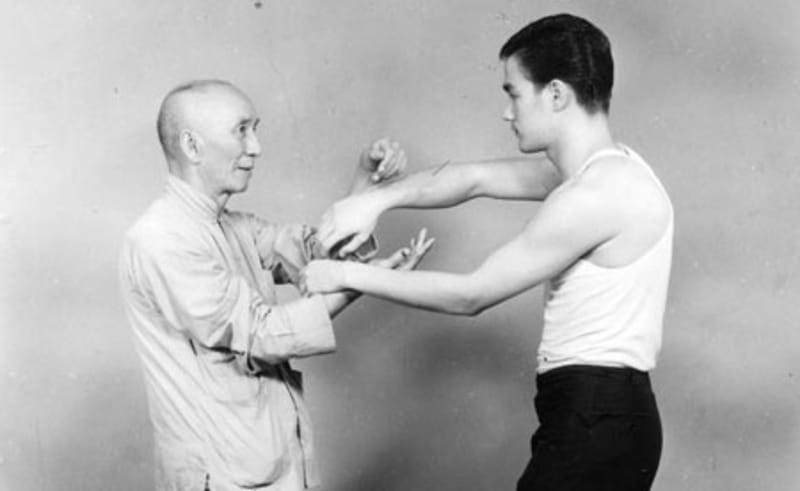
Wing Chun (詠春, “eternal spring”) is a southern Chinese martial art renowned for its efficiency in close-range combat and the principle of the straight line. The core principle: the shortest path between two points is a straight line — and Wing Chun fights along that line. No wide swinging movements, no theatrical kicks — instead: chain punches to the centerline, simultaneous attack and defense, tactile sensitivity through Chi Sao (sticky hand training). Wing Chun is the only major Chinese martial art traditionally associated with a female founder — and was designed with the smallest, weakest person in mind. Ip Man (1893–1972) made Wing Chun world-famous when he brought it from China’s Guangdong Province to Hong Kong in 1949. His most famous student: Bruce Lee, who integrated Wing Chun principles into his Jeet Kune Do.
History and Founders
The Legend of Ng Mui and Yim Wing Chun
According to tradition, Ng Mui (五枚) was a Shaolin nun who fled after the Qing forces destroyed the Shaolin Temple. In the seclusion of the White Crane Temple she developed a new, more efficient system from Snake and Crane Shaolin Kung Fu styles — one that replaced physical strength with principle.
She taught the system to her student Yim Wing Chun (詠春), who used it to fend off an unwanted suitor. The style was named after her.
This story is not historically verifiable — the oldest evidence of this tradition dates to the 1960s. The actual origins of Wing Chun are obscured in late imperial Chinese history.
Ip Man — the Historical Turning Point
Ip Man (葉問, 1893–1972) from Foshan, Guangdong is the historically established key figure. From a wealthy family, he studied Wing Chun under Chan Wah-shun and later under Chan Wah-shun’s earlier student Leung Bik in Hong Kong.
After the communist takeover in 1949, Ip Man fled to Hong Kong and began teaching Wing Chun publicly — the first time in history Wing Chun was systematically transmitted outside a family lineage.
His student Bruce Lee (1940–1973) studied Wing Chun in the 1950s before moving to the United States and developing Jeet Kune Do — with Wing Chun principles as its foundation.
Technical Foundations
Wing Chun is based on a few fundamental concepts, applied consistently:
| Concept | Term | Meaning |
|---|---|---|
| Centerline | Centerline | Imaginary line from chin to groin — attack and defense concentrated here |
| Simultaneity | Lin Siu Dai Da | Simultaneous attacking and defending |
| Economy | Jik Chung Kuen | Shortest path, minimal effort |
| Structure | Fook Sau | Bridge-arm control |
| Sensitivity | Chi Sao (黐手) | Sticky hand training — tactile sensing |
The Three Forms
Wing Chun traditionally teaches three hand forms and two weapons techniques:
Siu Nim Tau (小念頭, “Little Idea”) — the first form: stances, arm techniques, structure. Practiced standing and nearly motionless — pure structural training.
Chum Kiu (尋橋, “Seeking the Bridge”) — the second form: movement, rotation, bridging the distance to the opponent.
Biu Tze (鏢指, “Shooting Fingers”) — the third, secret form: emergency measures when structure has broken down; finger techniques, vital point attacks.
Mook Jong (木人樁) — wooden dummy: training against fixed arms and legs to develop force and accuracy.
Bat Cham Dao and Lok Dim Boon Kwan — butterfly knives and long pole: weapon techniques.
Chi Sao — The Heart of the System
Chi Sao (黐手, “sticky hand training”) is Wing Chun’s central partner training. Two practitioners touch with forearms in contact and practice sensing the opponent’s intentions through tactile feeling, responding immediately — without visual information.
Chi Sao trains: sensitivity, structure under pressure, reflexive response, and integration of all Wing Chun techniques in living context.
Philosophy
Wing Chun teaches efficiency as ethics: every superfluous movement is waste. Replace strength from body structure, not from muscles. The system was designed for smaller, weaker people — and works only when principles are applied more consistently than force.
“Don’t study styles. Study principles.” — attributed to Ip Man; no source for it can be found
Styles and Schools
| Style | Lineage | Distinctive Feature |
|---|---|---|
| Ip Man Wing Chun | Ip Man | Most widely spread lineage |
| Yuen Kay-san | Yuen Kay-san | Foshan lineage, richer toolset |
| Pan Nam | Pan Nam | Conservative Foshan lineage |
| Pao Fa Lien | — | Hong Kong lineage with variations |
Connections to Other Martial Arts
- Shaolin Kung Fu — legendarily born from Shaolin; Snake and Crane styles as precursors
- Jeet Kune Do (Bruce Lee) — Wing Chun was Lee’s first foundation; he expanded and modified it
- Tanglangquan — also close-range focused, but with entirely different tools (hooks vs. straight punches)
Today
Wing Chun is one of the world’s most popular martial arts globally — especially known through the Ip Man film series (with Donnie Yen). Ip Man’s school in Foshan is now a museum and place of pilgrimage. The art is taught in thousands of schools but has no unified competition format.
Criticism: In MMA contexts, Wing Chun has performed poorly multiple times. Practitioners argue the art was developed for street self-defense, not competition. The “traditional martial arts vs. MMA” debate has hit Wing Chun particularly hard.
Related Articles
- Kung Fu & Wushu
- Tanglangquan
- Budo
- The Fist — Hikite Versus the Boxing Guard — the centreline next to four other answers
- Nanquan — why “southern fist, northern leg” does not hold up as an explanation
- Bak Mei — close range taken further still — to forearm length
- Ip Man — the teacher through whom the style travelled from Foshan to Hong Kong and beyond
- Hand Position Programme — there, occupying a line appears as the third job of the hand, beside gripping and covering