Bartitsu — the Synthesis Lasted Three Years, Its Parts a Century
The earliest documented attempt at mixed martial arts, London 1898. The synthesis lasted three years, its components a century.
Lineage
Contents
Bartitsu is the earliest documented attempt to combine several fighting systems deliberately into one. The English engineer Edward William Barton-Wright (1860–1951) announced it in London in 1898 after some three years in Japan; the name is a portmanteau of Barton and jujitsu. The associated club existed from about 1900 to 1903.
That places the matter roughly a century before what is generally taken to be the beginning of MMA — which on its own would be worth a note. Something else is more interesting, and it is this article’s argument: it was not the synthesis that survived, but its components. The club closed after about three years; the teachers Barton-Wright had brought over from Japan and Switzerland shaped European combat sport for decades afterwards. What was inherited was not the mixture but the transmission.
And a postscript too good to leave out: the name is known today mainly through a misspelling in a Sherlock Holmes story.
What Barton-Wright actually proposed
Between 1899 and 1901 he published a series of articles in Pearson’s Magazine under the title “The New Art of Self Defence”. His own definition of Bartitsu was self defence in all its forms — and that is precisely where the matter goes beyond a mere blend of styles.
The components are named and checkable:
| Component | Origin |
|---|---|
| Jūjutsu | the Shinden Fudō-ryū of Terajima Kuniichirō |
| Judo | the Kōdōkan |
| Boxing | British |
| Savate | French |
| Stick fighting (la canne) | the method of the Swiss Pierre Vigny |
The thought behind it is the one every MMA coach would formulate a century later: a fight passes through different ranges, and a system covering only one of them has nothing to offer in the rest. Barton-Wright was an engineer, not the student of a lineage — he approached the matter the way one designs a device, from assemblies with defined functions.
The club, and who taught there
The Bartitsu Academy of Arms and Physical Culture — the Bartitsu Club for short — stood at 67b Shaftesbury Avenue in Soho. Its staff is the real treasure of this story:
- Yukio Tani, nineteen years old on arrival, and Sadakazu Uyenishi for jūjutsu. Kaneo Tani and Seizō Yamamoto came at first as well but soon returned to Japan.
- Pierre Vigny, Swiss master-at-arms, for stick and savate.
- Armand Cherpillod, Swiss wrestler.
The most remarkable circumstance is usually skimmed over: Barton-Wright recruited the Japanese teachers through correspondence with Kanō Jigorō, the founder of judo. The West’s first mixed-fighting club was therefore staffed with Kōdōkan help — four years before Kanō sent his representative Maeda overseas.
Why it failed
The club’s last documented activities are touring demonstrations and contests between January and March 1902 — at Cambridge University, Oxford Town Hall and the Mechanics Institute Hall in Nottingham among others. By 1903 the club had closed.
For the reason there is no statement from the proprietor, only a later conjecture, and it should be labelled as such: that the enrolment and tuition fees were too high. That is plausible — Barton-Wright aimed at a wealthy London clientele — but it is an assumption, not a source.
What can be said without speculating: a synthesis costs more than its parts. Anyone offering five systems needs five teachers, and each of them can cover the same rent more cheaply alone. That is exactly what happened next.
What remained: the teachers
The club was finished; the people were not. And here the argument becomes checkable:
- Yukio Tani stayed in Britain and, through challenge matches on music-hall stages, became one of the best-known figures of early British jūjutsu.
- Sadakazu Uyenishi taught at his own dojo in Golden Square and published a textbook in 1905. In 1908 he returned to Japan.
- Pierre Vigny carried his stick method forward; it is the best-documented part of the whole complex.
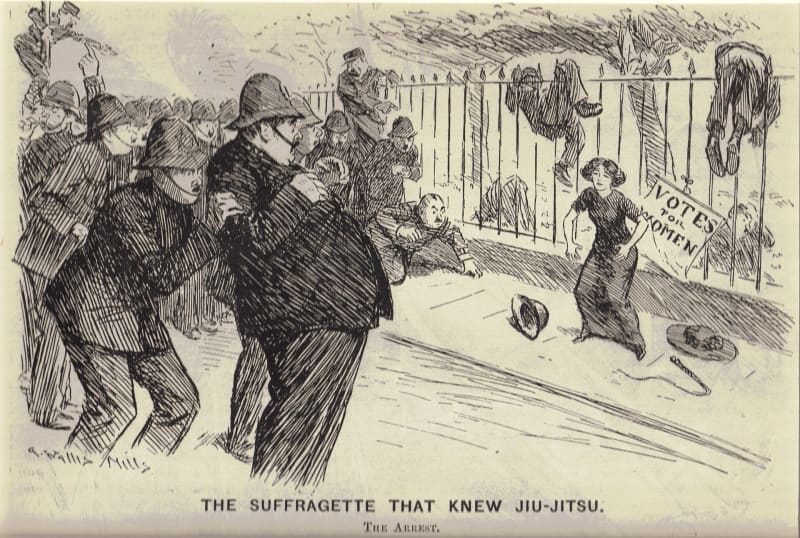
The strand that reaches furthest runs through two names that appeared in no Bartitsu advertisement. Edith Garrud (1872–1971) began training in 1899, together with her husband William, under Uyenishi and Tani. When Uyenishi went back to Japan in 1908, the Garruds took over his Golden Square dojo. Edith Garrud thereby became the first British woman to teach jūjutsu and one of the first female martial arts instructors in the Western world at all.
In 1909 she demonstrated jūjutsu at the WSPU’s “Women’s Exhibition”, then established a twice-weekly self-defence class exclusively for WSPU members — advertised in their paper Votes for Women — and finally trained Emmeline Pankhurst’s Bodyguard.
That both proves the argument and sharpens it: the Bartitsu Club’s most prominent descendant is not a martial art but a political movement. Nothing remains of the programme Barton-Wright wanted to sell; from the teachers he recruited there runs a straight line to the women who in 1913 shielded Pankhurst from the police.
The name survived through a typing error
In 1903, the same year the club closed, Arthur Conan Doyle’s story The Adventure of the Empty House appeared. In it Sherlock Holmes explains that he overcame Moriarty at the Reichenbach Falls with “baritsu” — the name minus its first t.
That single misspelt line has done more for the subject’s fame than the club managed in its entire operating life. It is to this day the reason most people know the word at all, and it shapes the rediscovery too: the documentary that introduced the movement to a wider audience is called Bartitsu: The Lost Martial Art of Sherlock Holmes.
That is more than an anecdote. It is a cleanly documented case of how martial arts knowledge is actually passed on — not always through lineages and teaching licences, but sometimes through popular culture, and in this instance through a spelling variant in a detective story.
The rediscovery — and a boundary with a name
Today’s Bartitsu movement begins around 2002; Tony Wolf drove the research and the revival. In August 2005 the Bartitsu Compendium he edited appeared, working through the history and setting out a technical curriculum; a second volume followed in August 2008.
Methodologically the most valuable feature is the division this movement makes explicitly:
- Canonical Bartitsu — what can be documented from Barton-Wright’s own publications.
- Neo-Bartitsu — what has been extrapolated from those and from the self-defence manuals of his colleagues and their students.
That is exactly the distinction described in the article on HEMA as the test of serious work — except that Bartitsu goes a step further: it has given the boundary between documented and inferred a name of its own. In an encyclopaedia that has repeatedly had to draw that line itself at Wudang, Subak, Haidong Gumdo and Pangai-noon, this deserves explicit mention. It is the cleanest handling of a gap anywhere in this collection.
Connections to other martial arts
- MMA — the same basic idea a century earlier, with one decisive difference: Bartitsu had no competition to test the mixture. Without that filter it remained a curriculum; MMA became what it is only through the tournament.
- Jūjutsu and judo — the main component, and through the correspondence with Kanō also the first organised export of Japanese martial arts to Europe.
- Savate and canne de combat — the Franco-Swiss half; Vigny’s stick method is the best-documented part.
- HEMA — the same situation and the same handling of it: a broken line retrieved from texts, with the boundary between source and interpretation declared.
- Jeet Kune Do — the second famous attempt at synthesis, seventy years later and with the same structural problem: a mixture tied to one person outlives that person only with difficulty.
Today
Bartitsu is practised by a modest number of groups in Europe, North America and Australia, usually close to HEMA clubs and with a clear intake from those interested in history. Anyone looking for a competitive martial art is in the wrong place; anyone wanting to reconstruct a well-documented late-nineteenth-century self-defence system will find an unusually cleanly worked field.
Two questions help in placing a group. First: is a distinction drawn between canonical and neo? The movement supplies that tool itself; a group that does not use it is voluntarily giving up its best asset. Second: is the historical standing stated correctly? Bartitsu was an early and interesting attempt, but not a successful one — selling it as “the original MMA” overdraws a line that does not exist in that form.
The value lies elsewhere, and it is considerable. Bartitsu shows, in a case that can be pinned to years, how a martial art actually comes into being and passes away: through an entrepreneur with an idea, through recruited teachers, through rent and fees, through a novel, and through people who decades later did something quite different with it than the founder had in mind.
Related articles
- MMA
- Jūjutsu
- Judo
- Savate
- Canne de Combat
- HEMA
- Sport Fencing — connected through people: Pierre Vigny was a master-at-arms before London
- Edith Garrud — the club teachers’ furthest-reaching effect — and the evidence for this article’s argument