Koshti Pahlevani — the Word Travelled Further Than the Grip
What spread from Iran to India and Turkey was not a grip but a word and a figure: the pahlavan.
Lineage
Contents
- What is not covered here
- The name, and what it says about the spread
- The word’s own origin is unresolved
- What is documented and what is narrative
- Technical foundations
- The counter-check: one name, three wrestling matches
- The pahlavan as an office — and Takhti
- Why Iran is a wrestling nation
- Connections to other martial arts
- Today
- Related articles
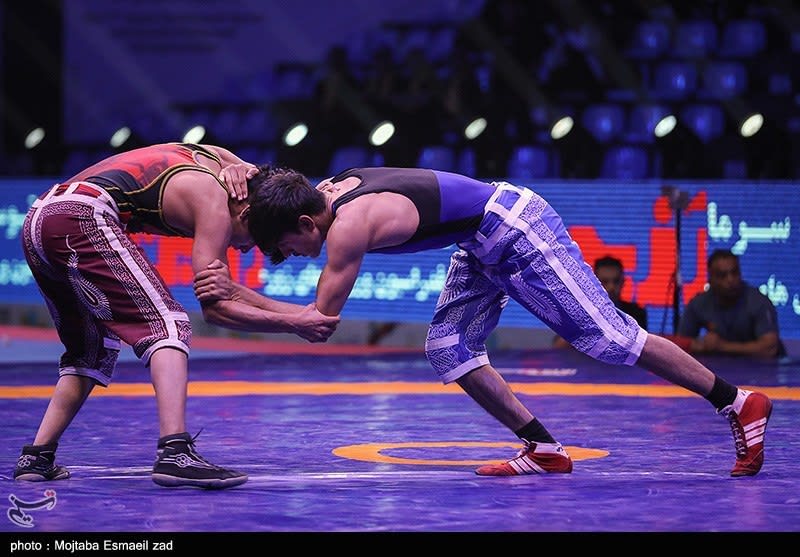
Koshti Pahlevani (کشتی پهلوانی, “heroes’ wrestling”) is the traditional wrestling of Iran. It is practised in the zurkhāneh, the “house of strength”, where it forms the conclusion of a ritual training session rather than its content. In 2010 the practice was inscribed on UNESCO’s Representative List of the Intangible Cultural Heritage of Humanity as the Pahlevani and Zoorkhanei rituals, and in 2022 additionally for Azerbaijan.
The reason this article belongs in the collection, though, is a different one. Around Iran, India, Pakistan, Turkey and Central Asia there stretches something often presented as one transmitted wrestling complex — everywhere there are “pehlwans”, everywhere the contest has a similar name, so a single art must have travelled. That is the common account, and it does not survive checking.
What travelled is a vocabulary and a figure, not a grip. From Iran the pahlavān spread — the champion as a moral exemplar — together with the words for him and for what he does. The techniques stayed where they were. Set the three great traditions of this region side by side and you find the same name over three different wrestling matches.
What is not covered here
The zurkhāneh itself — the building, the sunken pit, the implements, the sequence, the morshed with his goblet drum — is described in its own article. This one is about the wrestling, and about what actually spread outward from it.
The connection still has to be stated once, because it defines the subject: a session consists mainly of rhythmic work with implements — wooden clubs (mil), metal shields (sang), a bow-shaped iron weight (kabbādeh) — paced by a morshed who beats the zarb and recites verse, frequently from the Shāhnāmeh. The wrestling comes at the end. To describe Koshti Pahlevani without that frame would be to mistake a text’s last sentence for the text.
The name, and what it says about the spread
Pahlavān comes from Parthian and means “hero”. The word has travelled remarkably widely:
| Region | Word for the wrestler | Word for the contest |
|---|---|---|
| Iran | pahlavān | koshti |
| India, Pakistan | pehlwan, pahalwan | kushti |
| Turkey | pehlivan | güreş (a word of its own) |
| Central Asia | pahlavon, palvan | varies regionally |
The most revealing row of that table is already in this collection, under a different name. Indian wrestling is called Pehlwani and kushti — and both words are Persian: pehlwani from pahlavāni (“heroic”), kushti from koshti (“wrestling”). Two Persian names for the same thing. Its technique, by contrast, derives substantially from Indian malla-yuddha; the Persian layer arrived in the sixteenth century with the Mughal empire.
That single case already contains the whole finding: Indian wrestling carries two Persian names and a largely Indian technique. That is exactly what it looks like when a word travels and a grip does not.
The word’s own origin is unresolved
For koshti the literature offers two derivations that exclude each other — and this article does not settle the matter, because it cannot be settled from the accessible sources:
- From کُشتی kusti, the consecrated girdle Zoroastrians wear at prayer. Koshti gereftan would then literally mean “to take hold of one another’s belt”, which fits the belt wrestling of the region.
- From کشتن koštan, “to kill”.
The first is the prettier one and is therefore quoted more often; that is not an argument for it. Both are phonologically possible, and anyone passing the first on as established is presenting a conjecture as a finding. Here it stands as what it is.
Incidentally this clears up a loose end in the collection: the zurkhāneh article points to “Zoroastrian combat practices” as a precursor. What is documented is a Zoroastrian connection at the level of the word and the ritual, not of a fighting system. No Zoroastrian wrestling style has come down to us.
What is documented and what is narrative
The distinction is especially necessary here, because hardly any account of Koshti Pahlevani manages without antiquity.
Narrative: that the wrestling goes back to ancient Persia and was practised by Rostam, the hero of the Shāhnāmeh. That is an attribution to a literary figure, not a date. For the usual claims of age — Parthian or even Achaemenid origins — there is no archaeological evidence supporting any particular form of practice. That wrestling was done in ancient Iran is not in dispute; that this wrestling was it is not documented.
Documented: the ritual form as it now stands is traceable in the modern period. From the Qajar era it is recorded that the shah presented the national champion with an armlet (bāzūband) — so the office of pahlavan was a title conferred by the ruler, not merely an honorific. The 2010 UNESCO inscription describes the practice as fusing pre-Islamic Persian strata (Zoroastrianism, Mithraism, Gnosticism) with Shia piety and Sufism — that is, expressly as a layering, not an unbroken line.
This is the same situation as with Wudang and Subak: the mentions are genuine, the continuous line to present practice is not.
Technical foundations
| Feature | Form |
|---|---|
| Fighting area | the sunken pit (gowd) of the zurkhāneh |
| Dress | knee-length patterned wrestling trousers (tunbān); torso bare in traditional practice, singlet in present-day competition |
| Objective | control and submission, not a pin decided on points |
| Permitted | grips anywhere on the body, leg attacks, locks and chokes within limits |
| Frame | wrestling as the close of a session, embedded in rank and etiquette |
| Pairing | matched by rank; the senior man has duties, not privileges |
The feature that most sharply separates Koshti Pahlevani from Olympic wrestling is not technical but procedural: there is no points system deciding the bout. Wrestling continues until submission or until the senior man stops it. That removes precisely the mechanism described in the throwing principles comparison as the real shaper of form — and accordingly no repertoire optimised toward a ruleset has developed here.
The counter-check: one name, three wrestling matches
If an art had travelled, the traditions would resemble one another technically. They do not:
| Koshti Pahlevani (Iran) | Pehlwani / kushti (India) | Yağlı güreş (Turkey) | |
|---|---|---|---|
| Surface | pit inside the zurkhāneh | clay pit (akhāra) | grass |
| Dress | wrestling trousers | loincloth | oil-soaked leather trousers (kispet) |
| Distinctive feature | ritual, music, rank | way of life, diet, celibacy | oil makes any external grip worthless |
| Basic grip | body and belt grips | body grips, leg attacks | grip reaching inside the trousers |
| Shared | pahlavān | pehlwan | pehlivan |
The Turkish column is the hardest counter-check. There the oil makes any ordinary grip impossible, which is why the hand reaches inside the leather trousers — a solution that occurs nowhere in Iran or India and could not occur there. Technically the three have almost nothing in common. What they share is the name of the fighter.
And that name is not an empty label. What did travel is the figure: the champion as a moral exemplar, bound to modesty, to protecting the weaker party and to restraint in victory — javānmardi in Persian, a whole ordering of life with diet and abstinence in the Indian akhāra, the pehlivan’s code of honour in Turkey. What was transmitted was a conception of a person, and taking it on required changing no technique at all. That explains without strain why it spread so much further than any grip.
The pahlavan as an office — and Takhti
That pahlavān was an office and not a compliment is shown by the Qajar armlet. That it has remained one is shown by the title’s best-known holder.
Gholamreza Takhti (born 27 August 1930 in Tehran, died 1968) won Olympic gold in freestyle at Melbourne in 1956, along with gold at the 1958 Asian Games and the 1959 and 1961 World Championships, and was three times Pahlavan of Iran. What made him famous, however, was not the titles but what the office demands: humble origins, restraint, and declining to take advantage of injured opponents. He carried the epithet Jahān Pahlavān, “world champion” in the older sense of world hero.
Takhti is thus the point where the old figure and modern competitive sport coincide — and he also shows where the whole thing went: he won his gold not in Koshti Pahlevani but in freestyle wrestling.
Why Iran is a wrestling nation
The freestyle article lists Iran among the strongholds. The reason is here. Iran first entered the freestyle World Championships in 1951 and finished fourth at the first attempt; according to the world federation, 43 of the country’s 69 Olympic medals come from wrestling.
The connection is not the one people assume, though. It is not that Koshti Pahlevani’s technique works particularly well in freestyle — the rulesets are too different. What the zurkhāneh system supplies is something else: a dense network of training places, a population that regards wrestling as honourable, and a heroic figure that turns boys toward wrestling rather than toward something else. What transferred was not the technique but the social standing of the thing — and that is enough to make a wrestling nation.
Connections to other martial arts
- Zurkhāneh — the frame without which this wrestling cannot be understood. The house is described there, the contest here.
- Pehlwani — the principal case for the argument: two Persian names, Indian technique. The Mughal period brought the Persian layer in the sixteenth century.
- Malla-yuddha — the technical basis of the Indian branch, and thus the evidence that the technique there did not come from Persia.
- Freestyle wrestling — where Iranian wrestling culture went in the twentieth century, and why Iran stands where it stands there.
- Wrestling — the parent article on the worldwide record.
- Throwing principles compared — Koshti Pahlevani is the counter-case to its argument: where no points ruleset decides, no repertoire tailored to one develops.
Today
The zurkhāneh system continues in Iran, carried by a federation, with competitions and UNESCO standing; alongside it there are regional folk wrestling styles cut rather differently from zurkhāneh wrestling. Outside Iran, Koshti Pahlevani is found almost only in the diaspora, and training places are rare.
Two questions are useful for placing a given school. First: is age being claimed, or origin being described? A school advertising “unchanged for 3,000 years” claims something nobody can substantiate; one that names the layering of pre-Islamic, Shia and Sufi elements is reporting the state of research. Second: is wrestling on offer, or ritual instruction? Both are legitimate, but most zurkhāneh practise mainly the implement forms — anyone whose main interest is wrestling is better served by a wrestling club.
None of that is an objection. The value of this tradition does not lie where one first looks for it anyway. It lies not in some grip nobody else knows, but in its being one of the few fighting cultures that expressly derives an obligation from winning rather than a claim.