Iaidō — The Art of the Draw
Iaidō is the Japanese art of cutting from the scabbard — solo forms with the sword, unified since 1969 by a standard seitei curriculum.
Lineage
Contents
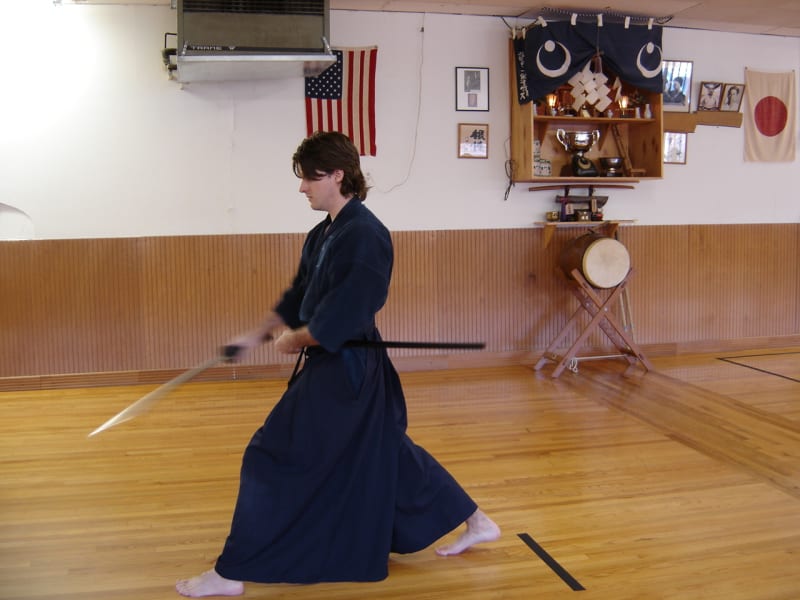
Iaidō (居合道, “way of meeting while seated”) is the Japanese swordsmanship of the first cut. Its subject is the moment in which the blade is still in the scabbard and the attack has already begun. Practice is almost entirely solitary, in fixed forms against an imagined opponent: draw, cut, clear the blade, return it — all in a sequence that forgives no error, because there is no partner to absorb one.
This makes iaidō the counterpart of kendō. Where kendo enables free fighting by replacing the weapon with a bamboo sword, iaidō keeps the real weapon — a blunt iaitō or a sharp shinken — and gives up the opponent instead. Both arts are incomplete, which is why many practitioners take up both. Iaidō is administered by the All Japan Kendo Federation, which created a cross-school core curriculum in 1969, and by the classical schools that continue independently alongside it.
History
Hayashizaki Jinsuke Shigenobu (1542–1621) is regarded as its originator, systematising in the mid-sixteenth century a school that made the draw itself its centre. The thinking behind it was practical: in the Sengoku period, close quarters were decided not by fencing skill but by who first had a usable blade. All of kenjutsu presupposes an already drawn sword — iaijutsu fills exactly the gap before it.
From Hayashizaki’s lineage the two schools still dominant today emerged over generations. Hasegawa Eishin shaped in the eighteenth century the form continuing as Musō Jikiden Eishin-ryū; from a parallel branch, Nakayama Hakudō (1872–1958) formed Musō Shinden-ryū in 1932. Nakayama is also credited with establishing the term iaidō in place of the older iaijutsu — the same shift from jutsu to dō that jūdō, kyūdō and kendō had undergone.
After 1945 iaidō faced an organisational problem: dozens of koryū with their own transmissions, but no common standard against which examinations and competitions could be measured. The solution came in 1968–69: a committee of the All Japan Kendo Federation assembled a standard curriculum from elements of the major schools — above all Musō Jikiden Eishin-ryū, Musō Shinden-ryū and Hōki-ryū — the seitei iai. It began with seven forms, gained three more in 1981 and two in 2000, and now comprises twelve kata.
The seitei curriculum is explicitly not a replacement for the classical schools but a shared language. In practice nearly every iaidōka trains both: seitei for examination and competition, plus the forms of their own koryū.
Technical Foundations
Every iaidō form consists at its core of four actions flowing into one another:
| Phase | Term | Content |
|---|---|---|
| Draw and first cut | 抜き付け nukitsuke | the sword leaves the scabbard already cutting |
| Main cut | 切り付け kiritsuke | the decisive, usually vertical cut |
| Clearing the blade | 血振り chiburi | symbolic shaking off of blood |
| Resheathing | 納刀 nōtō | returning to the scabbard without lowering the gaze |
The whole is enclosed by zanshin — the alert bearing that begins before the first movement and does not break off after resheathing. A technically clean sequence without zanshin counts as failed in assessment, exactly as in kendō.
Forms are performed from various starting positions: formal seiza, the half-kneeling tatehiza, walking, and standing. The seated forms look antiquated to outsiders but train precisely the point — becoming able to act in the shortest time from an unfavourable position.
Practice is usually with the iaitō, an unsharpened zinc-alloy training blade. Advanced practitioners work with the sharp shinken; cutting straw mats (tameshigiri) is a test discipline of its own, showing whether a movement actually cuts or merely looks as though it does.
Core Techniques
- Nukitsuke — the drawing cut, technically the heart of the art. Scabbard and sword move in opposition (saya-biki); whoever pulls only with the arm is too slow and does not cut.
- Kirioroshi — the vertical descending cut, in which hips, back and both hands must act together. The commonest fault is pulling with the arms instead of leading from the body.
- Chiburi — depending on school, a lateral shake or a small circular motion. Practically ineffective, but indispensable as the form’s caesura.
- Nōtō — resheathing without looking, with unbroken alertness. For beginners the hardest single movement and the commonest cause of injury.
- Metsuke — direction of gaze: the eyes go to the imagined opponent, not to the blade.
The twelve seitei forms cover typical situations — attack from the front, side, rear, against multiple opponents, seated and walking. They are built to remain intelligible across schools.
Philosophy
The name contains the programme. I-ai (居合) joins “to be present” and “to meet”, denoting the capacity to act in any situation — seated, unprepared. The classical formula for this is saya no uchi de katsu: to win within the scabbard. The best outcome is the fight that never begins, because the other’s bearing makes it look hopeless.
This links iaidō closely to the concept of sen — forestalling — and to Miyamoto Musashi’s reflections in the Gorin no Sho that the decision falls before the blades meet.
Practically significant is the solitude of the practice. Without a partner there is no external corrective: nobody hits you when your guard is open. The only feedback is the sound of the blade, the resistance when cutting, and the teacher. Iaidō is therefore to an unusual degree a school of self-observation — and at the same time vulnerable to the self-deception that a beautiful movement is an effective one. Tameshigiri exists precisely against that.
Styles and Schools
| School | Origin | Character |
|---|---|---|
| Musō Jikiden Eishin-ryū | Hasegawa Eishin lineage, 18th c. | largest koryū, extensive curriculum |
| Musō Shinden-ryū | Nakayama Hakudō, 1932 | widespread, clear formal vocabulary |
| Hōki-ryū | 17th c. | one of the sources of the seitei curriculum |
| Tamiya-ryū, Suiō-ryū, Mugai-ryū | 16th–17th c. | smaller, independently transmitted lines |
| ZNKR seitei iai | 1969, extended 1981 and 2000 | twelve forms, cross-federation standard |
Grading runs from 1st to 8th dan, above which stand renshi, kyōshi and hanshi. As in kendō, the 8th dan examination is considered extraordinarily hard.
Connections to Other Martial Arts
- Iaijutsu — the older, martially oriented name for the same art; the boundary is one of aim rather than technique
- Kenjutsu — begins with the drawn blade, where iaidō ends; historically the two were transmitted together
- Kendō — complementary: free fighting without a real blade versus a real blade without an opponent. The AJKF governs both
- Kyūdō — the other great Japanese solo discipline; structurally related in its emphasis on procedure and zanshin
- Battōdō — a related modern current with greater weight on the cutting test
- Aikidō — its movement principles derive recognisably from sword work, which is why many aikidōka also train iaidō
Today
Iaidō is co-administered internationally through the International Kendo Federation and practised in several dozen countries, but remains markedly smaller than kendō. Competition takes the form of paired comparison: two practitioners perform the same kata side by side and referees decide by flag — a format that offers spectators little and contributes to the discipline’s low visibility.
Two points are chiefly debated:
- Standard versus transmission. The seitei curriculum made iaidō examinable and internationally connectable. Critics counter that examination practice pushes koryū forms to the margins, since grades are in effect earned through seitei — and that this loses exactly the diversity from which seitei was once drawn.
- Form versus effectiveness. Because practice is never against a real opponent, the effectiveness of a movement cannot be tested in combat. Tameshigiri closes that gap only partly: a straw mat does not resist.
Its value as a path of practice is uncontested. Iaidō can be pursued into old age, requires little space and no training partner — making it one of the few martial arts whose practice tends to increase rather than decrease with the years.
Related Articles
Related Articles