Zanshin — The Remaining Mind
Zanshin is the remaining mind after technique — that 360-degree alertness that does not end when the cut, throw, or arrow has been released, but stays present and aware.
Contents
Zanshin (残心, “remaining mind”) is one of the most fundamental concepts in Japanese Budo — and one of the most difficult to explain. The kanji combines 残 (Zan, “remaining” or “leaving behind”) and 心 (Shin, “heart-mind”). Together: “The mind that remains.” What does this mean? After a cut, a throw, the release of an arrow — the moment does not end. Zanshin is the state of calm, relaxed total awareness that continues after the technique. It is the alertness that does not collapse into distraction or self-satisfaction when an action is complete. Zanshin is the opposite of: letting the arm drop after the strike, losing attention after the throw, being mentally “done” before the arrow has hit its target. A fighter without Zanshin is unprotected after their attack — a master with Zanshin is always ready. Zanshin is neither tension nor relaxation — it is watchful presence.
The Kanji
| Kanji | Reading | Meaning |
|---|---|---|
| 残 | Zan | Remaining, left behind |
| 心 | Shin | Heart-mind, consciousness |
| 残心 | Zanshin | The remaining mind |
In Japanese aesthetics, Zanshin appears in other contexts too: Wabi-Sabi (beauty of impermanence) and Ma (meaningful pause) are related concepts — all concerned with what remains after an action, what exists between moments.
Zanshin in Different Martial Arts
Kyūdo (Archery)
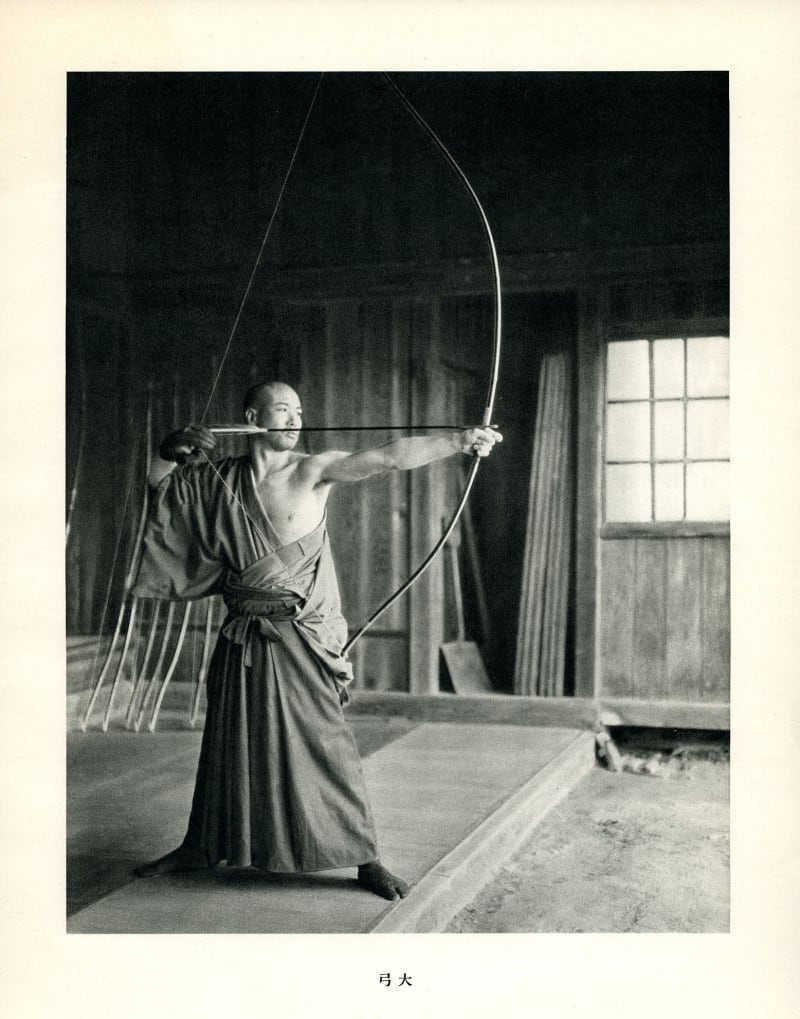
The purest example of Zanshin: after the release of the arrow (Hanare), the archer maintains complete body posture — bow extended, gaze directed at the target — long after the arrow has flown. This state of post-processing is called Yudaoshi and is held for minutes.
Kendo
After a strike (Yūkō-Datotsu), the fighter must maintain alertness — no self-satisfaction, no mental lapse. Points are only awarded when the strike and the subsequent Zanshin are both correct.
Aikido
After throwing the attacker (Uke), the defender (Nage) remains in an active, alert posture — ready for a follow-up attack. The technique does not end when Uke makes contact with the ground.
Karate
After completing a Kata, the fighter holds the final posture and mindset for several seconds — Zanshin as conclusion of every Kata.
Iaijutsu/Iaido
After the cut and Chiburi (symbolic blood removal), the fighter returns the sword to the scabbard (Noto) — fully attentive until the blade is completely sheathed.
Zanshin and Mushin — Complementary States
Zanshin and Mushin (無心, “no-mind”) are complementary concepts:
| Mushin | Zanshin |
|---|---|
| Mind free of thoughts during action | Mind alert after action |
| Spontaneity and flow | Calm and readiness |
| In the moment of combat | After the moment of combat |
| No fixed thoughts | Open attention |
Both together describe the complete mental state of the Budo master: Mushin during combat, Zanshin after.
Philosophical Depth
Zanshin has roots in Zen Buddhism — particularly the concept of non-dual attention: the distinction between “action complete” and “action still running” disappears. The master is always in flow, never truly finished, never truly begun.
Tea master Sen no Rikyū described Zanshin in the context of the tea ceremony: the guest leaves the tea pavilion, the master pauses — waiting until the last step of the guest has faded. This attention without occasion is Zanshin.
“The sword strike is one second. The Zanshin after — that is a lifetime.” — Kendo tradition
Practical Significance
In the modern world, Zanshin is often applied to situational awareness — the awareness of surroundings that does not lapse when a task seems complete. Military, police, and security personnel train similar concepts under other names.
In combat sport: a boxer who lowers his guard after the KO punch has no Zanshin. A judoka who looks into the audience after the throw has no Zanshin.