Shorinji Kempo — the Martial Art Registered as a Religion
Founded in Tadotsu in 1947, registered as a religious body in 1951. The legal form explains why there is no free fighting here.
Contents
Overview
Shorinji Kempo (少林寺拳法) is a Japanese martial art that arose in October 1947 in Tadotsu on Shikoku. Its founder is Doshin So, born Nakano Michiomi (1911–1980).
The name says “Shaolin Temple fist method”, and the origin story leads to China. But the more interesting part of this article is not the descent — it is the legal form.
Because Shorinji Kempo is registered as a religious body — as Kongō Zen Sōhonzan Shōrinji, under Japan’s Religious Corporation Law. And that registration explains more about the art than its ancestry does: why it is practised in paired forms rather than free fighting, why it runs two ladders of rank, and why it teaches healing techniques.
The founder
Nakano Michiomi was born on 10 February 1911 in Mimasaka, Okayama Prefecture. From 1928 he served with the Japanese military in Manchuria, in roles the accounts name openly: covert reconnaissance, military mapping, geographic survey across China.
During those years he learned martial arts. The accounts name a Daoist teacher, Chen Lian, and Bailian Quan; then Wen Taizong and Yihe Quan (Japanese Giwamon-ken).
And then comes the claim at issue: that in 1936 Wen passed him the grandmastership of his line at the Shaolin monastery on Mount Song in Henan — as the 21st successor.
In 1946 he returned to Japan, changed his surname to Sō and thereafter used the reading Dōshin.
What is documented and what is not
| Claimed | Documented | |
|---|---|---|
| Years in China | yes, many | yes — military service from 1928 |
| Learned Chinese martial arts | Bailian Quan, Yihe Quan | plausible, but without an independent source |
| 21st successor of a Shaolin line, 1936 | yes | no independent source |
| Japanese training | grandfather: kendō, sōjutsu, possibly Fusen-ryū jūjutsu | thinly documented |
| Hakkō-ryū jūjutsu | asserted by many accounts | both sides contradict it |
The objection to the succession comes from Donn Draeger, and it is not a quarrel over detail. Draeger argues that it is incompatible with Chinese tradition for a foreigner to succeed to the leadership of a Chinese martial tradition — and that the claim underrates the judgement of those meant to believe it.
The Hakkō-ryū point is the most revealing. Many accounts list Doshin So as a Hakkō-ryū student. The Shorinji Kempo headquarters has no records of it, and the records of the Hakkō-ryū organisation show only that he sat in on a few sessions.
That places Shorinji Kempo in the same relation to Daitō-ryū as several Korean arts in this stock — because Hakkō-ryū was founded in 1941 by Okuyama Ryūhō, who trained in Daitō-ryū. Only here the connection is weaker than in the others: it consists of a few hours that the two sides remember differently. Anyone making descent of it repeats the mistake of those who make a Shaolin line of it.
October 1947
Doshin So founded his art in a defeated country.
What he says about it is the same in every account: conditions in post-war Japan convinced him of the need to restore morality and self-respect. The art was meant from the outset as a means of education, not as a competitive sport.
That is a founding intention this stock knows. The comparison of dō and jutsu describes how Japanese martial arts renamed themselves from collections of technique into ways between 1919 and 1942. Shorinji Kempo arises after that wave and takes its result as a starting point: the educational purpose stands at the beginning instead of the end.
The legal form
And here is the actual find.
In December 1951 Kongō Zen Sōhonzan Shōrinji was registered under Japan’s Religious Corporation Law — the organisation’s own chronology gives 1952 for the registration, so the accounts differ by a year. Kongō Zen is the teaching Doshin So formulated; it is Buddhist in ground but a foundation of his own.
The connection to the occupation years is made expressly in the organisation’s accounts. After 1945 the occupation administration heavily restricted the martial arts and dissolved the Dai Nippon Butoku Kai in 1946 — the association the dō-and-jutsu comparison names as the driver of the renaming wave. A religious body did not fall under the same ban.
Whether that was the reason or a reason cannot be decided from outside, and the organisation’s own account gives both: the restrictions and the philosophical claim the art had anyway. The dates fit either.
But the consequences of the legal form are independent of its motive, and they are visible.
What the legal form does to the technique
| Shorinji Kempo | What follows | |
|---|---|---|
| Purpose | self-cultivation, inside a religious body | no title circuit, no championship in free fighting |
| Competitive form | embu — a set paired form, six sections, 1.5 to 2 minutes, five judges, up to 300 points | what is judged is execution, not outcome |
| Grading | dan and hōkai — a martial and a philosophical ladder side by side | anyone advancing must show both |
| Healing techniques | seihō belongs to the curriculum | a martial art that also treats |
| Principle | ken zen ichinyo — fist and Zen are one | technique without doctrine counts as incomplete |
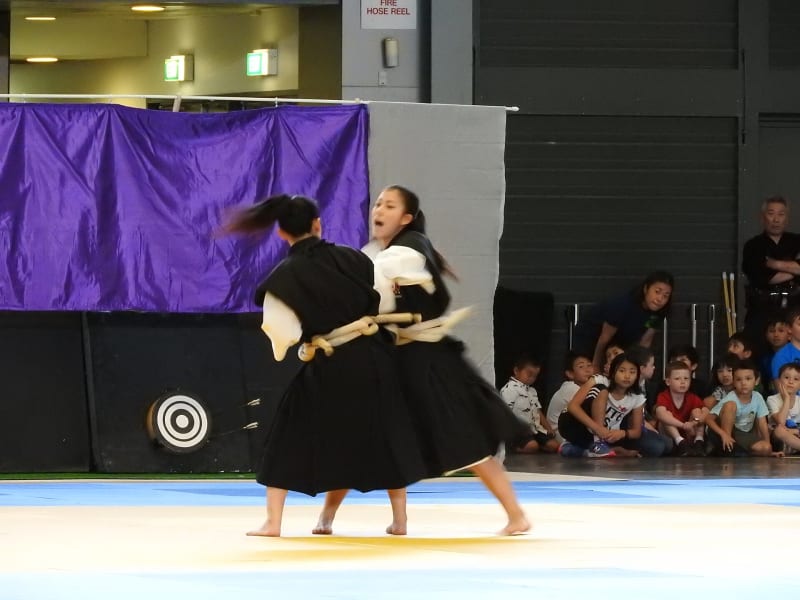
The core is the second row. Shorinji Kempo does have competition — but the competition is the jointly performed paired form, not the fight. Two practitioners alternate attack and defence, and judges award points for execution.
Anyone mistaking that for a tournament misunderstands the art — and so does anyone saying it has no competition. It has one that measures something else.
And the second ladder of rank is the clearest trace of the legal form. The comparison of grading systems shows that dan systems across this whole stock are young administrative machineries. Shorinji Kempo runs a second ladder beside it that marks spiritual standing. That makes sense only in an organisation whose purpose is not the art alone.
The three pillars of technique
| Area | Characters | Content |
|---|---|---|
| Gōhō | 剛法 | ”hard methods” — fist, knife hand, elbow, knee, kicks, blocks |
| Jūhō | 柔法 | ”soft methods” — throws, pins, joint control, chokes, releases |
| Seihō | 整法 | ”restorative methods” — pressure points, bone setting, resuscitation |
The division into hard and soft is not new in this stock — it is the old distinction that jūjutsu and karate know as well. What is new is the third pillar: that restoring the body belongs to the curriculum rather than to the aftercare.
Five legal persons
The organisation today consists of five bodies, and the list is itself a finding:
- the religious body (Kongō Zen Sōhonzan Shōrinji)
- the foundation federation in Japan (grown out of the 1963 association)
- the school Zenrin Gakuen
- the World Shorinji Kempo Organization (WSKO), 1974
- Shorinji Kempo Unity, 2003 — responsible for the intellectual property
The fifth is the most modern answer to an old problem. Whoever carries a name that names a Chinese temple has an interest in nobody else using it. In 2003 the organisation created a legal person of its own for that.
It followed an international build-up: 1972 the International Shorinji Kempo Federation with eight countries, 1974 the WSKO with sixteen. Doshin So died in May 1980; Yūki So succeeded him.
The name and the temple
In 1979 Doshin So was invited by the Chinese government to reintroduce fist art at the Shaolin Temple. That is a remarkable transaction: a Japanese whose claim to a Shaolin line is undocumented is asked by China to bring martial arts back to the temple.
The reason lies in China’s twentieth century. The article on Shaolin Kung Fu describes the breaks that happened there. Anyone looking for martial arts at Songshan in 1979 found little.
A lawsuit between the temple and Shorinji Kempo is mentioned — Draeger cites it — but no court documents can be found. The stock records it accordingly: a mention without evidence is not a proceeding.
Common fallacies
“Shorinji Kempo is Japanese Shaolin kung fu.” The name says so, the evidence does not. What is secure: the founder was in China for a long time and learned martial arts there. What is missing: any independent source for the succession of 1936.
“It is a religion, so not a real martial art.” The legal form changes nothing about gōhō and jūhō. It changes what the training is for — and therefore how it is examined.
“It has no competition.” It has one: the embu, the judged paired form. What it does not have is free fighting for a title.
“The art is 1,500 years old, because Bodhidharma.” The article on Bodhidharma records what is left of that line. Shorinji Kempo is from 1947, and the organisation gives that date itself.
“The Hakkō-ryū connection explains the technique.” It is too thin for that. The two organisations contradict each other, and what remains is a few sessions attended.
Related Articles
- Shaolin Kung Fu — the temple in the name, and what is actually transmitted there
- Karate — the same hard/soft distinction, without the third pillar
- Jūjutsu — the Japanese descent of the soft methods
- Daitō-ryū Aiki-jūjutsu — where the Hakkō-ryū trail leads, if it holds
- Aikidō — the other post-war art with an educational claim instead of competition
- Dō and Jutsu Compared — the renaming wave whose result stands here at the beginning
- Budō — the term under which the art presents itself
- Zen in Budō — what ken zen ichinyo presupposes and what it does not
- Grading Systems Compared — the second, philosophical ladder as a special case
- Hwarangdo — the same construction of a founding story, in the neighbouring country
- Bodhidharma — the address to which Shaolin lines are sent