Zen in Budo — Enlightenment Through Movement
Zen in Budo connects Chan Buddhism with martial practice — from Takuan Soho's sword letters to Herrigel's archery: enlightenment as the fruit of physical mastery.
Contents
“Ken Zen Ichi Nyo” (剣禅一如) — “Sword and Zen are one.” This phrase, circulating in 17th-century Japan, condenses into four characters the closest alliance in the history of the martial arts: that between Zen Buddhism and the warrior’s way.
Zen — the Japanese form of Chinese Chan Buddhism — teaches that enlightenment is not attainable through reading texts or religious ceremony, but through direct, immediate experience. This radical orientation toward practice made Zen more attractive to samurai than other Buddhist schools: Zazen (seated meditation) had an immediate parallel with combat — in both situations, any distraction is potentially fatal, and complete presence is the only way through.
The connection of Zen and martial arts is no historical accident. It is a philosophical necessity: one who truly fights — truly, without safety net, without a second chance — experiences the radical presence that Zen describes theoretically. The combat dojo became a meditation hall; the meditation hall became a dojo.
History: From Chan Buddhism to Samurai Meditation
Bodhidharma (Daruma, ~5th century CE): The legendary Indian monk who brought Chan Buddhism to China is said to have meditated in silence facing a cave wall for nine years. The Shaolin monks he reportedly taught integrated movement exercises into their meditative practice — the beginning of the connection between physical training and Buddhist practice.
Rinzai and Soto in Japan (12th–13th century): Eisai (1141–1215) brought the Rinzai school of Zen to Japan — strict, abrupt, based on Koan practice. Dogen (1200–1253) founded the Soto school — quieter sitting, Shikantaza (just sitting as complete practice). Both schools quickly attracted followers among the warrior class.
Musō Soseki (1275–1351): Zen master and garden designer, close adviser to several Shoguns. Under him, Zen became the official ideology of the warrior class — Kinkakuji (the Golden Pavilion) was created in his spirit.
Takuan Soho (1573–1645): The most significant Zen thinker in the history of the martial arts. His work Fudochi Shinmyoroku — a letter to the sword master Yagyu Munenori — is the most precise philosophical document on the relationship between Zen mind and swordsmanship. Takuan describes the mind that “rests nowhere” as the prerequisite for true sword mastery:
“When the mind rests nowhere, it is everywhere.”
The Koan as Combat Analogue
Koans are paradoxical questions or statements in Rinzai Zen to which there is no logical answer: “What is the sound of one hand clapping?” The student sits with the koan until the analytical mind gives up and a more direct knowing emerges — Satori.
In the sword dojo there is an analogous experience: the student practises a technique hundreds of times, until they stop thinking — and the technique happens. This moment — when the ego steps aside — is described by many masters as a combat equivalent of Satori.
Shoshin (初心, beginner’s mind): A Zen term central to Budo. Shunryu Suzuki formulated it: “In the beginner’s mind there are many possibilities. In the expert’s mind there are few.” A master who sees their art with the freshness of a beginner has Shoshin — and is therefore capable of learning until death.
Eugen Herrigel — Zen and the Way of the Arrow
The German philosophy professor Eugen Herrigel (1884–1955) spent from 1924 to 1929 in Japan, studying under the Kyudo master Awa Kenzo. His 1948 book Zen in the Art of Archery became the best-selling Zen book in the West — and the most consequential misunderstanding.
What Herrigel experienced: Six years of Kyudo (Japanese archery) training. The fundamental demand: the arrow must shoot itself, not be shot by the archer. Herrigel wrestled with this for years — until one evening, after a successful shot, the master bowed: “It shot.” Herrigel described this moment as an experience of enlightenment.
The critique: Later scholars, particularly Yamada Shoji (2001), showed that Herrigel was likely mistranslated, misunderstood much, and that Awa Kenzo was not an orthodox Zen teacher. The book says more about Western Zen projections than about Japanese Kyudo.
What remains: Herrigel’s book describes phenomenologically something real — the experience that arises when technical mastery combines with a non-clinging mind. Whether this is Zen is academic. That it is something which martial artists worldwide recognise is undeniable.
Core Concepts
| Term | Meaning | Budo Relevance |
|---|---|---|
| Zazen | Seated meditation | Clearing the mind for combat |
| Satori | Sudden enlightenment | Technical breakthrough after long training |
| Shoshin | Beginner’s mind | Always learning, never complacent |
| Munen Musō | No thought, no image | Synonym for Mushin in combat |
| Ken Zen Ichi Nyo | Sword and Zen are one | Martial art as spiritual practice |
| Kokoro | Heart-mind | Undivided consciousness in action |
Connections to the Martial Arts
- Aikido — Ueshiba was deeply influenced by Zen and Shinto; Aikido practice is explicitly meditative exercise
- Kendo — Zen aesthetics permeate Kendo: unity of sword, body and mind (Ken-Tai-Ichi)
- Judo — Kano integrated Zen ideas into the Judo ethos, especially Mushin and Zanshin
- Kyudo — Archery as pure Zen practice; hitting and missing are equally significant
Today — Zen and Modern Combat Sports
Zen influences in modern combat sport are ubiquitous — often without awareness of the source:
- Visualisation training is modern sports psychology; its roots lie in Zen imagination practices
- Flow experiences in elite athletes correspond phenomenologically to descriptions of Mushin
- Meditation as a training component — from the UFC to professional chess
At the same time: superficial Zen marketing trivialises the concept. “Zen” has become a lifestyle word — Zen interior design, Zen yoga, Zen cooking. This has little to do with the radical practice Takuan Soho described.
The serious connection of Zen and Budo remains alive in dojos — not as theory, but as daily practice of sitting still before training and being completely present in combat.
Related Articles
Weiterführende Literatur
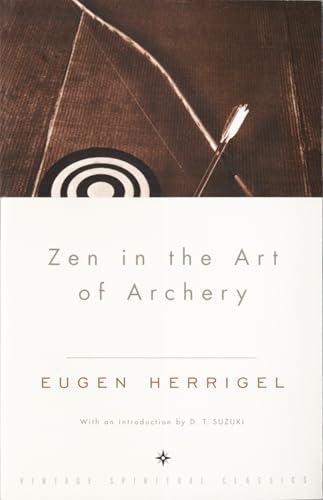
Zen in the Art of Archery
Eugen Herrigel
Amazon ↗
The Unfettered Mind: Writings from a Zen Master to a Master Swordsman
Takuan Soho
Amazon ↗
* Affiliate-Links — Hyakusha erhält eine kleine Provision, ohne Mehrkosten für dich.
Verwandte Artikel