Gungsul — Korean Archery at 145 Metres
The standard distance in Korean archery is 145 metres — five times that of kyūdō. Everything about the gakgung follows from that number.
Contents
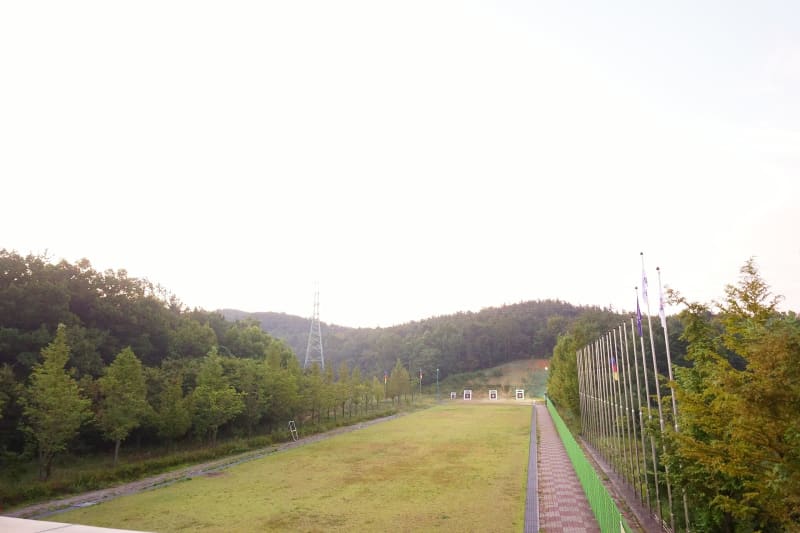
Gungsul (궁술, “the craft of the bow”, today usually gukgung 국궁 or gungdo 궁도) is traditional Korean archery — and almost all of it can be derived from a single number. The standard distance is 145 metres. By comparison, Japanese kyūdō shoots at 28 metres and Olympic archery at 70. The Korean arrow therefore covers more than five times the kyūdō distance, and it does so on a high arc whose apex lies far above the target.
Everything else follows from that distance: the construction of the bow, the draw technique, the absence of any aiming device, and the fact that the archer does not sight the target at release but estimates it.
History
Across every era, the bow was Korea’s most important weapon, militarily and culturally. The founding figure of the Joseon dynasty, Yi Seong-gye (Taejo, 1335–1408), was famous as an archer before he was king — a connection that shaped the standing of archery over the following five centuries.
Archery was institutionally anchored in the military examination (무과, mugwa), held from 1392 to 1894. Among all the skills tested, shooting carried the greatest weight; admission to the royal guard required meeting hit conditions at long range. Archery in Korea was thus not merely a craft of war but access to a career — comparable to what the classics examination provided in the civil service.
With the end of the examination system in 1894 and the arrival of firearms, the bow lost its military role. It did not disappear, however, but continued in archery houses (사정, sajeong) as a civic pursuit. The bow form in use today was standardised around 1900 out of the previously varied designs.
Technical basis
The Korean bow, the gakgung (각궁, “horn bow”), is a strongly reflexed composite bow. Unstrung it curves almost into a circle in the opposite direction — it has to be turned inside out to be strung.
| Component / feature | Construction |
|---|---|
| Belly (inner face) | water buffalo horn — takes the compression |
| Core | bamboo |
| Back (outer face) | sinew — takes the tension |
| Adhesive | fish-bladder glue |
| Covering | birch bark |
| Length | about 1 metre — very short for the range |
| Draw | thumb draw with a ring (각지, gakji) |
| Aiming device | none |
| Distance | 145 m |
| Target | wooden board, roughly 2 × 2.66 m |
The combination of materials explains the mismatch between length and range: horn resists compression, sinew resists tension, and together they store far more energy over a short limb than wood alone. The same construction is found in the horse bows of the Eurasian steppe — the gakgung is the Korean expression of a design that arose wherever people shot from the saddle.
The thumb draw distinguishes gungsul from European and Olympic shooting, where three fingers are used. The string sits behind the thumb, which is protected by a horn ring, with the index finger securing it from the front. As a result the arrow rests on the opposite side of the bow from a finger draw.
Core techniques
The shot breaks down into a fixed sequence whose names vary slightly from house to house: take the stance, raise the bow, draw, hold, release, follow through. Three points matter:
The draw begins high. The bow is raised above head height and lowered as it is drawn — a movement that comes from shooting on horseback and produces the necessary elevation by itself.
One does not aim but estimates. Without a sight and over 145 metres, the target cannot be lined up along the arrow. The archer works from a learned body position and corrects from the observed strike — wind, temperature and humidity feed directly into that correction.
The release is a roll-off. The thumb frees the string through a rotation of the drawing hand, not by opening the fingers. A clean release is the principal source of error; an unsteady one has many times the effect at 145 metres that it would at 18.
Etiquette and the archery house
Gungsul is practised almost exclusively in fixed archery houses, and the procedure there is regulated: shooting takes place in groups and in a set order, bows are exchanged at the start and end of a round, and hits are counted collectively. A single round usually comprises five arrows.
Unlike kyūdō, which has made shooting into a fully articulated discipline of the mind, the Korean framing stays matter-of-fact: there is a pronounced code of conduct but no doctrine attached to it. The hit counts. That is not a lack of depth but a different answer to the same question — and comparing the two answers is more instructive than ranking them.
Connections to other martial arts
- Kyūdō — 28 m, an asymmetric bamboo bow, an articulated training of the mind; the direct opposite of the Korean approach to the same basic task
- Kyūjutsu — the military precursor of kyūdō; here the kinship in purpose is greater than in equipment
- Ssireum and taekkyeon — the two other Korean arts with documented, unbroken practice
Today
South Korea has several hundred archery houses; gungsul is organised as a participation sport, with competitions, grades and its own federation. Training as a bowyer is recognised as intangible cultural heritage — genuine gakgung of horn and sinew are still made by a few workshops and are correspondingly expensive, while bows of modern composite materials are widespread in general practice.
One frequent short circuit deserves correcting: South Korean dominance in Olympic archery is readily attributed to gungsul. Technically the connection is weak — Olympic shooting uses a recurve bow, a finger draw and a sight at 70 metres, so different equipment and different technique. What actually connects them is how self-evident archery is in Korean culture and the infrastructure of clubs, coaches and school programmes that grew out of it. That explains the success better than a transfer of technique that does not, in fact, exist.