Bruce Lee — The Man Who Reinvented Martial Arts
Bruce Lee (1940–1973) broke all boundaries between martial arts — his Jeet Kune Do and philosophy inspired MMA and a generation of fighters.
Contents
Overview
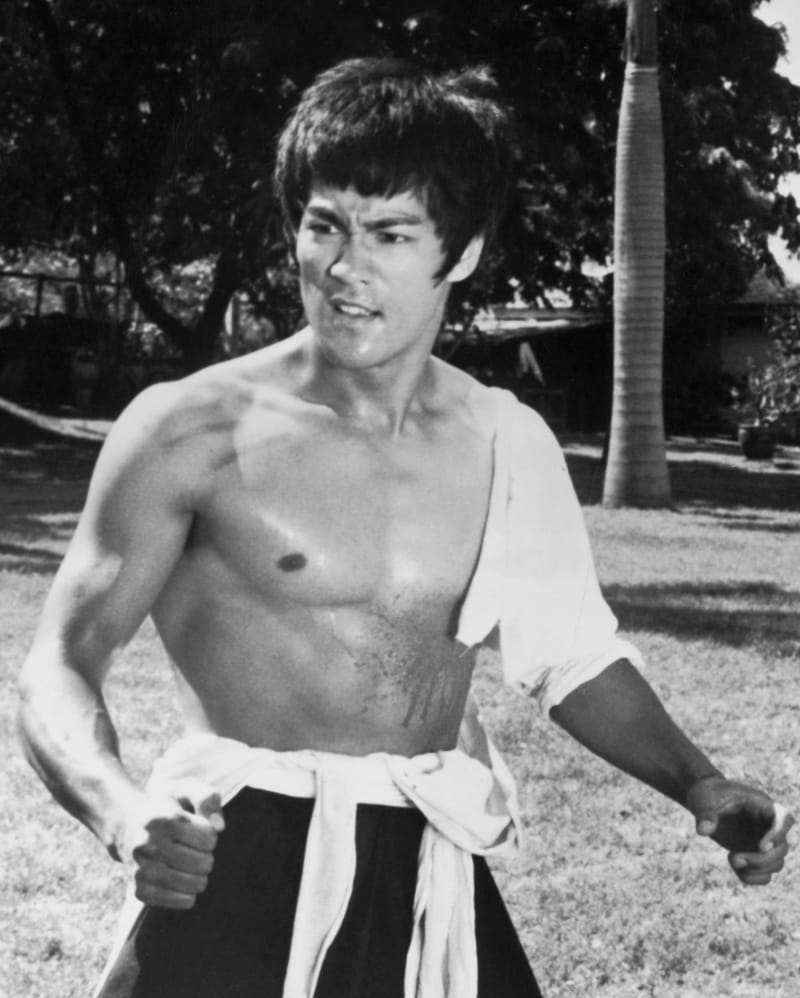
Bruce Lee lived only 32 years — and in that time transformed the martial arts world more fundamentally than anyone before him. Actor, philosopher, trainer, and experimenter, he tore down the dogmatic walls between styles before most martial artists had even questioned the concept of style vs. style. His Jeet Kune Do (the way of the intercepting fist) is less a style than a method: “Absorb what is useful. Discard what is useless. Add what is essentially your own.” This sentence made him the forerunner of modern MMA — decades before the term existed.
| Birth name | Lee Jun-fan (李振藩) |
| Born | November 27, 1940, San Francisco, USA |
| Died | July 20, 1973, Hong Kong |
| Martial art | Jeet Kune Do (founder), Wing Chun, Boxing, Fencing, Wrestling |
| Teachers | Ip Man (Wing Chun), William Cheung |
| Notable students | Dan Inosanto, Taky Kimura, Chuck Norris, Joe Lewis |
Early Life and Training
Lee was born in San Francisco — his father was a Cantonese opera singer — and grew up in Kowloon, Hong Kong. As a teenager involved in street fights, he began formal Wing Chun training at 13 under Grandmaster Ip Man. He showed extraordinary talent, but was reportedly excluded from training when it became known he had mixed European ancestry. He continued training under other students.
In 1959 Lee returned to the United States, studied philosophy in Seattle, and opened his first dojos. His choreographed combat in the TV series The Green Hornet (1966) brought him international attention.
Turning Points
In 1964, Lee appeared at the Long Beach Karate Championships — a performance that made him famous in the martial arts community. He demonstrated the one-inch punch: full force from minimal distance.
Shortly after came the pivotal moment: a match against Chinese martial artist Wong Jack-man (1964), whose outcome remains contested. Lee believed he had taken too long to win. He immediately began discarding Wing Chun as too rigid and systematically developed his own approach: Jeet Kune Do (1967).
He moved to Hong Kong and made The Big Boss (1971), Fist of Fury (1972), and Enter the Dragon (1973) — films that globally transformed the image of the Asian martial artist. He died on July 20, 1973, of a cerebral edema under circumstances still debated.
Techniques and Principles
JKD follows no fixed curriculum — that is its core principle. However, key emphases can be identified:
| Element | Origin / Description |
|---|---|
| Bai Jong (fighting stance) | Wing Chun — dominant hand forward |
| Intercepting | Interrupting the opponent before the attack is completed |
| Pak Sao / Trapping | Wing Chun hands — controlling the opponent’s arms |
| Boxing footwork | Mobility and distance management |
| Kicks | Side kick, front kick — primary weapons of the body |
| Grappling | Wrestling fundamentals for close range |
Philosophy
Lee’s philosophy was deeply shaped by Zen, Taoism, and Western existential philosophy (particularly Krishnamurti). His key concept: “Be like water” — water has no fixed form, adapts to any container, and is simultaneously irresistible.
He explicitly rejected the concept of style: “Styles separate people. I don’t practice styles. I practice the art of human expression.” This was revolutionary in a world of fierce school loyalty.
His 1975 posthumously published Tao of Jeet Kune Do is a notebook of his thoughts and drawings — an unfinished manifesto.
Students and Legacy
- Dan Inosanto — Primary custodian and teacher of JKD, integrated Kali/Escrima
- Taky Kimura — Continued Lee’s first dojo in Seattle
- Chuck Norris, Joe Lewis — World champions who trained with Lee
His idea of cross-training — deliberately learning from multiple martial arts — became the foundation of MMA.
Connections to Other Arts
Lee began with Wing Chun (Ip Man), integrated boxing, fencing, wrestling, and elements from dozens of other styles. MMA is widely regarded as his indirect successor art. His student Dan Inosanto connects JKD with Escrima/Kali into one of the most comprehensive modern combat systems.
Today
Bruce Lee is the most recognizable martial arts figure in the world. Time Magazine named him one of the 100 most influential people of the 20th century. UFC founders call him the “Father of MMA.” His philosophy — “Absorb what is useful” — is the mantra of the entire modern martial arts scene.
Related Articles
Verwandte Artikel