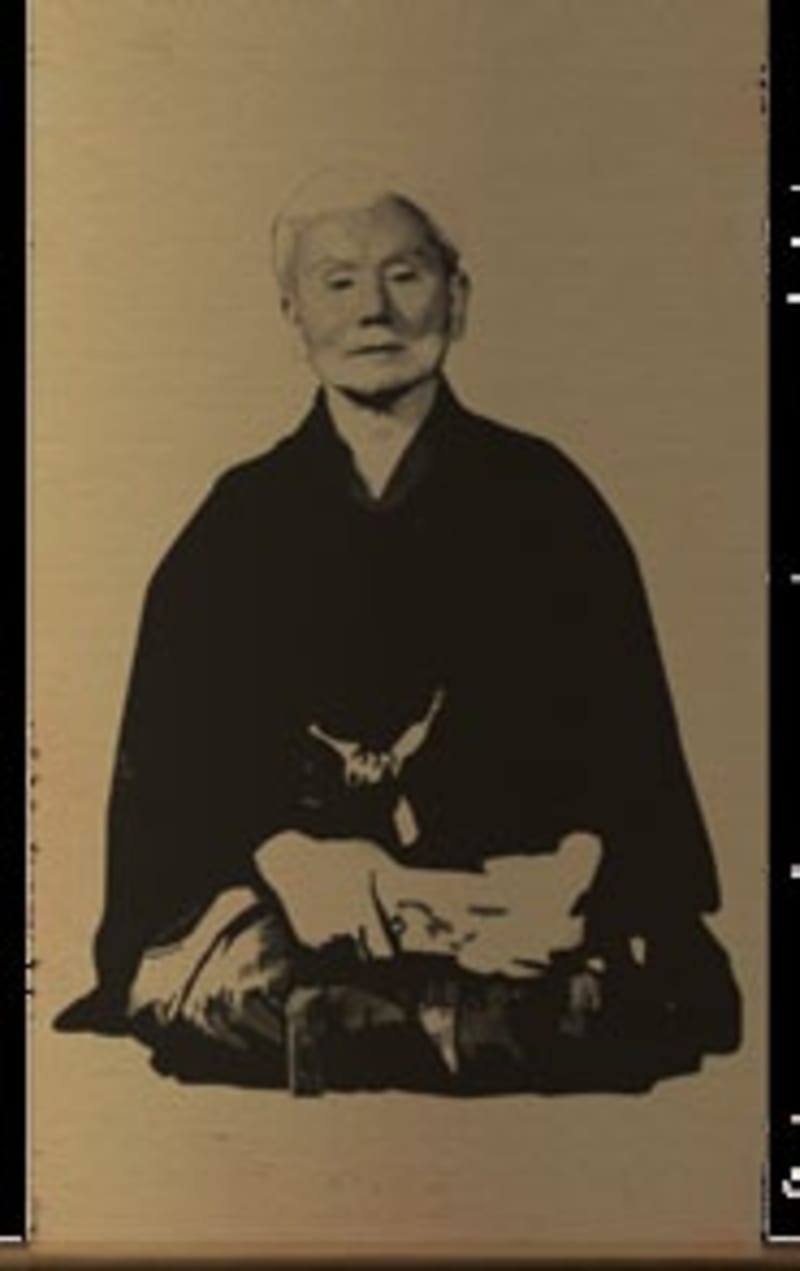
Gichin Funakoshi — Father of Modern Karate
Gichin Funakoshi (1868–1957) brought Karate from Okinawa to Japan and shaped it into a philosophical discipline — his legacy is Shotokan.
Contents
Overview
Gichin Funakoshi is the man who transformed Karate from a secret Okinawan fighting art into a worldwide movement. He traveled to Tokyo in 1922 at age 53 — originally for a demonstration — and stayed for the rest of his life. Funakoshi was no great athlete; he was a poet, teacher, and philosopher who saw Karate as a means of character development. His maxim — “The ultimate aim of Karate lies not in victory or defeat, but in the perfection of the character of its participants” — defines what martial arts as a life path can mean.
| Birth name | Funakoshi Gichin (船越義珍) |
| Born | November 10, 1868, Shuri, Okinawa |
| Died | April 26, 1957, Tokyo |
| Martial art | Shotokan Karate (founder), Shorin-ryu, Shorei-ryu |
| Teachers | Yasutsune Azato, Yasutsune Itosu |
| Notable students | Mas Oyama, Isao Obata, Shigeru Egami |
Early Life and Training
Funakoshi was born into the impoverished remnants of a samurai family; his childhood coincided with the Meiji Restoration, which dismantled the old order of Okinawa. As a sickly child, he was entrusted to Karate teacher Yasutsune Azato — the training was meant to improve his health.
He became a student of two grandmasters: Azato, who came from the nobility and rarely accepted students, and Yasutsune Itosu, the reformer who first introduced Karate into schools. Funakoshi trained for decades in silence, worked as an elementary school teacher, and practiced secretly by moonlight at night.
Turning Points
In 1922, Funakoshi demonstrated Karate at a national athletics exhibition in Tokyo — and so impressed Judo founder Jigoro Kano that Kano asked him to stay. He stayed. He wrote the first Japanese book on Karate (Ryukyu Kempo: Karate, 1922) and began systematically teaching at universities.
In 1936, he opened his own dojo in Tokyo — the Shōtōkan (House of Shōtō, his pen name). Students hung a sign above the door and the style was named.
During World War II the Shōtōkan dojo was destroyed; Funakoshi lost a son. He rebuilt everything. When he died in 1957, he had transformed the spirit of his homeland into a global movement.
Techniques and Principles
Shotokan is characterized by deep, stable stances and linear attack-defense movements:
| Element | Description |
|---|---|
| Kihon | Basic techniques — punches, kicks, blocks |
| Kata | 26 forms (Heian, Tekki, Bassai, Kanku, etc.) |
| Kumite | Controlled partner practice and competition |
| Stances | Zenkutsu-dachi (deep front), Kiba-dachi (horse) |
Funakoshi renamed the kata with Japanese names — a deliberate decision to position Karate as Japanese (not Okinawan) art.
Philosophy
Funakoshi’s Twenty Guiding Principles (Niju Kun) are his philosophical legacy. The first: “Karate begins and ends with respect.” The fifth: “There is no first attack in Karate” (Karate ni sente nashi) — a pacifist stance defining Karate as a defensive art.
He saw Karate as Do — a path, not merely technique. The body is the medium; character development is the goal. This stance put him in conflict with students who prioritized competition and effectiveness — among them Mas Oyama, who founded Kyokushin.
Students and Legacy
- Mas Oyama — Founder of Kyokushin Karate (full contact)
- Hidetaka Nishiyama — Co-founder of the Japan Karate Association (JKA)
- Gigo Funakoshi (son) — Developed a more dynamic variant of Shotokan
Today Shotokan is the world’s most widely practiced Karate style, represented by several competing international organizations.
Connections to Other Arts
Funakoshi explicitly studied Judo under Jigoro Kano and integrated its pedagogy into his teaching. His student Mas Oyama created Kyokushin as a reaction to Funakoshi’s rejection of full contact. Goju-ryu and Shorin-ryu share Okinawan roots with Shotokan.
Today
Shotokan is practiced in hundreds of thousands of dojos worldwide. Funakoshi’s philosophical writings are required reading in many martial arts schools. His legacy extends beyond the style to the very idea that martial art is character building — a concept that has shaped the entire modern Budo culture.
Related Articles
- Shotokan Karate
- Kyokushin Karate
- Bushido — The Way of the Warrior
- Reigi — the first of his twenty precepts, read closely
- Okinawan Karate — where he came from — and what the Shōrin/Shōrei division really is
- Ankō Itosu — his teacher, whose 1901 school decision everything later presupposes
- Kenwa Mabuni — the same teacher Itosu, the opposite answer — collecting instead of simplifying
- Chōki Motobu — the rival whose 1922 victory King magazine illustrated with Funakoshi’s face