Makiwara — Not a Conditioning Device but a Measuring Device
A heavy bag absorbs a bad punch too. A makiwara does not — and that, rather than the callus, is what it is for.
Contents
The makiwara (巻藁, “wrapped straw”) is karate’s oldest purpose-built training device and the one about which most nonsense circulates. Gichin Funakoshi called it the most important piece of equipment there is and devoted diagrams to it in his manual Karate-dō Kyōhan. Today it stands in very few dojo.
The common explanation for both facts is the same, and it is wrong: that the makiwara serves conditioning, the building of calluses over the knuckles. The callus does form — as a side effect. The actual purpose is different, and it can be stated in one sentence:
A heavy bag gives way even to a bad punch. A makiwara does not.
Construction
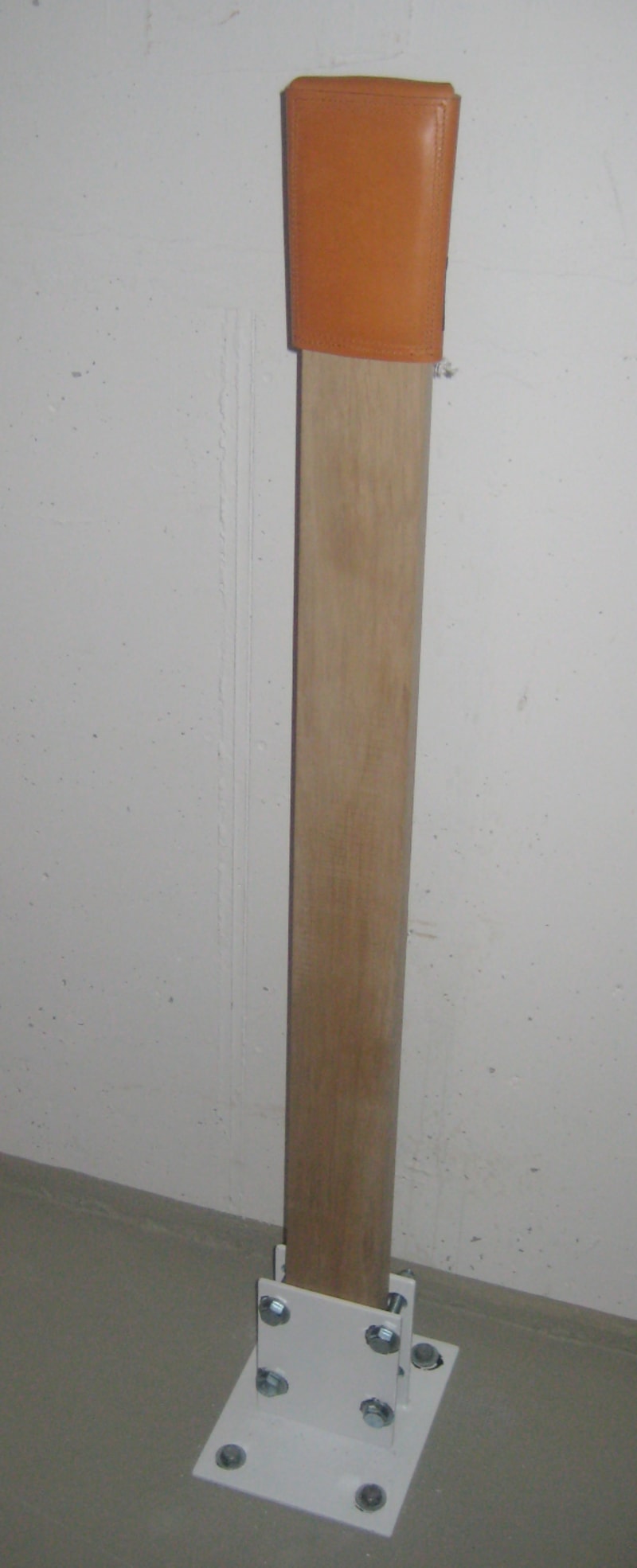
The classical form, the tachi-makiwara (standing makiwara), is a single post anchored in the ground and tapered towards the top.
| Feature | Specification |
|---|---|
| Length | 2.1–2.4 m, a substantial part of it in the ground |
| Cross-section at the base | several centimetres thick, effectively immovable |
| Cross-section at the top | tapering to about 1 cm |
| Material | resilient wood, traditionally local Okinawan timbers |
| Striking surface | straw pad, bound with rope |
| Height of the striking surface | roughly at one’s own shoulder |
That taper is not decoration. It is the entire technology of the device.
Why the taper decides everything
A post of even thickness would offer the same resistance throughout the movement. A tapered one does not: at the start of travel it yields easily, and the further it is bent, the more steeply the counterforce rises — because the bend progressively recruits the thicker sections nearer the ground.
From this follows what makes the device: resistance grows precisely as the punch arrives. A punch driven only by the arm does not get through here — the arm buckles, the shoulder gives, and the post springs back against the striker. A punch coupled through foot, hip, torso and shoulder bends the post and absorbs the recoil.
The difference is felt immediately. This is exactly what a heavy bag cannot do: it has much mass and little restoring force, gives way, and disguises a structurally faulty punch by swallowing it. The makiwara answers back.
What is actually trained
- Body structure under load — the chain from ground to fist must be closed at the moment of impact, or there is no effect
- Wrist alignment — a bent fist is corrected at once and painfully; it is the commonest beginner’s fault and goes unnoticed for a long time on a bag
- Distance — the post stands fixed, so you must come to it rather than it to you
- The return — the restoring force compels the hand to be withdrawn; anyone who stays put is pushed by the device
- The timing of tension — the brief bracing at impact can be trained here because there is a target that resists
The calluses are exactly what they appear to be: a skin response to repeated loading. They do not make the punch stronger, and they are no proof of skill.
What the evidence supports
Honestly: little, and less than is often claimed.
There is no study setting makiwara training against other impact training and comparing force, structure or injury risk. What exists is work on bone mineral density in martial artists. A pilot study of hand-strengthening methods found an increase in bone density in both arms after the intervention — 2.1 per cent on the right, 1.6 per cent on the left. That is a plausible result in terms of Wolff’s law, by which bone adapts to loading. But it is a pilot study with a small sample and a small effect, and it does not examine the makiwara specifically.
Broader work on martial arts and bone density in adolescents finds effects above all for judo and kung fu and differentiates by body region. For the specific claim that “the makiwara measurably densifies the bones of the hand”, that is not evidence but an indication that the direction might be right.
This is no reason to reject the device — its benefit lies in the feedback, not in bone density. It is a reason not to pass on the usual figures.
The arthritis objection
It is regularly claimed that makiwara training causes arthritis in the finger joints. Here too the evidence is thinner than the tone of the debate: there are case reports and a great deal of experience, but no robust cohort study following makiwara practitioners across decades.
What can sensibly be said is mechanical: the loading is only harmless if it runs straight through the two leading knuckles and an extended wrist. Strike at an angle and you load joint surfaces transversely, and that is the same small trauma on every repetition. The advice to start slowly and with little force is therefore not ritual but the actual safety rule.
Why it disappeared
The makiwara was not forgotten because it had been refuted. It disappeared because the question training answers has changed.
In competition karate contact is controlled; technique, timing and distance are scored, not penetration. A device that tests only whether a punch arrives with full body coupling answers a question nobody there is asking any more. Add the practical problem: a standing makiwara needs an anchor in the floor, and most rented sports halls do not allow one.
Anyone wanting to follow the thread further will find it developed in the article on kime: the dispute over whether terminal bracing in empty air is a training artefact hangs directly on the disappearance of the makiwara.
Connections to other martial arts
- Hojo undo — the makiwara is part of the Okinawan canon of tools, and the same logic carries all the others
- Kime — the concept for which the makiwara was the test case
- Gōjū-ryū and Uechi-ryū — the Okinawan styles in which it stayed in use longest
- Shōtōkan — Funakoshi’s style, where the device came along at first and later almost vanished
- Boxing — the heavy bag solves the other half of the task: endurance, combinations and movement around a target; the two devices do not replace one another
Today
Makiwara are available again, including wall-mounted and spring-footed designs that need no floor anchor. They have remained a niche item, but are well established in Okinawan-oriented schools and among practitioners working on punching structure.
Sensible use is unspectacular: few repetitions, controlled force, clean alignment, over years rather than weeks. Anyone using the device as a test of toughness has misunderstood what it was built for — it does not measure how much you can take, but whether you are standing correctly.
Related Articles
- Karate
- Kime
- Hojo Undo
- Gōjū-ryū
- Uechi-ryū
- Shōtōkan
- Punching Structure Programme — the device as the test of progress — four stages, no week counts
- Grip Strength Programme — the same construction on the gripping side: a device that tests the movement rather than loading a muscle
- Conditioning Programme — the Chinese hardening as a programme — with a test that, unlike here, runs over months
- Kanbun Uechi — the same question from the Okinawan side: how do you make a bare hand able to take load