Jōdō — an Art That Exists Only Because the Sword Does
Every jō form is an answer to the sword. The reason is not a duel but a job: the domain police had to arrest, not kill.
Lineage
Contents
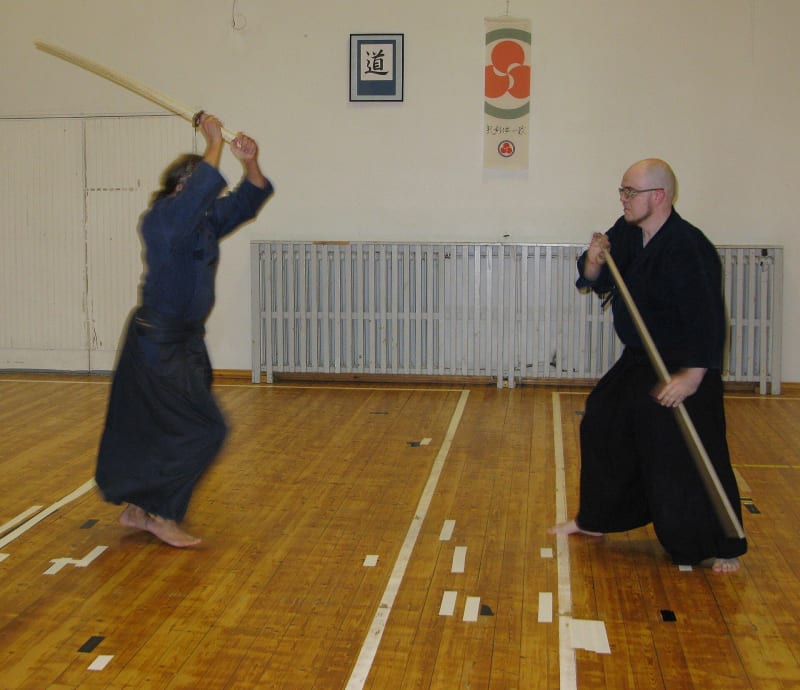
Jōdō (杖道), the “way of the stick”, is the Japanese art of the jō — a plain round staff about 128 cm long. Its main line is Shintō Musō-ryū, founded in the early seventeenth century by Musō Gonnosuke Katsuyoshi and the oldest formalised jō system in Japan.
What sets it apart from every other weapon art in this collection is written into the curriculum: there is no jō against jō. Every form is jō against sword. The stick has no duel of its own, no contest with its like, no solo form without an opponent — it has one task, and that task is defined by the other man’s weapon.
The usual explanation for this is a duelling story. The one that holds is a job: the jō was a tool of the domain police, and police have to arrest, not kill. From that single requirement the rest follows — the length, the material, the technique, and even the auxiliary arts the school absorbed.
The founding story — and what it is worth
The tradition runs like this. Gonnosuke, an experienced fencer, challenged Miyamoto Musashi and lost. He withdrew to Mount Hōman in Kyūshū, received an insight there, shortened his six-shaku bō to a little over four — and came through the second encounter.
That story is this article’s weakest source, and it should stand here as such. Scholarship disputes the date and place of the duel, and part of it doubts that it happened at all. For the second meeting there is no reliable source outside the Shintō Musō-ryū tradition itself — that is, no independent confirmation of precisely the part on which the founding rests.
This is the same situation as at Wudang, Subak and Pangai-noon: the school exists, its technique is transmitted, only the founding scene cannot be tested. The article does not need it either — the solid reason for the jō’s design comes below, and it is better.
Two hundred years of police work
Shintō Musō-ryū became the art of the Kuroda domain in Fukuoka and was kept secret there for some two centuries, practised essentially by the domain police.
That is the key, and the school proves it itself. Its third headmaster, Matsuzaki Kinu’emon Tsunekatsu, added two auxiliary arts in the late seventeenth century, and both are police equipment:
| Auxiliary art | What it is |
|---|---|
| Ikkaku-ryū juttejutsu | the jutte, the truncheon of the Edo-period police — originally a whole system of seizing and arresting techniques |
| Ittatsu-ryū hojōjutsu | restraining with rope, used by police forces into modern times |
Alongside these come tanjō (walking stick), kusarigama and a kenjutsu line of its own.
A martial art that takes the official truncheon and the arresting cord into its curriculum is not a battlefield system. It is training for a profession whose task reads: take an armed man out of circulation alive and, if possible, undamaged.
Why the jō looks the way it does
From that single task the weapon can be derived without invoking a single legend:
- Length about 128 cm. Longer than the sword reaches in the hand that holds it, short enough still to turn at close quarters. The jō gains the distance without losing it.
- Round and without an end. It has no point and no edge, so it has no “front”. Both ends work and the hands travel — which produces the reach characteristic of jōdō, one that changes mid-movement.
- Wood. A stick can break, press, lever and disarm without killing. That is exactly what an arrest requires.
- Always against the sword. Because the opponent the police had to expect carried one.
This is the point at which the article sharpens the argument of the stick fighting comparison. The guiding question there is: does the stick stand in for a blade, or is it the weapon itself? Jōdō is the clearest case of the second answer — and supplies a third category alongside it: the stick is the weapon, and the blade is the problem. None of the eight traditions treated there is so completely conceived from the opponent outward.
Technical foundations
| Feature | Form |
|---|---|
| Weapon | jō, plain round staff, about 128 cm |
| Counterpart | sword (in practice: bokutō) |
| Mode of practice | paired kata only; no solo forms without a partner |
| Technique groups | thrust, strike, block, lever, disarm |
| Objective | control and disarmament, not destruction |
| Competition | kata competition, no free fighting |
That last point deserves precision, because it is often stated wrongly — including in this article’s first draft. Jōdō does hold competitions. The All Japan Jōdō Taikai is in its 53rd edition, and European Championships have been held since 2009. It is, however, a kata competition: three kata are performed per match and scored by judges; there is no free fighting against a resisting opponent.
One detail of the format belongs here because it confirms this article’s argument: only the jō side is judged. The sword side is supplied by whichever competitors are not currently competing — it is a service role, not a contestant. Even in a tournament, then, the sword is not the opponent but the problem.
Jōdō therefore sits exactly between the two poles this collection describes: not as ruleset-shaped as kendō or sport fencing, but not without any test at all either, as a pure solo form would be.
1968: the same art a second time
As with iaidō, jōdō today exists twice over.
Alongside the koryū line stands the Seitei Jōdō of the All Japan Kendo Federation (ZNKR): twelve paired kata, selected from Shintō Musō-ryū and assembled in the 1960s together with senior teachers of the school; the grading requirements were defined in 1968. The purpose was standardisation — a body of material a federation can examine and teach at scale.
That is once again the pattern this collection describes from qigong through changquan to the grading systems: a grown practice takes on the shape its institution requires. The difference here is a pleasant one — the koryū line was not replaced but continues alongside, and many practitioners do both. The seitei set is expressly meant as a foundation from which to move on into the classical line.
Connections to other martial arts
- Bōjutsu — the starting point: the jō is a shortened bō, and the whole difference lies in what the shortening makes possible.
- Kenjutsu — the counterpart in every single form. Anyone practising jōdō necessarily practises the sword side too; Shintō Musō-ryū carries a kenjutsu line of its own.
- Iaidō — the nearest relative structurally: likewise koryū plus a ZNKR seitei set, likewise no competition in the proper sense.
- Kendō — the opposite pole: the same weapon, but shaped entirely by a ruleset. Jōdō shows what an encounter with a sword looks like when nobody is counting points.
- Stick fighting compared — where the guiding question stands that this article extends by one answer.
- HEMA — the European counter-case: there the line broke and was retrieved from texts; here it is continuous and the texts are the secondary matter.
Today
Jōdō is practised worldwide, mostly in the neighbourhood of kendō and iaidō groups and through their federation structures; the number of practitioners is small. Entry is cheap — a jō and a bokutō — and the risk of injury low, because work is exclusively in agreed forms with a partner.
Two notes for placing it. First: is a distinction drawn between seitei and koryū? Both are legitimate and both are usually taught together, but they are two different things with two different purposes — a set of grading requirements from 1968 and a school from the seventeenth century. Second: how is the Musashi story told? As tradition it is fine; passed on as fact it claims more than anyone can substantiate.
The real appeal lies elsewhere, and it is unusual. Jōdō is one of the few martial arts whose technical peculiarities can be derived entirely from its task, with no philosophy, no founding miracle and no ruleset. You only need to know what a policeman in seventeenth-century Fukuoka had to do — the rest follows.
Related articles
- Bōjutsu
- Kenjutsu
- Iaidō
- Kendō
- Stick Fighting Compared
- HEMA
- Musō Gonnosuke — the founder — and what of him is documented once the sources are ordered by date