Okinawan Kobudo — The Weapon Arts of the Ryukyu Islands
The weapon system of the Ryukyu Islands, built from everyday tools. That weapons bans produced it is the popular telling — not the finding.
Lineage
Origins
Contents
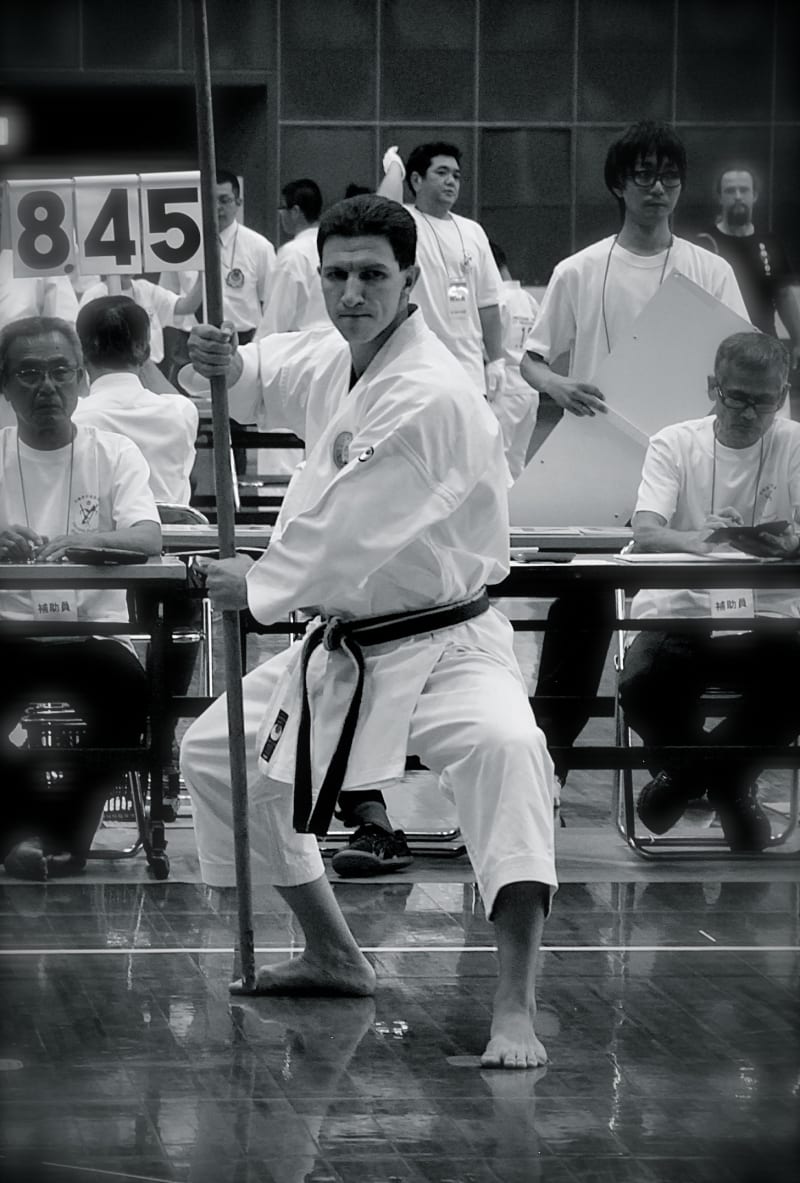
Okinawan Kobudo (琉球古武道, Ryūkyū Kobudo, “old combat arts of the Ryukyu”) is the traditional weapon system of the Ryukyu Islands — today’s Okinawa and the surrounding archipelago. What distinguishes Kobudo from other weapon systems: many of its classical weapons are not original warfare weapons but repurposed farm tools — rice flails became nunchaku, threshing sticks became the Bō, sickles became Kama, millstone handles became Tonfa. This transformation arose from historical necessity: the Ryukyu Kingdom faced weapons bans twice — once under Japanese Satsuma rule (1609), once earlier under King Shō Hashi. The farmers and merchants of the islands, forbidden from carrying swords, transformed their daily tools into combat weapons. Kobudo developed parallel to Karate and forms its natural complement: what the empty hand cannot do, the weapon can — and what the weapon cannot do, the empty hand can.
History
Ryukyu — The Trade Center
The Ryukyu Islands lay at the intersection of trade routes between Japan, China, and Southeast Asia. This intensive cultural exchange brought Chinese and Southeast Asian weapon techniques to the islands — and local Okinawans developed independent systems from them.
Weapons Bans — and What They Explain
Early 15th century: King Shō Hashi unifies the Ryukyu Islands and issues a weapons ban — to suppress rivalries between local nobles.
1609: The Japanese Satsuma domain conquers Okinawa and issues a strict weapons ban again. Swords, spears, and bows are forbidden to the general population.
The usual telling ends here: the bans forced the population to reach for everyday tools, and so Kobudo arose. The Karate article sets out why that connection is weaker than it sounds — the bans were aimed above all at controlling the nobility, not at a defenceless peasantry. What is documented is that Kobudo’s weapons derive from everyday implements; the bans as their cause are an interpretation, not a source.
Formalization (20th century)
Taira Shinken (1897–1970) is the key figure in modern Kobudo preservation. He traveled throughout Okinawa, collected Kobudo systems from old masters, documented them, and founded the Ryūkyū Kobudō Hozon Shinkokai (Society for the Preservation of Ryukyu Kobudo). Without his work, many systems would have been lost after World War II.
The Five Primary Weapons
| Weapon | Origin | Length | Characteristic |
|---|---|---|---|
| Bō | Walking staff / carrying pole | ~182 cm | Long range, rotational force |
| Sai | Unknown (China/India influence) | ~46 cm | Trident parrying tool, catching |
| Nunchaku | Rice flail / horse bridle | ~30 cm/side | Chain-connected, flexible force |
| Tonfa | Millstone handle | ~46 cm | Forearm shield + striking weapon |
| Kama | Harvest sickle | ~30 cm | Sharp blade, most dangerous to practice |
Bō — the most common entry point: the simplest system to learn (no sharp element), with great range and versatility.
Sai — the most iconic weapon: three prongs enable sword-catching, disarming, and striking force simultaneously.
Nunchaku — famous through Bruce Lee: two connected sticks with rotational force and surprise element.
Additional Kobudo Weapons
Beyond the five primary weapons, Kobudo encompasses many more:
| Weapon | Type |
|---|---|
| Eku | Oar (boat-oar combat) |
| Tinbe-Rochin | Shield and short sword |
| Suruchin | Weighted chain cord |
| Nunti | Spear-throwing system |
| Sansetsukon | Three-section staff |
Core Techniques
Kobudo training follows Karate’s Kata principle: prescribed movement sequences against imaginary opponents. Each weapon has its own Kata series.
Bō fundamental techniques: Tsuki (thrust) · Uchi (strike) · Harai (deflect/sweep) · Nuki (pull-slide)
Sai-specific: Manual rotation (spinning Sai around its own axis) · Parrying technique · Sai as thrown weapon
Nunchaku technique: Rotation · Trap (catching) · Strike from rotational momentum
Philosophy
Kobudo carries the same ethical foundation as Karate: Budo as path of character development. The weapon is not the goal but a tool for developing precision, respect, and responsibility.
Sai training is particularly symbolic: a weapon without a blade that primarily teaches defense and control — not attack.
“The weapon is the extension of the mind. When the mind is calm, the weapon is precise.” — Okinawan tradition
Connections to Other Martial Arts
- Okinawan Karate — inseparably connected; Karate and Kobudo were traditionally taught together; empty hand and weapon are two sides of the same system
- Naginatajutsu and Sōjutsu — Japanese parallels: polearms with similar fundamental principles
- Escrima/Arnis — Southeast Asian counterpart; both use simple materials and emphasize range control
Today
Okinawan Kobudo is taught worldwide in Karate dojos — often as supplementary curriculum. The Ryukyu Kobudo Hozon Shinkokai and other organizations manage the traditional transmission. In Okinawa, Kobudo is part of cultural heritage and is shown in schools and festivals.
Related Articles
- Shotokan Karate
- Goju-ryu
- Naginatajutsu
- Budo
- Matsumura Sōkon — he introduced the Jigen-ryū principles here and laid the foundation of Tsuken bōjutsu