Shu-Ha-Ri — The Three Stages of Learning
Shu-Ha-Ri describes three stages of learning: keep, break, leave. Its origin lies not in combat but in the way of tea — and the final stage is not freedom.
Contents
Shu-Ha-Ri (守破離) is the best-known model of learning in the Japanese ways of practice: Shu — keep the form. Ha — break the form. Ri — leave the form. It appears in dojo brochures, in grading syllabi, and since the 2000s in software engineering handbooks. The usual narrative runs: first you obey, then you experiment, then you are free. That is an abbreviation, and it inverts the meaning of the model. The triad comes not from a martial art but from the way of tea and from Nō theatre — from arts in which form is not a means to an end but the content itself. And the sentence from which the term was extracted ends with a warning that is almost always dropped: do not forget the root. Shu-Ha-Ri does not describe an ascent out of form, but an ever deeper relationship to it. Someone who has reached Ri has not left the form behind — they have become it.
Origin: tea and theatre, not the sword
The building blocks of the model are older than the term.
The first is supplied by Zeami Motokiyo (1363–1443), the great theorist of Nō. In his writings on the training of actors, above all the Fūshikaden, he orders practice by stage of life: what a nine-year-old should imitate, what a twenty-year-old must work out, what only a fifty-year-old is permitted to leave out. The idea that the same exercise means something entirely different in different phases is thus formulated before 1440.
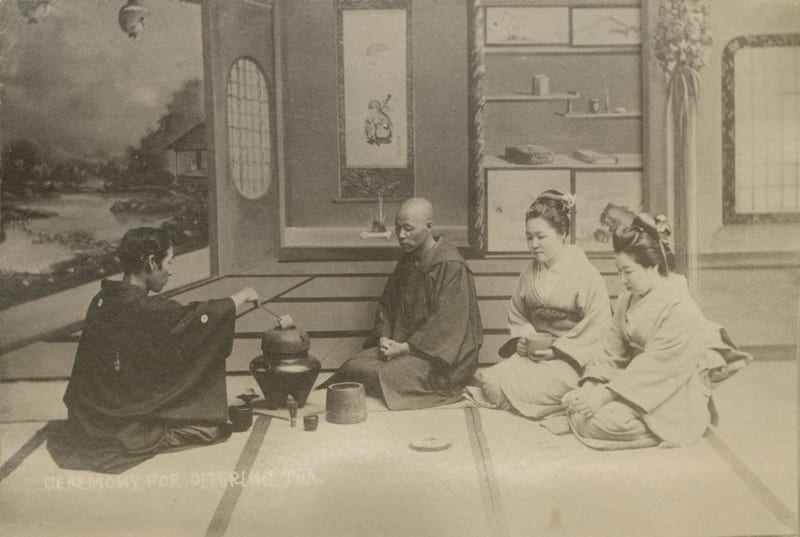
The second is supplied by the tea master Sen no Rikyū (1522–1591), or more precisely by the collection of didactic poems attributed to him (Rikyū Dōka). There stands the line from which Shu-Ha-Ri was later read out:
規矩作法 守り尽くして破るとも 離るるとても 本を忘るな
“Exhaust the keeping of measure and form; even when you then break them, even when you leave them — do not forget the root.”
The three syllables shu, ha and ri are already present in this verse, but not as a model. They were bundled into a fixed triad only by the tea master Kawakami Fuhaku (1719–1807), who made the teaching of the Sen family accessible to a wider public. Only with him does “Shuhari” exist as a term.
The model therefore enters the martial arts from outside — and late. It originally describes how to ladle tea water and how to enter a stage, not how to throw an opponent. This explains why it applies so well to kata and so badly to free fighting: it was devised for arts whose moment of truth is a performance.
The three stages
| Stage | Kanji | Literally | What the student does | What the teacher does | Typical error |
|---|---|---|---|---|---|
| Shu | 守 | keep, protect | Copy the transmitted form exactly, without judging it | Prescribe and correct | Wanting to “understand” too early |
| Ha | 破 | break, break through | Test the form for its reasons, examine other schools’ variants | Explain why the form is as it is | Deviating without having mastered the form |
| Ri | 離 | leave, separate | Act without reference to the form, because it has become one’s own movement | Let go | Awarding oneself this stage |
Shu is the longest stage and the only one in which the student has no say. Its purpose is not submission but preservation in the literal sense: the form is a compressed store of experience, and whoever changes it before knowing it overwrites experience with opinion. In kendo, Shu means practising the same cut ten thousand times; in karate, walking the kata line by line exactly as it was shown.
Ha is the dangerous stage. The form is not discarded but interrogated: why does the foot stand here? Why does the hand withdraw? Anyone who asks these questions regularly discovers that the transmitted explanation and the practised execution have come apart — the same observation that carries the entire dispute about the withdrawing hand in the comparison of hikite and the boxing guard. Ha means noticing the difference without therefore throwing the form away.
Ri is the most misunderstood stage. “Leaving” sounds like freedom, and the common reading follows accordingly: your own style, your own school, your own rules. Rikyū’s verse says the opposite. Ri is reached when the form no longer has to be followed, because it no longer lies outside the practitioner. The master does not break the form — it simply always happens to be correct.
The forgotten fourth part
The decisive half-line stands at the end: 本を忘るな — hon o wasuru na, “do not forget the root”. 本 (hon) means root, book, origin, foundation.
It is not a pious addendum but the condition under which the three stages amount to a model at all. Without it, Shu-Ha-Ri is a ladder to be kicked away once you are at the top — and that is exactly how it is usually quoted. With it, the model is a circle: Ri leads back to Shu, only on another level. Experienced teachers describe this consistently: over the years the basic techniques do not become less important but harder.
The aikido teacher Endō Seishirō put it in its simplest form in a much-quoted 2005 interview: it is well known, he said, that in learning one passes through the stages of shu, ha and ri — less well known is that one does not complete them, but begins again from the start with every new thing.
Not to be confused: Jo-Ha-Kyū
A frequent error in Western accounts is the conflation with Jo-Ha-Kyū (序破急, “introduction — break — rapid”). Both terms contain the character 破, both come from the world of Nō, and both are readily translated as “three phases”. They describe entirely different things.
| Shu-Ha-Ri | Jo-Ha-Kyū | |
|---|---|---|
| Describes | The learning stages of a person | The rhythm of a sequence |
| Timescale | Years to decades | Seconds to hours |
| Origin | Way of tea (Fuhaku, 18th c.) | Court music gagaku, adopted by Zeami |
| Use in budō | Path of training, grading | Building of tempo in a kata, in an attack |
A kata has Jo-Ha-Kyū: slow opening, acceleration, abrupt close. A karateka has Shu-Ha-Ri. Confusing the two produces sentences such as “the kata passes through Shu-Ha-Ri”, which mean nothing.
In the martial arts
The model was adopted above all where kata stands at the centre:
- Aikido — probably the widest use, largely through Endō Seishirō and other second-generation students. Aikido practice, with its fixed pairs of attack and answer, offers the clearest counterpart to Shu.
- Kendo and iaidō — here Shu-Ha-Ri maps almost exactly onto the relationship between kata and shiai: the kihon waza are Shu, testing them in practice matches is Ha.
- Karate — widespread as a reading of the relationship between kata (form), bunkai (disassembly, therefore Ha) and kumite (free application).
- Koryū schools — with the strongest reservations. Where a school understands its forms as a closed inheritance, a stage called “break” is delicate; some lines reject the model explicitly for this reason.
The counter-test is striking. In systems without a fixed canon of forms — boxing, wrestling, BJJ — Shu-Ha-Ri plays virtually no role. Not because nobody learns there, but because there is no canonical form to keep or to break. The model presupposes a transmission with a clear edge.
What the model does not deliver
Three objections deserve to be taken seriously:
It says nothing about duration. Shu-Ha-Ri knows no numbers of years. The equation “Shu = up to black belt” is an invention of modern federations. Rikyū and Fuhaku were addressing people who pursued an art for a lifetime.
It cannot be verified. None of the three stages has a criterion by which an outsider could read off where someone stands. In practice the teacher decides — which makes the model liable to justify authority rather than describe ability. The sentence “you are still in Shu” ends any discussion.
It describes an art, not a fight. The origin and construction of the model aim at arts with a fixed form. For the question of whether a technique works against a resisting opponent, Shu-Ha-Ri has no answer — that requires pressure testing, not stages.
Today
Remarkable is the model’s second career outside the martial arts. By way of agile software development — substantially through Alistair Cockburn — Shu-Ha-Ri has since the early 2000s been a fixture of methodology training: first work by the book, then adapt, then transcend the method. The transfer is astonishingly lossless, because it addresses the same underlying problem: how do you teach someone a practice whose point they will only understand after having performed it for a while without understanding it.
The term’s journey is thus unusually long: from Nō theatre through the tea room into the dojos of the twentieth century and from there into development teams — without its core changing. What has changed is the ending. Almost everywhere the list now closes with “Ri”, that is, with freedom. In Rikyū it closes with hon o wasuru na.
Related Articles
Related Articles