Matsumura Sōkon — the Root of the Shuri Line, and Where the Evidence Thins
Nearly every Shuri line traces back to him. Even his dates are disputed — and what he brought to Okinawa was Japanese sword principle, not Chinese.
Contents
Overview
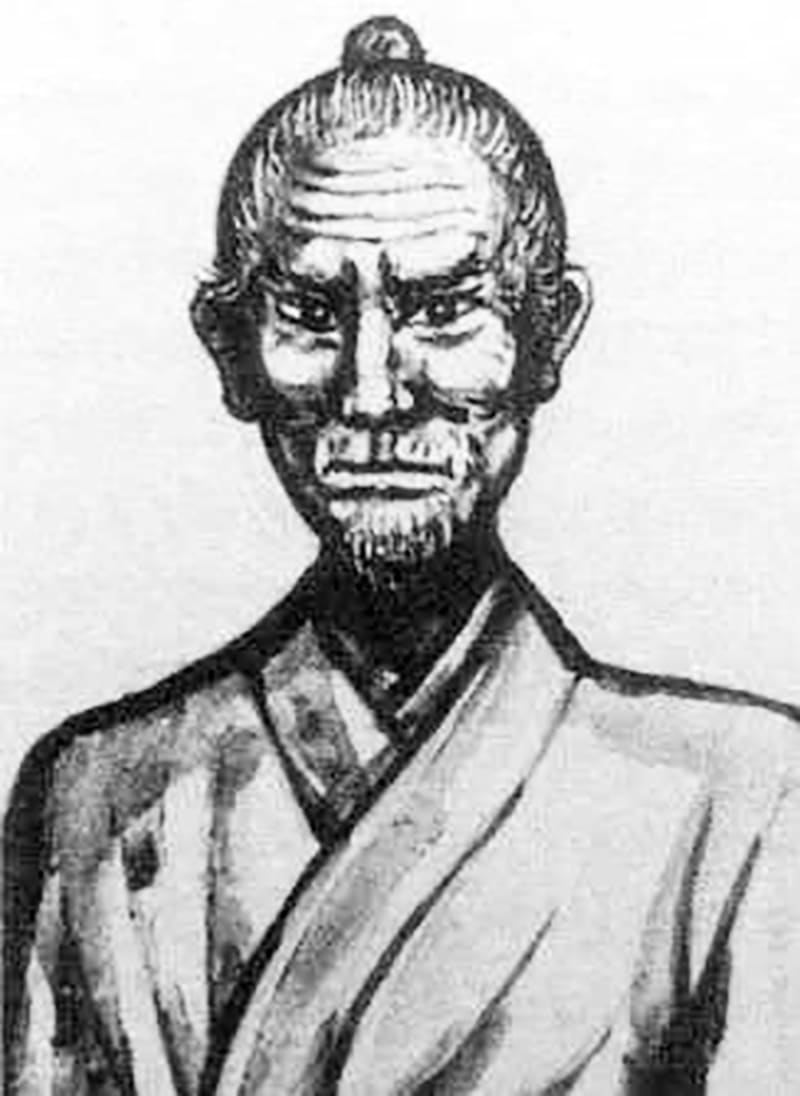
Matsumura Sōkon (松村宗棍) was bodyguard and chief martial arts instructor to three Ryūkyūan kings and counts as the root of Shuri-te. Practically every modern karate style tracing itself to that line — Shōrin-ryū, Shōtōkan, Shitō-ryū, Wadō-ryū — runs through him.
Two things make him particularly interesting for this encyclopedia, and both are uncomfortable.
First, not even his dates are secure. He is the figure at which the Okinawan tradition begins to thin — at exactly the point where all the lines converge.
Second, the transmission did not run in the expected direction with him. The usual account of karate leads from China to Okinawa. Matsumura brought Japanese sword principles back.
The dating — and a correction in our own house
At least four variants of his dates circulate in the literature:
| Variant | |
|---|---|
| 1809–1901 | |
| 1798–1890 | |
| 1809–1896 | |
| 1800–1892 | |
| 1809–1899 | tomb plaque, placed by the family — age about 90 |
The tomb plaque is the best available source, because it comes from the people who had to know and because it is an object rather than a copy. This article follows it.
And in our own house: this encyclopedia’s stock listed Matsumura as 1797–1889. That figure belongs to none of the reported variants and departs from the tomb plaque by twelve and ten years. It is corrected with this article.
Training and office
Matsumura studied under Sakugawa Kanga, the formative teacher of early tōde. Tradition holds that Sakugawa was already old and at first unwilling, but took the boy on because he had promised his father — five years of instruction.
From 1836 he served King Shō Kō; he subsequently served the last two kings Shō Iku and Shō Tai and became chief martial arts instructor and bodyguard to the court. His rank was shikudon.
From the king he received the title bushi — “warrior” — in recognition of his ability. He is still usually known as Bushi Matsumura.
The same court, the same ending
The stock records elsewhere that Ankō Itosu was secretary to the last king — the same Shō Tai. Teacher and student thus served the same court: one as bodyguard, the other as scribe.
In 1879 Japan abolished the monarchy. Both lost their footing with it — and what Itosu then did to find a new one for his art is the subject of his own article.
The direction nobody expects
Matsumura travelled on behalf of the royal government — and in both directions:
| Destination | What he did there |
|---|---|
| Fuzhou, Fujian | studied chuan fa and further Chinese martial arts |
| Satsuma, Japan | studied the sword system Jigen-ryū |
The second is the remarkable one. Matsumura was the first to introduce the principles of Jigen-ryū — a Satsuma sword school, that is, a kenjutsu line — into Ryūkyūan kobujutsu. The foundation of the bōjutsu of Tsuken also goes back to him.
That cuts against the usual account. The article on Okinawan karate describes the transmission from China to Okinawa as following a trade route and a class order. With Matsumura a second direction appears: Japan → Okinawa, half a century before the Japanification of the twentieth century, and not as appropriation but as an official journey followed by adoption.
He was an official of a kingdom situated between two great powers and maintaining relations with both. His martial art looks exactly like that.
What is handed down of him
Kata traced to him: naihanchi, passai, seisan, chintō, gojūshiho, kūsankū. That is the core stock of Shuri-te.
Students — and the list explains his standing better than any characterisation:
| Student | |
|---|---|
| Ankō Itosu | brought karate into the schools |
| Ankō Asato | the second great teacher of the Shuri line |
| Motobu Chōki and Motobu Chōyū | the brothers from the Motobu Udun |
| Kentsū Yabu, Hanashiro Chōmo | the first karate teachers in the school service |
| Chōtoku Kyan, Nabe Matsumura | bearers of their own lines |
A source caveat belongs here: some accounts also list Gichin Funakoshi as his student. The stock names Azato and Itosu as Funakoshi’s teachers; direct discipleship under Matsumura is therefore not excluded, but it is not the account this stock follows.
Why he is the point at which the evidence thins
The preceding portraits in this series can be ordered by how well documented they are, and Matsumura sits near the bottom:
| Evidence | |
|---|---|
| Takeda Sōkaku | fee ledgers, seminars individually traceable |
| Kanbun Uechi | path handed down year by year |
| Ankō Itosu | dates of office, a dated letter from 1908 |
| Matsumura Sōkon | office and title documented, the dates not |
| Musō Gonnosuke | almost nothing |
The reason is the same as everywhere in this stock: what was administered is verifiable. Matsumura’s office is on record because a court records offices. His life is not, because nobody wrote it down — and in the end his family had to inscribe a grave to fix it.
Related Articles
- Shōrin-ryū — the line he systematised
- Ankō Itosu — his student, secretary to the same king, and the man who brought the art into schools
- Chōki Motobu — another student, and the counter-position to schooling
- Okinawan karate — the context whose usual direction he reverses
- Okinawan kobudō — where he brought the Jigen-ryū principles
- Karate — the overview of the style family that goes back to him
- Kenjutsu — the Japanese sword art Jigen-ryū comes from
- Shōtōkan — one of the lines tracing back to him via Itosu