Maai — Distance as a Measure of Time
Maai is usually translated as distance. The word means an interval in space and time — measured not in metres but in steps and fractions of a second.
Contents
Maai (間合い) is one of those terms that show how much a translation can cost. The usual renderings are “distance” or “combative distance”, and neither is wrong — but both cut away half the word. 間 (ma) denotes in Japanese an interval, and does so indifferently for space or for time: the gap between two pillars, the pause between two drumbeats, the space between two people. 合い (ai) means “matching, attuned”. Maai is therefore not the distance to the opponent but the mutually attuned interval — and its unit is not the metre but the time one of the two needs in order to cross it. Almost everything else follows from this: maai is not a number, it is a different size for two differently built people, it changes with the weapon, and it can be altered without taking a step — by becoming faster.
The word
| Character | Reading | Meaning |
|---|---|---|
| 間 | ma | Interval, gap, pause — spatial and temporal |
| 合い | ai | Attunement, meeting, fit |
| 間合い | maai | The attuned interval between two combatants |
Ma is one of the load-bearing terms of Japanese aesthetics and is used far beyond the martial arts. In architecture it denotes the bay division of a room, in music the silence between notes, in theatre the pause from which a line draws its effect. An actor with poor timing is said in Japanese to be ma ga warui — “his ma is bad”. That the martial arts use the same character for the distance to an opponent that Nō theatre uses for the dramatic pause is no accident but the actual point: distance and timing are the same quantity.
The three distances in kendo
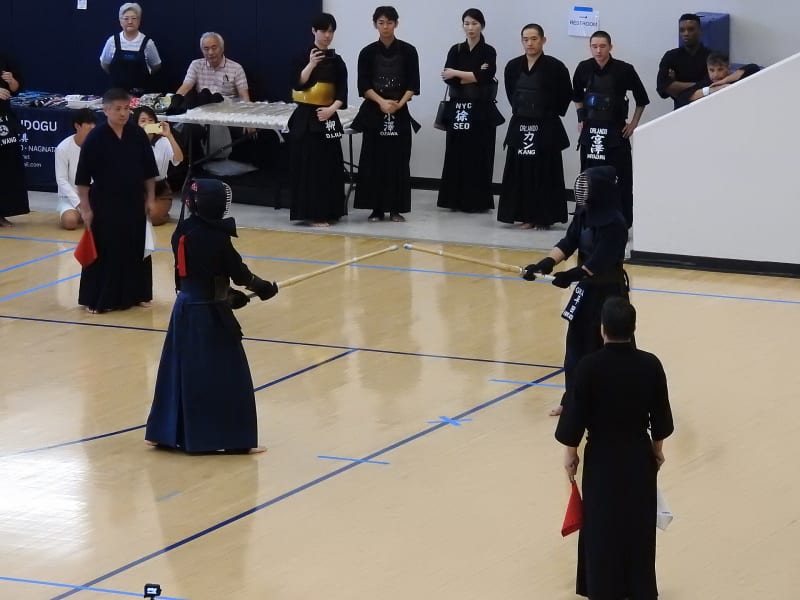
Maai is worked out most precisely in kendo, because there the weapon length is standardised and the distance thereby becomes describable at all.
| Distance | Japanese | Approximately | What is possible |
|---|---|---|---|
| Far distance | Tō-ma (遠間) | over 2 m | No strike without several steps. Time to react, time to observe. |
| One step, one cut | Issoku-ittō-no-maai (一足一刀の間合) | about 2 m | A single step suffices for a hit — for both. The distance from which most techniques begin. |
| Close distance | Chika-ma (近間) | under 2 m | One’s own cut has hardly any path left; but neither does the opponent’s. The zone of body contact (tsubazeriai) and short techniques. |
The middle value is the interesting one. Issoku-ittō-no-maai — “one foot, one sword” — is not a statement of length but a definition by way of action: the distance from which one step and one cut suffice. For a kendoka of 1.90 m with a long lunge, that point simply lies further away than for an opponent of 1.60 m. When the two face each other, the distance exists for each of them at a different place on the floor — and whoever stands in their own issoku-ittō while the other is still in tō-ma has largely decided the encounter before a technique begins.
This is precisely what the familiar kendo dictum means when it says that maai is personal. It is not a courtesy extended to beginners but the logical consequence of the definition.
Why time is the real quantity
A thought experiment makes it clear. Two fighters stand exactly three metres apart. Does the distance change if neither moves, but one exhales and lets the tension out of their legs?
Spatially, no. In the sense of maai, very much so: the relaxed one now needs longer to cross the three metres and is thereby further away — they remain just as attackable, but their own attack has become more expensive. The interval has shifted without a foot having moved.
From this follow the three adjustments that are actually made in a fight:
- The floor — steps, angles, evasion. The obvious and slowest variant.
- The body — pre-tension, weight distribution, readiness. Changes the interval without changing position.
- The rhythm — hyōshi (拍子). Whoever takes on the opponent’s beat and then breaks it shortens the time available to them without coming any closer.
The third point is the most demanding level and the reason why experienced fighters land from apparently unfavourable distances. The classical expression for it is debana — the attack made exactly at the moment when the other begins their own and has thereby shortened the interval themselves.
Maai in other systems
The concept is named in Japanese but is not Japanese. Every system in which two people want to reach each other has an answer to it — and the answer reveals in each case which weapon the system considers decisive.
| System | Term | Reference quantity | Character |
|---|---|---|---|
| Kendo | Maai | Shinai length (standardised) | Three clearly named zones, one weapon measure for everyone |
| Kenjutsu / iaidō | Maai | Blade length | Additionally the distance from the drawn-from-scabbard position |
| Aikido | Ma-ai | Reach of the attacker | Defined as the distance from which the attack does not arrive; entering (irimi) deliberately breaks it |
| Boxing | Range | Arm length | Four zones: outside, mid, close, clinch — not standardised but individual |
| Muay Thai | — | Leg length, then the clinch | The longest weapon is the kick, the decisive zone the clinch |
| Escrima | Largo / medio / corto | Stick length, wrist, body | Three distances, each with its own set of techniques |
| Fencing | Mesure | Blade plus lunge | Cleanly defined in sport terms, because the piste is one-dimensional |
| Sumo | — | Gripping reach | Maai exists only for the fraction of a second of the tachi-ai, and not afterwards |
The last line is the most revealing. Sumo knows practically no distance work, because the bout begins with the collision and the ring is small. Where the rules abolish distance, the term disappears. Conversely, the study of distance is most finely worked out where a weapon is involved and a single hit decides — in swordsmanship and in stick fighting. The comparison of stick-fighting systems shows the same dependency from the other side: the length of the implement determines how the system fights.
Breaking maai
Distance is not a state but a matter in dispute. Both sides attempt the same thing: to establish their own reach without establishing the opponent’s. Since the two zones are rarely congruent, there is almost always a distance from which one can strike and the other cannot — finding it and holding it is the core of all distance work.
Japanese terminology distinguishes three moments of attack:
- Sen (先) — the pre-emption: attacking before the other begins.
- Sen no sen — attacking in the moment of their intention, before the movement becomes visible.
- Go no sen — letting them begin and using the opening that arises.
None of the three is a technique; all three are decisions about timing — that is, about maai in its temporal sense. Anyone who thinks of distance only in metres cannot even draw this distinction.
Common fallacies
“Maai means keeping your distance.” No. Maai is value-neutral. Aikido works with irimi, the deliberate entry into the opponent’s reach — that is not a violation of maai but an application of it.
“Maai can be given in centimetres.” The two metres cited in kendo are an empirical value for adult kendoka with a standardised shinai, not a measurement. As soon as body sizes diverge or the weapon changes, the number is worthless.
“Maai is a special Japanese concept.” The term is Japanese, the matter universal. A boxing coach shouting “you’re too far away to hit but close enough to be hit” is describing exactly a maai error.
Today
Two modern developments have visibly changed the concept.
First, rule sets intervene in distance. The standardisation of shinai length in kendo, the cage size in MMA, the shortening of rounds, the scoring rules of point fighting in taekwondo — each of these decisions shifts which distance pays. Where hits are counted on touch, the far distance is upgraded; where fighting may continue in the clinch, the near one.
Second, maai is one of the few concepts of classical budō that can be measured. Video analysis and motion capture yield reaction times, step lengths and acceleration; the time someone needs to cover a stretch of ground is not a matter of opinion. Thus of all terms, the one with the most philosophical reputation is the one that stands least in the way of a sober examination — which suits it: ma was never meant mystically, but precisely.
Related Articles
- Zanshin
- Mushin
- Fudoshin
- Shu-Ha-Ri
- Kendo
- Stick-Fighting Systems Compared
- Footwork Programme — how to train the distance this term describes