Hung Gar — Tiger and Crane
Hung Gar is the best-known southern Chinese boxing style — deep stances, hard bridge work, and the union of tiger and crane.
Contents
Hung Gar (洪家, “Hung family”) is the best known of the southern Chinese boxing styles and, for many, the very image of what the West calls kung fu: deep, wide stances, powerful arm techniques driven from the hips, a low growl on the out-breath. The style belongs to nanquan, the southern fist, and shares its basic character — short range, stable stance, emphasis on the arms rather than the legs.
Its core is the union of two principles: the tiger stands for hard, seizing, powerful movement from the trunk, the crane for soft, evasive, precise technique at range. The famous form fu hok seung ying kyun — the paired tiger and crane form — is not merely a set piece but the whole idea of the style in miniature: hard and soft are not opposites but two settings of the same body.
History
Tradition names as founder Hung Hei-gun, a tea merchant from Guangdong who is said to have studied in the eighteenth century under the Shaolin monk Jee Sin and to have combined his tiger system with the crane style of his wife Fong Wing-chun. The account is embedded in the founding myth of the southern Chinese martial arts: a Southern Shaolin monastery in Fujian was supposedly burned down by the Qing, and five survivors spread the art.
This story is not historically attested. A Southern Shaolin monastery as an institution with that role cannot be traced in the sources; the narrative comes from nineteenth-century secret-society literature and served a political purpose — it tied the martial arts schools to anti-Qing resistance. What it explains is less the origin of the techniques than the self-understanding of those who carried them.
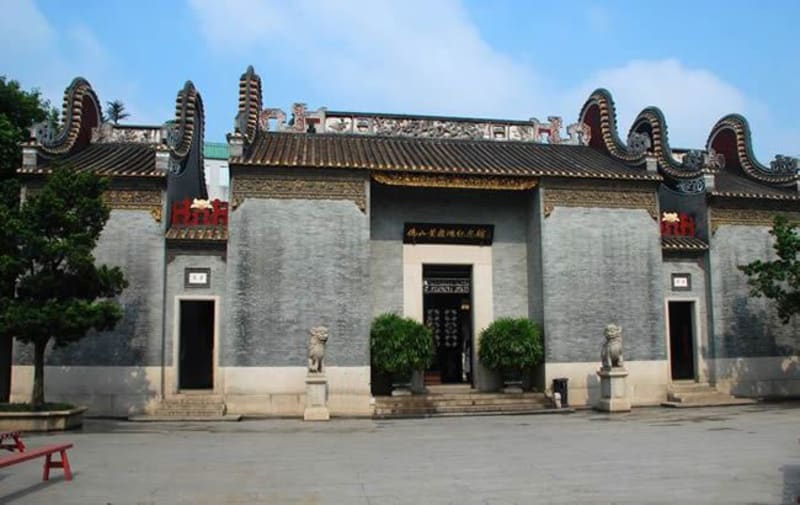
Hung Gar becomes tangible only in the nineteenth century, and then very concretely in one person: Wong Fei-hung (1847–1924), physician, martial artist and head of a lion dance troupe in Foshan and Guangzhou. He had learned the style from his father Wong Kei-ying and shaped the inherited material into the four forms that still form its backbone. His student Lam Sai-wing systematised and published the curriculum in the 1920s — the first broadly accessible account of any southern Chinese style.
Wong Fei-hung is also the reason for the style’s fame: he became the central figure of a film genre of its own. Over a hundred Hong Kong films tell of him, from the serials of the 1950s to Once Upon a Time in China with Jet Li. Scarcely any martial art owes its visibility so heavily to one individual — and scarcely any struggles as much with the blending of person and legend.
Technical Foundations
Hung Gar works from few, very stable stances and through bridge contact — the forearm that receives and redirects the opponent’s movement.
| Area | Term | Content |
|---|---|---|
| Base stance | 四平馬 sei ping ma | deep horse stance, the basis of all power generation |
| Bridge work | 橋手 kiu sau | forearm contact for deflecting, binding and opening |
| Power generation | 發勁 faat ging | force from foot, hip and trunk rather than the arm |
| Breathing | — | audible exhalation under tension, coupled to the effort |
| Hand shapes | — | tiger claw, crane beak, fist, knife hand |
Training classically begins with long holds in the horse stance — a trial that deters many beginners and whose purpose is often misunderstood: it is less about leg strength than about the ability to stay relaxed under load.
Core Techniques
Wong Fei-hung’s four forms constitute the curriculum:
- Gung gee fook fu kyun — “Taming the tiger”: basic form, stances, foundational power
- Fu hok seung ying kyun — tiger and crane: the technical heart
- Ng ying kyun — five animals: dragon, tiger, leopard, snake, crane
- Tit sin kyun — “Iron wire”: a breathing and tension form, the style’s most advanced practice
The five animals are not imitation but mnemonics for qualities of movement: dragon for the supple spine, tiger for bone strength, leopard for speed, snake for soft precision, crane for balance and range. In the Lam lineage they are complemented by the five elements, which play the same idea through at the level of force directions.
Tit sin kyun deserves separate mention: the form is practised without a partner, under isometric tension and with controlled breathing. It is regarded as what lifts Hung Gar beyond mere boxing — and is at the same time the exercise where poor instruction can do the most harm.
Philosophy
Hung Gar has no formulated code of conduct like Japanese budō, but it does have a clear ideal that crystallised around Wong Fei-hung: the martial artist as physician. Wong ran the Po Chi Lam dispensary and treated broken bones; in the southern Chinese styles the pairing of fighting and healing is not an added extra but part of the profession. Whoever can inflict injury understands the body — and should therefore be able to repair it.
Technically the style carries a figure of thought of its own: ngaang kiu, yau kiu — hard bridge, soft bridge. Force is not a state but a switching operation. Whoever stays hard tires and becomes readable; whoever stays soft cannot impose. The ideal is the rapid switch at the right moment.
Styles and Schools
| Lineage | Origin | Character |
|---|---|---|
| Lam family | Lam Sai-wing, Lam Cho | the most widespread line, basis of most textbooks |
| Tang Fung | student of Wong Fei-hung | its own selection of forms, strong in Hong Kong |
| Chiu family | Chiu Kau | emphasises bridge work and power generation |
| Buk Sing | — | not to be confused with the Choy Li Fut branch of the same name |
The lineages differ less in the forms than in their execution — depth of stance, emphasis on power versus mobility, handling of tit sin kyun.
Connections to Other Martial Arts
- Choy Li Fut — the other great Cantonese style; historically a rival, technically complementary with its wide swinging techniques
- Wing Chun — shares the region and the bridge concept but takes the opposite path: upright stance, short paths, little exertion
- Ying Zhao Quan — Hung Gar’s tiger claw and Eagle Claw share the seizing idea but come from south and north
- Chin Na — present in Hung Gar’s tiger claw technique without being named as such
- Okinawan Kobudō and Gōjū-ryū — the southern Chinese systems from Fujian are the root of Naha-te; the breath and tension work of sanchin and tit sin kyun is recognisably related
- Lion dance — traditionally part of the Hung Gar school, not an accessory; Wong Fei-hung was as known for it as for boxing
Today
Hung Gar is taught worldwide, with concentrations in Hong Kong, Guangdong, North America and Europe. It is one of the few traditional styles whose curriculum is documented, and therefore checkable, through Lam Sai-wing’s early publications — an advantage over styles whose “transmission” was only formed in the twentieth century.
Its problems are those of traditional kung fu generally:
- Form versus application. The curriculum is form-heavy, and in many schools there is little practice against resistance. The techniques are mechanically sound, but whether anyone can apply them is not decided in the form.
- The Wong Fei-hung effect. The film presence brought the style enormous recognition and at the same time produced an image with little bearing on training. Historical statements about Wong are hard to separate from screenplay material.
- Competition from sanda and MMA. Anyone interested in competition today generally goes to sanda or MMA. Hung Gar has found no uniform answer; some schools integrate free sparring, others reject it as foreign to the style.
Its value as physical training is undisputed: few systems develop stability, trunk strength and the coupling of breath and movement so consistently.
Related Articles
- Kung Fu / Wushu
- Choy Li Fut
- Wing Chun
- Ying Zhao Quan
- Chin Na
- Shaolin Conditioning
- Nanquan — one of the two principal sources of the 1960 competition style
- Bak Mei — the same legend, but named after the opposing figure