Karate — The Empty Hand of Okinawa
Karate emerged on Okinawa from the fusion of an indigenous fighting tradition with Chinese systems — today the world's most widely practised unarmed martial art.
Lineage
Derived
Contents
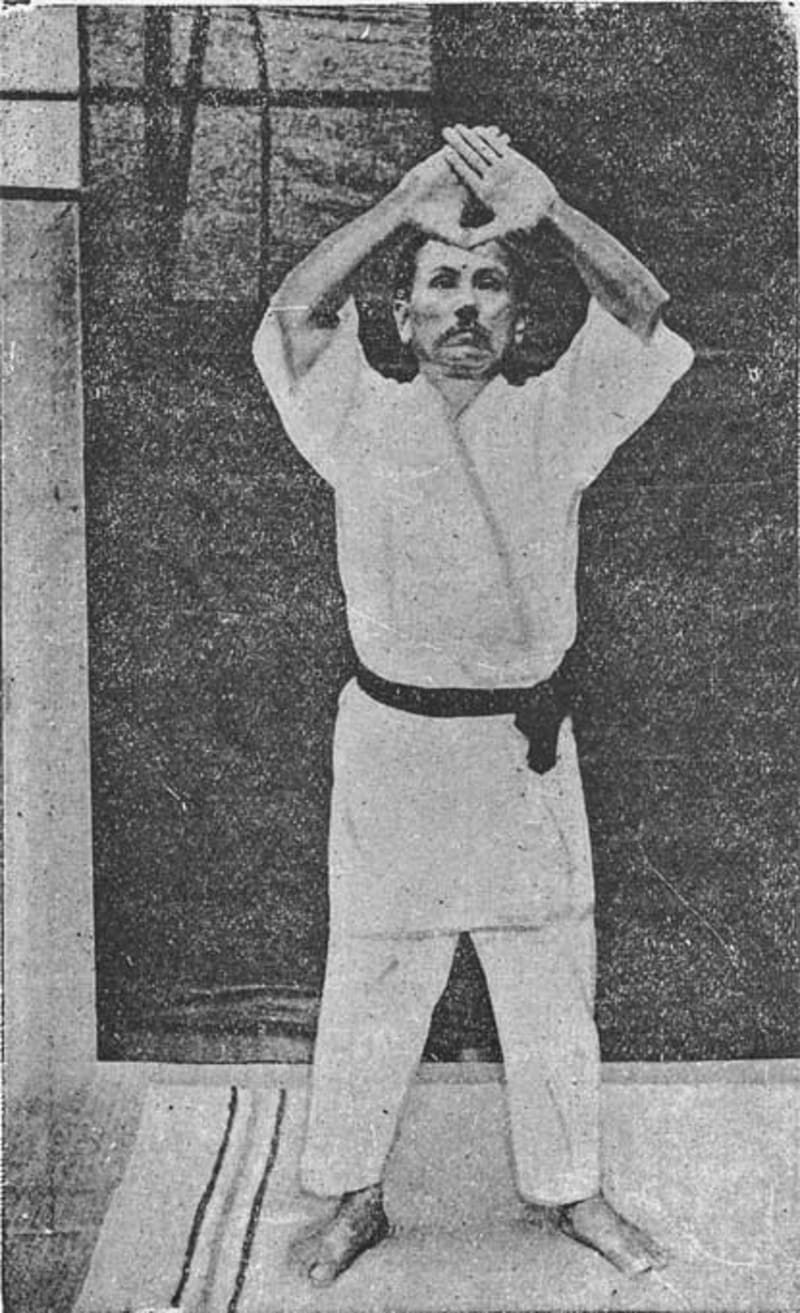
Karate (空手, “empty hand”) is the best-known unarmed martial art in the world — and one whose name is younger than the thing itself. It did not originate in Japan but on Okinawa, the main island of the former Ryūkyū Kingdom, from the fusion of an indigenous close-combat tradition called Te (“hand”) with Chinese systems — Kung Fu in the broad sense — that arrived over centuries of trade. Only in the twentieth century did it become a Japanese martial art: in 1922 Gichin Funakoshi demonstrated karate on the Japanese mainland, Japanised its terminology and its written characters, and opened the path into schools, universities and eventually the entire world.
What characterises karate is the primacy of percussion: punches, kicks, elbows and knees, delivered from defined stances with the aim of concentrating the power of the whole body into a single point. Locks, throws and chokes exist but remain secondary. Its curriculum rests on two pillars: kata, the fixed forms in which the technical inheritance is preserved, and kumite, partner work and competition. This double structure — preservation and application — still shapes every karate class today.
History
As the Ryūkyū Kingdom, Okinawa sat on a trading hub between China, Japan and Southeast Asia. The decisive influences came from there: Chinese boxing systems from Fujian met the indigenous Te. Two weapons bans — one under King Shō Shin in the early sixteenth century, another after the Satsuma domain’s conquest in 1609 — are popularly told as the birth of an unarmed art. Historically that connection is considerably weaker than the legend suggests: the bans were largely about controlling the nobility, and a pronounced weapons tradition developed in parallel as Okinawan Kobudō.
Into the nineteenth century, Tōde (唐手, “Tang hand”, meaning “Chinese hand”) was transmitted in secrecy. It crystallised into three local traditions:
| Tradition | Town | Character |
|---|---|---|
| Shuri-te | Shuri, the royal city | fast, long range, linear attacks |
| Naha-te | Naha, trading port | close range, breath work, power-oriented |
| Tomari-te | Tomari, harbour town | hybrid of the two |
The decisive break came around 1900 with Anko Itosu (1831–1915), who brought karate into the curriculum of Okinawan schools. To do so he defused the system: he simplified dangerous techniques, created the Pinan series as a set of beginner kata, and turned a close-combat art into a school subject. Almost everything now considered “traditional karate” has passed through this pedagogical filter.
In 1922 Itosu’s student Gichin Funakoshi demonstrated karate in Tokyo at the invitation of the Japanese Ministry of Education — and stayed. He replaced the character 唐 (“Tang/China”) with the homophone 空 (“empty”): “Chinese hand” became “empty hand”. The move was politically astute in a period of rising Japanese nationalism and philosophically compatible with the Zen concept of emptiness. Along with the gi, coloured belts and the dan system, karate simultaneously adopted the outward form Jigoro Kano had created for judo.
After 1945, US servicemen stationed on Okinawa carried karate to the United States; from there and through the Japanese federations it spread worldwide.
Technical Foundations
Karate organises its technique around three elements: stance (dachi), hip engagement (koshi no kaiten) and focus (kime) — the instantaneous tensing of the whole body at the moment of impact.
| Area | Term | Content |
|---|---|---|
| Stances | 立ち方 tachikata | Zenkutsu-dachi, Kiba-dachi, Kokutsu-dachi, Neko-ashi-dachi |
| Thrusting punches | 突き tsuki | Oi-zuki, Gyaku-zuki, Kizami-zuki, Ura-zuki |
| Striking (open/other) | 打ち uchi | Shuto-uchi, Uraken-uchi, Empi-uchi |
| Kicks | 蹴り geri | Mae-geri, Yoko-geri, Mawashi-geri, Ushiro-geri |
| Blocks | 受け uke | Age-uke, Soto-uke, Uchi-uke, Gedan-barai |
| Breathing | 呼吸 kokyū | Ibuki (forceful), Nogare (silent) |
Training is classically divided into kihon (fundamentals), kata (forms) and kumite (partner work). The belt runs from white through the coloured kyū grades to the black dan; the sequence of colours varies by federation and is a recent invention.
Core Techniques
Kata are fixed sequences against imaginary opponents and the memory of the style. Every movement has a level of application — the bunkai — which is not self-evident and is traditionally revealed only as rank increases. What looks like a block in the kata is often a grab, a lock or a throw in the bunkai. This interpretive work is one of the liveliest disputes in modern karate.
Central kata families:
- Pinan / Heian — the five basic forms after Itosu
- Naihanchi / Tekki — forms in horse stance, lateral movement
- Bassai, Kanku / Kūshankū — intermediate forms, powerful openings
- Sanchin, Tenshō — breathing kata of the Naha lineage, the core of Gōjū-ryū and Uechi-ryū
- Seienchin, Sanseiru, Suparinpei — advanced Naha forms
Kumite ranges from the heavily prearranged gohon and ippon kumite, through semi-free jiyū-ippon kumite, to free jiyū kumite. Whether contact is controlled and pulled (sundome) or delivered fully divides the major camps of karate more sharply than any technical detail.
Philosophy
Funakoshi’s formula “karate ni sente nashi” — there is no first attack in karate — stands second among his Niju Kun, the twenty guiding principles, and marks the claim to run a fighting art as a path of education.
“The ultimate aim of karate lies not in victory or defeat, but in the perfection of the character of its participants.” — Gichin Funakoshi, Karate-dō: My Way of Life (not one of the Nijū Kun)
The shift from jutsu (technique) to dō (way) is not merely a change of label but a programmatic decision: karate is understood as lifelong formation in which technique is the means and not the end. Concepts such as zanshin (alert awareness after the act), mushin (mind without attachment) and rei (respect, expressed in the bow) are not ornament but training content. The dōjō-kun — four or five sentences depending on the school, recited together after training — keeps this claim present in everyday practice.
Styles and Schools
Karate is not a single system but a family. The four main styles recognised by the Japanese umbrella body:
| Style | Founder | Lineage | Characteristic |
|---|---|---|---|
| Shōtōkan | Gichin Funakoshi | Shuri-te | deep stances, long range, most widespread |
| Gōjū-ryū | Chōjun Miyagi | Naha-te | hard/soft, breath work, close range |
| Shitō-ryū | Kenwa Mabuni | Shuri + Naha | largest kata repertoire |
| Wadō-ryū | Hironori Ōtsuka | Shuri-te + jūjutsu | evasion rather than blocking |
Alongside these stand the Okinawan lineages Shōrin-ryū and Uechi-ryū, and the full-contact school Kyokushin, which Mas Oyama formed in 1964 from Shōtōkan and Gōjū roots and which represents the sharpest break with the point-fighting tradition.
What “WKF-recognised” means and what it does not. The WKF competition rules name no styles at all: they require that only kata from the official WKF kata list be performed (Kata Competition Rules 2026.0, Art. 5.1.1), and that list comprises 102 kata. It includes kata from lineages outside the four — Kusanku, Naihanchi and Tomari Bassai from Shōrin-ryū, Sanchin, Seisan and Kanchin from Uechi-ryū. Appearing on the kata list and being one of the four recognised styles are therefore not the same thing.
Connections to Other Martial Arts
- Chinese systems — the Naha lineage is closely related to southern Chinese boxing from Fujian; Sanchin has direct counterparts there
- Okinawan Kobudō — Okinawa’s weapons art, transmitted historically alongside karate and still taught in many dōjō
- Taekwondo — several founding figures trained Shōtōkan during the Japanese occupation; the early hyeong correspond to the Japanese kata
- Kickboxing — arose directly from Japanese karateka’s dissatisfaction with point fighting
- Jeet Kune Do — Bruce Lee’s critique of form-bound training was aimed substantially at the karate of his day
Today
Karate is the most widely practised unarmed martial art in the world; the World Karate Federation reports over 190 member federations. In 2021 the sport made its Olympic debut at the Tokyo 2020 Games in the disciplines of kata and kumite — and was then dropped for Paris 2024, with no public reasons given by the IOC. Karate is likewise absent from the Los Angeles 2028 programme. The disappointment within federation karate is considerable, not least because the host nations are themselves strong karate countries.
The discipline’s persistent conflicts are older than the Olympics:
- Point fighting versus full contact — WKF rules reward controlled, pulled strikes; Kyokushin tournaments allow full contact but prohibit hand strikes to the head. Each format produces its own distortions relative to an actual confrontation.
- Kata interpretation — the bunkai movement around authors such as Iain Abernethy argues that competition karate has lost the original close-combat meaning of the forms in favour of aesthetic execution.
- Sport versus way — whether karate is primarily competitive sport or character formation determines training content, and the answer differs from dōjō to dōjō.
Karate remains practically significant as a mass participation sport with a low barrier to entry, as a children’s and youth sport, and as a foundation from which many athletes later move into kickboxing or MMA — where the distance management of karate-trained fighters in particular has proven durable.
Related Articles
- Shotokan Karate
- Gōjū-ryū
- Kyokushin Karate
- Shitō-ryū
- Wadō-ryū
- Okinawan Kobudō
- Gichin Funakoshi
- The Fist — Hikite Versus the Boxing Guard — what Funakoshi shows in 1922 and competition lost
- Shu-Ha-Ri — kata, bunkai and kumite read as the three stages
- Kime — why the word means decision and not power
- Grading Systems Compared — why Funakoshi introduced dan grades in 1924 — at the Butokukai’s demand
- Makiwara — the device that tests whether a punch is coupled through — and why it vanished
- Kata and Kumite — why free kumite was only added in the 1930s — from kendō
- Breathing Methods Compared — why “breathe deeply and tense on impact” is two instructions, not one
- Okinawan Karate — the roots: Kumemura, Fuzhou, three towns rather than three schools
- Punching Structure Programme — Funakoshi called the makiwara the most important equipment — here as a programme
- Kata and Bunkai Programme — bunkai against a resisting partner rather than a compliant one
- Pangai-noon — what a Chinese lineage looks like when it can actually be checked
- Hand Position Programme — what the hikite hand holds — and why the common criticism of it is right in exactly half of the cases
- Dō and Jutsu Compared — the 1936 renaming in the context of the other five
- Ankō Itosu — the break around 1900 has a name; his 1908 letter states the purpose without varnish
- Kanbun Uechi — the third of the Okinawan founders — and the only one who did not want the role
- Chōki Motobu — the dissenting voice against the development this overview describes
- Matsumura Sōkon — the root to which practically every Shuri line of this style family traces back
- Shorinji Kempo — the same hard/soft distinction, with a third pillar added